Delta Versus Ozark Deer Density
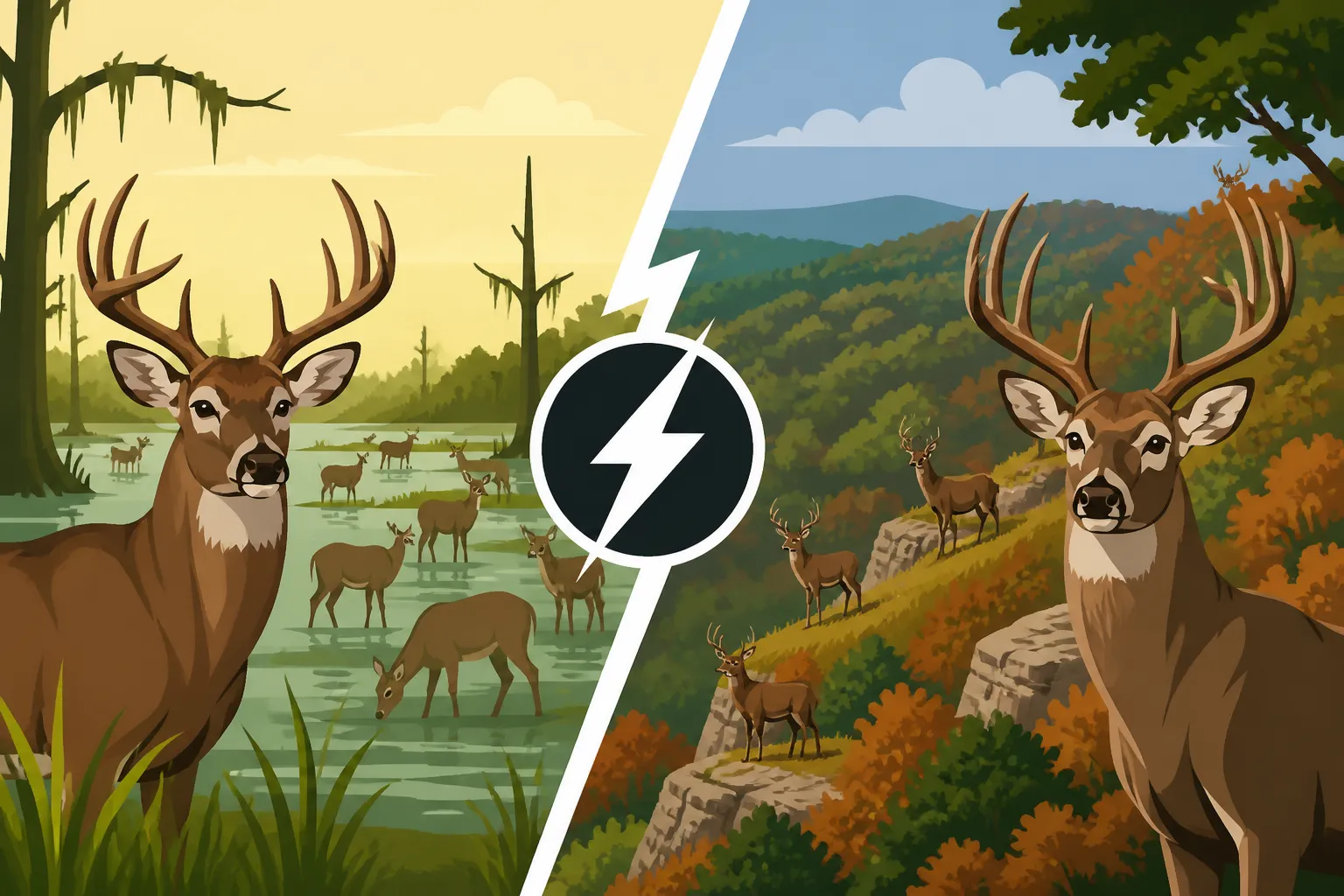
It's no secret that Arkansas deer hunting can feel like two completely different worlds, depending on whether you're navigating the sprawling agricultural fields and flooded timber of the Delta or climbing the steep, rocky ridges and hollows of the Ozarks. Hunters often wrestle with the perception that some areas are teeming with deer while others feel almost barren, leading to endless debates about where to focus their efforts for the best chance at success. This guide is here to untangle those differences, diving deep into the realities of deer density across these two iconic Arkansas landscapes, and giving you the insights you need to hunt smarter, no matter where you find yourself.
Understanding Deer Density in Arkansas
When we talk about "deer density," we're really talking about how many deer are living within a specific area, usually expressed as deer per square mile or per 1,000 acres. This number isn't just some abstract figure; it's a critical piece of information that can heavily influence your hunting strategy, your expectations, and ultimately, your success in the field. Ignoring it is like trying to navigate a new city without a map – you might get lucky, but you're probably missing out on a lot.
What is Deer Density and Why Does it Matter?
Deer density is essentially a snapshot of the deer population's concentration in a given habitat. A high density means more deer are packed into an area, which often translates to more frequent sightings, a higher chance of encountering a target buck, and generally more active deer movement. On the flip side, low density means deer are more spread out, making them harder to locate and demanding more patience and specialized tactics from hunters.
For us hunters, understanding density is paramount because it directly impacts our hunting opportunities and the quality of the deer herd. In areas with high deer densities, you might see deer more consistently, but you could also be dealing with higher hunting pressure from other folks drawn to those same numbers. Conversely, lower density areas might mean fewer deer, but potentially less competition and the chance for a more solitary, challenging hunt. The Arkansas Game and Fish Commission (AGFC) monitors these populations rigorously through aerial surveys, harvest data, and hunter observation surveys, all of which contribute to setting season dates and bag limits. Knowing these numbers helps us gauge our chances and adapt our approach.
Factors Influencing Deer Populations
Deer populations are incredibly dynamic, influenced by a complex web of environmental and human factors. It's never as simple as "more food equals more deer" – though that's certainly a big part of it!
First and foremost is habitat quality, which encompasses the availability of food, water, and cover. Deer need a diverse diet of forbs, browse, and mast, along with reliable water sources and secure places to bed down and escape predators. The type of land use also plays a huge role; agricultural areas, for instance, provide an almost endless buffet for deer, while mature, unbroken timberland might offer less consistent forage but excellent cover.
Predation pressure from coyotes, bobcats, and black bears can impact fawn survival rates, especially in areas where these predators are abundant. Of course, hunting pressure and regulations are designed to manage deer numbers, with liberal bag limits in high-density areas and more restrictive rules where populations are lower or need to be protected. Lastly, disease like Chronic Wasting Disease (CWD) and epizootic hemorrhagic disease (EHD) can significantly reduce deer numbers in affected areas, creating pockets of lower density even in otherwise productive habitats. All these factors combine to create the unique deer dynamics we see across Arkansas.
The Arkansas Delta: A Deer Haven
Ask any seasoned hunter where to find an abundance of deer and often the Arkansas Delta will be high on their list. This region, characterized by its flat, fertile land, massive agricultural operations, and winding river systems, truly lives up to its reputation as a deer haven, offering some of the highest deer densities in the state.
Habitat and Food Sources in the Delta
The foundation of the Delta's robust deer population lies squarely in its incredibly rich and diverse habitat. The soil here is legendary, deposited over millennia by the Mississippi River and its tributaries, making it prime agricultural ground. This means miles upon miles of soybeans, corn, rice, and even cotton – an endless, high-protein buffet for deer, especially during late summer and fall. These cultivated crops provide an unparalleled food source that allows deer to pack on weight and grow impressive antlers.
But the Delta isn't just one giant farm field. Interspersed with agriculture are vast tracts of bottomland hardwoods, especially along the Cache, White, and Arkansas Rivers. These areas offer critical cover, bedding sites, and additional natural food sources like acorns from various oak species, tender browse, and native grasses. The countless sloughs, oxbows, and swamps provide vital water sources and security cover, especially during flood events. Areas like the renowned Bayou Meto WMA or the Dave Donaldson Black River WMA exemplify this blend of agriculture and bottomland timber, creating ideal conditions for deer to thrive, reproduce, and grow large. The sheer biomass of available food and secure cover allows the Delta to support a remarkably high number of deer per square mile.
Higher Deer Density and Hunter Opportunity
The direct result of this abundant and high-quality habitat is a consistently higher deer density compared to other parts of the state. More deer mean more opportunities for hunters. It's not uncommon to see multiple deer during a single sit in the Delta, especially during prime morning and evening hours when deer are moving between bedding areas in the timber and feeding in the fields.
This rich nutrition also contributes significantly to why Delta bucks often grow larger body sizes and more impressive antlers. With a readily available, protein-rich diet, deer can allocate more energy to growth, leading to bigger racks and heavier animals. For a hunter, this translates to a higher potential for harvesting a trophy-class animal. However, this high density and trophy potential also mean the Delta can experience significant hunting pressure, especially on public lands and well-known private leases. You might be seeing more deer, but you're also likely sharing the woods and fields with more fellow hunters. Many seasoned hunters utilize tools like the GoHunt app to dissect public land boundaries, identify potential access points, and pinpoint less-pressured pockets within these high-density areas, giving them an edge in a competitive landscape. While the sheer numbers are appealing, smart hunting in the Delta requires strategic planning to capitalize on the abundance without getting lost in the crowd.
The Arkansas Ozarks: Rugged Beauty, Different Dynamics
Venturing into the Arkansas Ozarks is like stepping into a different state entirely when it comes to deer habitat and hunting. The rugged, scenic beauty of this region is undeniable, but it presents a completely different set of challenges and rewards for the deer hunter compared to the lowlands of the Delta.
Ozark Terrain and Habitat Challenges
The Ozarks are defined by their ancient, uplifted plateaus, deeply carved by rivers and streams, resulting in a landscape of steep, rocky hills, narrow valleys, and heavily forested slopes. Unlike the fertile, flat soils of the Delta, Ozark soils are generally thinner and less productive, particularly in higher elevations. This directly impacts the vegetation and available food sources for deer.
The dominant cover here is hardwood forest, primarily oaks (white, red, black) and hickories, interspersed with pine plantations, especially in the western and southern reaches. While these forests provide excellent cover, the primary natural food source for deer is acorns in the fall, supplemented by various types of browse and forbs throughout the year. However, the consistency and quality of these natural food sources can vary greatly from year to year, depending on mast crop production and rainfall. You won't find vast agricultural fields providing a constant food supply here. This less fertile ground and reliance on natural cycles mean that deer typically have to work harder to find sustenance. Examples like the expansive Ozark National Forest or the rugged White Rock WMA showcase this challenging, yet beautiful, hunting environment where deer are truly wild and accustomed to survival in a more demanding landscape.
Lower Deer Density and Different Hunting Strategies
Because of the less abundant and more scattered food sources, combined with the challenging terrain, deer densities in the Ozarks are generally lower than in the Delta. This isn't to say there aren't plenty of deer, but they are typically much more spread out, often requiring hunters to cover more ground or scout meticulously to locate their preferred feeding and bedding areas.
Hunting here demands a different mindset and a completely different set of tactics. Still-hunting, where you slowly stalk through the woods, pausing frequently to observe, becomes a highly effective method. Success often hinges on finding concentrated mast crops in the fall, identifying travel corridors between ridges and hollows, or locating secluded bedding areas in thickets. Learning to read an Ozark bench for deer, understanding wind and thermals in Ouachita hollows, and patiently hunting Ozark ridges and hollows for deer are crucial skills here.
The rewards of hunting the Ozarks are often less about sheer volume of deer seen and more about the quality of the experience and the satisfaction of outsmarting a truly wild deer in its natural, rugged environment. Tools like the GoHunt app become absolutely indispensable in this terrain, allowing hunters to analyze topography, identify elevation changes, pinpoint potential funnels, and mark acorn flats or thick bedding areas long before they ever set foot in the woods. This preparation is key to success when deer are fewer and farther between.
Comparing the Numbers: Delta vs. Ozarks
When we look at the raw data, the differences in deer density and harvest between the Arkansas Delta and the Ozarks become strikingly clear. These numbers aren't just statistics; they paint a picture of distinct ecosystems and the contrasting opportunities they present to hunters.
AGFC Data and Harvest Trends
The Arkansas Game and Fish Commission's annual harvest reports consistently show higher overall deer harvests in the Delta zones compared to the mountainous regions of the Ozarks. For instance, counties within the Delta's Zone 4 and 5 often report some of the highest total deer kills year after year, alongside zones in the southwest corner of the state that also have significant agricultural influence. This isn't just due to more hunters; it's a reflection of the higher deer populations those habitats can support.
Consider a typical season: a Delta county might report several thousand deer harvested, while a comparably sized Ozark county, despite being heavily forested, might report significantly fewer. This disparity highlights the fundamental difference in deer per square mile. While precise "deer per square mile" figures aren't always publicly released at a granular county level, the harvest data serves as a strong proxy for underlying density. Furthermore, anecdotal evidence from hunter observation surveys often confirms more frequent deer sightings in the Delta.
To illustrate, let's look at a hypothetical comparison, which aligns with general AGFC trends:
| Feature/Region | Arkansas Delta | Arkansas Ozarks |
|---|---|---|
| Typical Deer Density | High (e.g., 20-30+ deer per square mile) | Moderate to Low (e.g., 10-20 deer per square mile) |
| Primary Habitat | Agriculture, bottomland hardwoods, river bottoms | Upland hardwoods, pine forests, rocky terrain |
| Main Food Source | Abundant row crops (corn, soybeans, rice), acorns | Acorns, natural browse, forbs |
| Average Buck Body Weight | Higher (often 180+ lbs live weight) | Moderate (often 140-160 lbs live weight) |
| Antler Potential | Higher (due to nutrition and age structure) | Moderate (can still produce excellent deer) |
| Hunter Success Rate | Generally higher sighting/harvest opportunities | Generally lower sighting/harvest opportunities, more challenging |
| Typical Hunting Style | Stand/blind hunting over food, travel corridors | Still-hunting, spot-and-stalk, focused scouting |
This table provides a generalized comparison, but the patterns are consistent: the Delta's rich agricultural base fuels a larger, healthier deer herd with higher harvest potential.
What These Differences Mean for Hunters
The stark contrast in deer density profoundly shapes the hunting experience in these regions. In the Delta, the high density often translates to greater trophy potential, not just in antler size but also in overall body weight. Bucks in the fertile Delta simply have access to more consistent, high-quality nutrition, allowing them to grow faster and larger. This is why some of the biggest bucks in Arkansas often come from the Delta, and why it's considered one of the best Arkansas counties for big bucks.
Success rates also tend to be higher in the Delta for hunters who can manage the pressure. You might see deer almost every hunt, and the odds of filling a tag are generally better. The type of hunting experience differs dramatically too. Delta hunting often revolves around stand or ground blind setups overlooking food sources or pinch points between bedding and feeding areas. It can be a waiting game, but one with frequent action.
In the Ozarks, the lower density means hunters might go several sits without seeing a deer. The success rates, in terms of sheer numbers, are typically lower, but the challenge and the satisfaction of harvesting an Ozark buck are immense. Here, hunting is often a more active pursuit – still-hunting, glassing distant slopes, or meticulously scouting for fresh sign and natural funnels. While the deer might not be as heavy-bodied as their Delta counterparts, an older Ozark buck that has survived in that rugged environment is a true testament to its wildness. What the three-point rule did to Arkansas bucks also plays a role in both regions, pushing hunters to let younger bucks walk, which impacts the age structure of the herd over time, regardless of density.
Navigating Your Hunt: Tips for Both Regions
Understanding the difference in deer density is one thing; translating that knowledge into successful hunting strategies is another. Whether you're chasing deer in the thickets of the Delta or climbing the steep slopes of the Ozarks, adapting your approach to the specific environment is paramount.
Tactics for High-Density Delta Areas
Hunting in high-density Delta areas means you're often dealing with a lot of deer, but also potentially a lot of other hunters. Your primary focus should be on exploiting the abundant food sources and the predictable patterns deer establish around them.
Stand placement near food sources is key. This could be a stand on a field edge overlooking corn or soybean stubble, or a setup deeper in the timber, on a travel corridor between a bedding thicket and a prime acorn flat. Look for natural pinch points where deer are funneled, such as narrow strips of timber between fields, creek crossings, or breaks in dense brush. When hunting in bottomland hardwoods, identifying productive oak trees (especially white oaks) or key travel routes becomes critical for treestand setups in Delta hardwoods.
Dealing with hunting pressure is inevitable. On public lands, you might need to walk farther, scout for overlooked pockets of cover, or hunt mid-week when crowds are thinner. Consider hunting the Arkansas Delta rut in January, when many hunters have packed it in, but breeding activity might still be occurring, leading to increased buck movement. Focus on areas that offer dense cover adjacent to food, as these become sanctuaries for deer trying to escape pressure. Don't be afraid to use a good mapping app like GoHunt to pinpoint those out-of-the-way thickets or small blocks of unpressured timber that other hunters might overlook.
Strategies for Lower-Density Ozark Terrain
Hunting the lower-density Ozarks is a more physically demanding and often solitary endeavor, but incredibly rewarding. Here, success hinges on meticulous scouting, patience, and a deep understanding of deer behavior in rugged topography.
Extensive scouting before the season is non-negotiable. Forget driving around looking for deer in fields; you need to walk, often for miles, looking for sign like rubs, scrapes, and feeding areas, especially around mast crops. Understanding how wind and thermals in Ouachita hollows affect deer movement is crucial; cold air sinks into hollows at night and rises up ridges during the day, carrying scent with it. Positioning yourself to intercept deer using these thermal currents can make or break a hunt. Reading an Ozark bench for deer, those subtle flat spots along hillsides, can reveal hidden travel routes and feeding areas.
Hunting remote areas can pay dividends. Many hunters stick to easy-access spots, so putting in the effort to get off the beaten path into the deeper woods of the Ozark National Forest or specific WMAs can lead you to less pressured deer. Still-hunting, moving slowly and deliberately through the timber, using binoculars to scan ahead, and being ready to take a shot quickly, is often more productive than sitting in one spot all day. Focus on natural funnels created by terrain features like saddles, points, and drainages, as these are natural travel routes for deer moving between bedding and feeding areas. Patience is paramount; you might not see many deer, but when you do, it could be the mature buck you've been after.
Other Factors Beyond Density
While deer density is a major driver of hunting dynamics in Arkansas, it's certainly not the only factor at play. Other considerations, ranging from disease impacts to personal preferences, can heavily influence where and how you choose to hunt.
Chronic Wasting Disease Impact
One significant factor that has emerged in recent years is the presence and management of Chronic Wasting Disease (CWD) in Arkansas. Primarily, CWD was first discovered in the Ozarks and has since been detected in numerous counties, predominantly in the northern and western parts of the state. This neurological disease is fatal to deer and elk, and while its direct impact on overall deer density is still being studied, it undeniably affects local populations and management strategies.
The AGFC has implemented strict regulations in CWD management zones, including mandatory testing, restrictions on baiting, and limitations on carcass transport. For hunters, this means not only being aware of the disease but also adapting their practices to help prevent its spread. Choosing to hunt outside CWD zones, or simply being extra diligent with testing and carcass disposal, becomes a part of the hunting equation. Understanding Chronic Wasting Disease in Arkansas is crucial, as it adds a layer of complexity to hunting decisions, especially in affected Ozark regions where deer populations may face additional pressures beyond natural predation and habitat limitations.
Hunter Preference and Experience
Ultimately, beyond all the statistics, habitat maps, and tactical advice, the choice of where to hunt often boils down to individual hunter preference and the type of experience one seeks. Not every hunter is chasing the biggest buck or the highest harvest numbers.
Some hunters thrive on the challenge of the Ozarks, appreciating the solitude, the rugged terrain, and the satisfaction of outsmarting a wary deer in a less populated environment. For them, the lower density isn't a deterrent but rather an enhancement of the "wild" hunting experience. It's about the journey, the physical exertion, and the deep connection to nature that comes from long hours of still-hunting through expansive forests.
On the other hand, many hunters are drawn to the high-volume opportunities of the Delta. They enjoy the increased chances of seeing multiple deer, the potential for larger animals, and perhaps the social aspect of hunting with friends or family in areas known for their productivity. The Delta often offers easier access and less strenuous hunting, making it appealing for different demographics or those looking for a different kind of challenge, such as managing the sheer number of deer moving through an area. Both regions offer incredible opportunities, but they cater to different styles and expectations. The best place to hunt in Arkansas isn't a universal answer; it's the place that best aligns with your hunting goals and desired experience.
Disclaimer
Please be aware that hunting regulations, season dates, and zone boundaries are subject to change by the Arkansas Game and Fish Commission (AGFC). Always consult the most current AGFC hunting guide and regulations before planning any hunt. This article is for informational purposes only and does not supersede official AGFC regulations.