Hunting Ouachita National Forest for Deer
Trying to find a solid deer hunting spot in Arkansas can feel like a maze, especially when you’re looking at vast areas like the Ouachita National Forest. It's easy to feel overwhelmed by the sheer size of it, wondering where to even begin and how to tackle the unique terrain. This guide is all about cutting through that confusion, giving you the practical strategies and insights you need to confidently hunt deer in the Ouachita National Forest, from understanding the landscape to mastering the tactics that work best there.
Understanding the Ouachita National Forest for Deer Hunting
The Ouachita National Forest isn't your typical flatland deer hunting country. It's a world unto itself, offering a truly wild and challenging experience for hunters who are willing to put in the work. Before you even think about loading up your truck, it's crucial to grasp the lay of the land, the deer that call it home, and the specific rules you'll encounter.
The Landscape and Terrain
Imagine endless rolling hills, steep ridges, and deep hollows, all blanketed in a mix of pine and hardwood timber. That's the Ouachita National Forest. We're talking about a vast area, covering over 1.8 million acres across western Arkansas and southeastern Oklahoma. The terrain can be brutal on your legs and lungs, with elevation changes that will test your endurance. Rivers and creeks cut through the valleys, providing critical water sources, while rock outcroppings and dense underbrush define many of the hillsides.
Unlike the flat, rich soils of the Delta, the Ouachitas are characterized by their rocky, infertile ground, which influences everything from timber growth to deer forage. Pine plantations are common, especially in areas that have been actively managed, creating distinct habitat types. Then you have the older growth hardwood bottoms and steeper slopes, often less disturbed, which offer different challenges and opportunities. Understanding these variations is key to locating deer. For instance, deer might use thick pine stands for bedding cover, while foraging heavily in nearby hardwood bottoms when acorns are dropping. The sheer size alone, often discussed in terms of its Ouachita National Forest Acreage, means you could hunt here your whole life and never see it all.
Deer Population and Behavior in the Ouachitas
Deer populations in the Ouachita National Forest, while healthy, generally aren't as dense as you might find in agricultural regions of eastern Arkansas. The challenging habitat means deer often have to work harder for their food, leading to different movement patterns. Bucks, in particular, tend to be more elusive, moving through the thick cover and rugged terrain with incredible stealth. You'll find both white-tailed deer and, in very specific areas, the occasional bear, adding to the truly wild feel of the hunt.
Their behavior is heavily dictated by topography and food sources. During the early season, when the weather is still warm, deer will often be found near water or in dense, shady thickets. As fall progresses and acorns start to drop, you'll see a shift towards hardwood ridges and bottoms where those precious mast crops are available. The rut in the Ouachitas can be intense but might feel spread out due to the lower deer density. You won't typically see huge groups of deer, but rather smaller, scattered pockets that require keen observation to locate. Being familiar with Arkansas Deer Seasons and Zone Limits will help you align your hunt with peak activity periods in these zones.
Access and Regulations Specific to the Forest
Accessing the Ouachita National Forest is generally quite good, with numerous forest roads crisscrossing the landscape. However, many of these roads are unpaved, steep, and can become impassable after heavy rain, especially for two-wheel-drive vehicles. It’s always a good idea to check road conditions before heading out. Dispersed camping is allowed in many areas, offering a true backcountry hunting experience, but be mindful of fire restrictions and Leave No Trace principles.
When hunting in the Ouachita National Forest, you are subject to both statewide Arkansas hunting regulations and specific rules for the National Forest. This includes things like hunter orange requirements, legal shooting hours, and restrictions on permanent stands or baiting. Always consult the current Arkansas Game and Fish Commission (AGFC) regulations and any specific rules posted by the National Forest service for the district you plan to hunt. It's your responsibility to know these rules inside and out before you step foot in the woods. Pay particular attention to weapon restrictions; while Legal Firearms for Arkansas Deer are generally allowed, certain areas might have special rules.
Essential Gear and Scouting for Ouachita Deer
Hunting the Ouachitas demands a different kind of preparation than hunting a food plot or flat timber. The rugged terrain and expansive wilderness mean your gear and scouting efforts need to be top-notch.
Navigating the Terrain with Technology
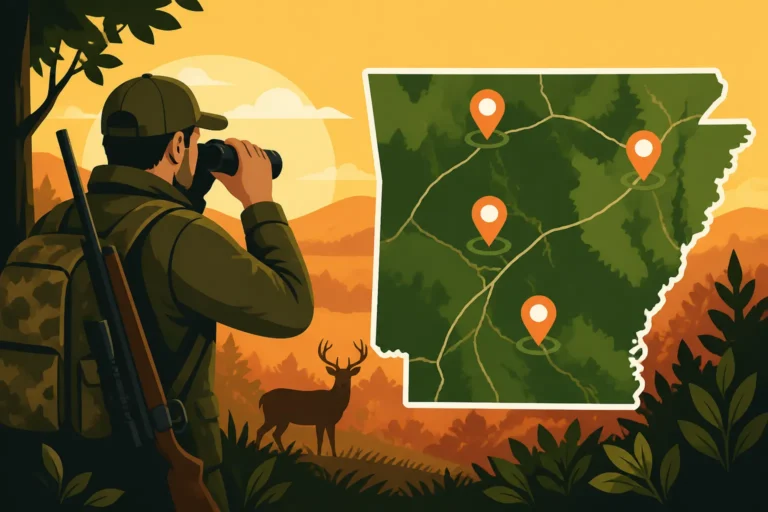
Forget about relying solely on paper maps, though a physical map and compass are still non-negotiables as a backup. Modern GPS devices and mapping apps are absolutely critical for navigating the Ouachita National Forest. Tools like onX Hunt or GoHunt provide invaluable layers, showing property boundaries, forest roads, topographic lines, and even satellite imagery. These apps can help you identify subtle terrain features that might concentrate deer, like saddles, benches, or hidden water sources.
Before you even leave your house, spend hours poring over these digital maps. Identify potential access points, calculate elevation changes, and mark areas of interest such as dense cover, possible food sources (like oak flats), or pinch points. Using the GPS on your phone or a dedicated unit allows you to drop pins for observations, track your movements, and, most importantly, find your way back to your vehicle after a long day in unfamiliar country. This technology isn’t just a convenience; it’s a safety tool, ensuring you don’t get disoriented in the vastness of the forest. The ability to cache maps for offline use is especially important, as cell service can be spotty to non-existent in many parts of the Ouachitas.
Pre-Season Scouting Strategies
Effective scouting in the Ouachitas is about covering ground, both physically and virtually. Begin your scouting by studying aerial photos and topographic maps long before the season. Look for changes in vegetation, potential funnels created by terrain, and areas of mature hardwoods mixed with pine. These could be key bedding or feeding areas. Once you have a few promising spots, it's time to hit the ground.
During the late summer and early fall, hike into these areas. Look for traditional deer sign: tracks, rubs, scrapes, and droppings. Pay close attention to subtle features like benches on a ridge, which can act as highways for deer moving between bedding and feeding areas. Find natural travel corridors, often along creek bottoms, old logging roads, or ridge lines. Don't be afraid to put on some miles; the more ground you cover, the better your chances of finding those elusive buck hotspots. Setting up trail cameras in key locations can also give you insights into deer movement patterns and specific bucks in the area. Scouting Arkansas Public Land Before Season is a detailed guide that can further enhance these strategies.
What to Pack for a Ouachita Hunt
Given the rugged and unpredictable nature of the Ouachitas, your pack list needs to be well-thought-out. Lightweight and durable gear is paramount. Here's a quick rundown of essentials:
| Item | Importance | Notes |
|---|---|---|
| Navigation | Absolutely critical for staying found and pinpointing locations. | GPS device (dedicated or phone app like onX Hunt), backup paper map, compass. Fully charged power bank for electronics. |
| Hydration | The Ouachitas are physically demanding; staying hydrated is key to endurance and safety. | Water bladder (2-3 liters), water filter or purification tablets. |
| First Aid & Safety | Injuries can happen deep in the woods, and self-rescue might be necessary. | Comprehensive first-aid kit, emergency shelter/blanket, whistle, headlamp with extra batteries, fire starter. |
| Clothing | Layering is essential for temperature regulation in fluctuating conditions. | Moisture-wicking base layers, insulation layers, waterproof/windproof outer shell. Sturdy, broken-in hiking boots. |
| Hunting Specifics | Depends on your chosen method, but some items are universal. | Quality optics (binoculars), rangefinder, knife, game bags, drag rope/game cart (if applicable). Scent control products. |
| Food | Sustenance for long days, especially if you get turned around or need to stay out longer than planned. | High-energy snacks (nuts, jerky, energy bars), a packed lunch. |
| Communication | Essential for emergencies, even if cell service is spotty. | Satellite messenger (Garmin inReach or similar) if you're going deep. Cell phone (for limited service areas, still good for photos and apps like GoHunt). |
Don't skimp on quality, especially for navigation and footwear. A comfortable pair of waterproof boots can make or break your hunt when you're covering miles of rocky, often wet, terrain.
Effective Deer Hunting Tactics in the Ouachita National Forest
Hunting the Ouachita National Forest isn't about sitting in one spot all day, waiting for a parade of deer. It often demands active, strategic hunting.
Still-Hunting and Stand Placement
Still-hunting is perhaps one of the most effective strategies in the Ouachitas. This involves moving slowly and deliberately through the timber, stopping frequently to observe and listen. You're not rushing; you're easing along, taking a few steps, then pausing for several minutes, scanning every shadow and thicket. The goal is to spot deer before they spot you. This method is especially productive when moving into the wind or across a thermal current that allows your scent to blow away from areas you expect deer to be. Focus on moving through areas with diverse cover, natural funnels, or known food sources. This approach is similar to techniques described in Still-Hunting Arkansas Pine Country.
While still-hunting is excellent, there are also times and places for stand placement. Setting a portable treestand or ground blind in a strategic location can be highly effective, particularly near active rub lines, scrape lines along a logging road, or heavily used trails connecting bedding and feeding areas. Consider placing stands on benches overlooking hollows, or in saddles that act as natural crossings between ridges. Think about how deer will approach these areas and set up to intercept them. Remember to pick a setup that allows for good concealment and a clear shooting lane.
Using Rattling and Grunting Effectively
During the rut, rattling and grunting can be surprisingly effective in the Ouachitas, especially for drawing out a curious buck. Given the lower deer density compared to some parts of the state, a well-timed rattling sequence can carry further and might be the only way to let a distant buck know there's "action" in his territory. Start with light sparring, then increase the intensity as if two bucks are really going at it, followed by a grunt or two. Then, go silent and watch for any movement.
Location is key when using calls. Set up in an area with good visibility, preferably with a thicket or heavy cover downwind where a cautious buck might circle to scent-check the commotion. Don't be afraid to experiment with different sequences and call volumes. Sometimes a subtle grunt is all it takes, while other times a full-blown rattling sequence can bring a buck running. This is where practice and understanding deer vocalizations, as explored in Rattling and Grunting in Arkansas, really pays off.
Understanding Wind and Thermals
In mountainous or hilly terrain like the Ouachitas, wind and thermals are your absolute best friends – or your worst enemies. Thermals are air currents that move up and down slopes based on temperature changes. In the morning, as the sun warms the ground, thermals generally rise. In the evening, as the air cools, they tend to fall down into the hollows.
Always try to hunt with the wind or thermals in your favor, carrying your scent away from where you expect deer to be. This means approaching stands or still-hunting routes carefully, often using ridge lines or cross-slope movements to manage your scent. If you're set up on a ridge in the morning, the rising thermal will carry your scent up and away from deer in the hollows below. In the evening, that same thermal will drop, potentially carrying your scent down into those hollows. Mastering this element, which is critical for success as outlined in Wind and Thermals in Ouachita Hollows, requires constant awareness and adjustment. Don't assume the wind at your truck is the same as the wind in a deep hollow a mile away.
Challenges and Considerations for Hunting the Ouachitas
The beauty and ruggedness of the Ouachita National Forest also bring unique challenges that every hunter needs to be prepared for.
Dealing with Hunting Pressure
While the Ouachitas are vast, certain easily accessible areas, especially those near main roads or popular campgrounds, can see significant hunting pressure, particularly during opening weekends of modern gun season. Hunting Pressure on Arkansas WMAs also applies to the Ouachita National Forest, which acts as a massive public hunting area. Hunters trying to escape the crowds might push deer deeper into less accessible terrain. This means you might need to hike further than others are willing to go, or focus on areas with steep climbs and thick cover that deter casual hunters.
Don't be discouraged by other hunters; instead, use their presence to your advantage. Hunters moving through one area might push deer into another. Understanding hunter access points can help you predict deer movement. Sometimes, waiting until mid-week, after the initial opening weekend rush, can provide a more peaceful and productive hunt. Scouting obscure trails, natural barriers, and areas a mile or two off the beaten path will often reveal pockets of unpressured deer.
Recovering a Deer in Tough Terrain
Perhaps one of the biggest challenges in the Ouachitas is recovering a deer after a successful shot. If you harvest an animal in a deep hollow or on a steep, rocky hillside, getting it out can be an arduous task. This isn't flat ground where you can easily drag a deer or roll it onto a cart. You'll often be dealing with slippery leaves, loose rocks, and significant elevation changes. This reality makes shot placement even more critical; a well-placed shot minimizes tracking distance.
Always have a plan for extraction before you even start hunting. Consider packing a quality game cart if the terrain allows for it, or at least a sturdy drag rope. If hunting solo, acknowledge your limits; sometimes, it's better to make two trips for gear than to try and drag a heavy deer out of a ravine by yourself in one go. If you're with a hunting partner, coordinate how you'll work together. Getting a deer out of a place like this, as discussed in Getting a Deer Out of an Ozark Hollow, is a serious undertaking that requires preparation and physical endurance. Don't forget field dressing essentials; being able to field dress and quarter your deer quickly can lighten the load significantly.
Safety First in the Ouachitas
Hunting in a vast, rugged wilderness like the Ouachita National Forest demands an unwavering commitment to safety. Getting lost is a real possibility, especially in unfamiliar territory or if bad weather rolls in quickly. Always tell someone exactly where you're going and when you expect to return. Carry reliable navigation tools and know how to use them, even when cell service fails.
Beyond navigation, firearm safety is paramount. Always be aware of your muzzle, your target, and what's beyond it. Assume there might be other hunters in the area, especially on public land. Hunter orange is not just a requirement; it's a vital safety measure that makes you visible to other hunters. Beyond that, be aware of the wildlife around you; black bears are present in the Ouachitas, and while generally shy, knowing how to react to an encounter is important. Proper hydration, carrying a first-aid kit, and being physically fit for the demands of the terrain are all part of putting safety first. This mindset is reinforced by broader guidelines found in Arkansas Hunter Education and Safety Rules.
Disclaimer
This article is for general informational purposes only and does not constitute professional advice. Laws, prices and regulations vary by location and change over time. Consult a qualified professional for guidance on your specific situation.