Wind and Thermals in Ouachita Hollows
If you've spent any time chasing whitetails or even calling turkeys in the rugged beauty of Arkansas's Ouachita Mountains, you know the frustration: you felt the wind on your cheek, you thought you had it figured out, and then a mature buck ghosts you, clearly having caught your scent. It's not just "wind" up here; it's a dynamic, swirling ballet of air currents driven by the sun, the shade, and the very contours of the land. This guide is all about peeling back the layers of that complex airflow, helping you truly understand and adapt to the unpredictable world of wind and thermals in Ouachita hollows so you can finally put the odds back in your favor.
Understanding the Basics of Mountain Airflow
Hunting in the Ouachita Mountains is a different beast compared to the flatlands of the Delta. Here, every ridge, hollow, and creek bottom acts as a channel or a barrier, fundamentally altering how air moves. It’s not enough to simply check a weather app; you need to grasp the invisible dance of warm and cool air that dictates where your scent travels. Ignoring these basic principles is a surefire way to educate every deer in the county about your presence.
The Dynamics of Thermal Drifts
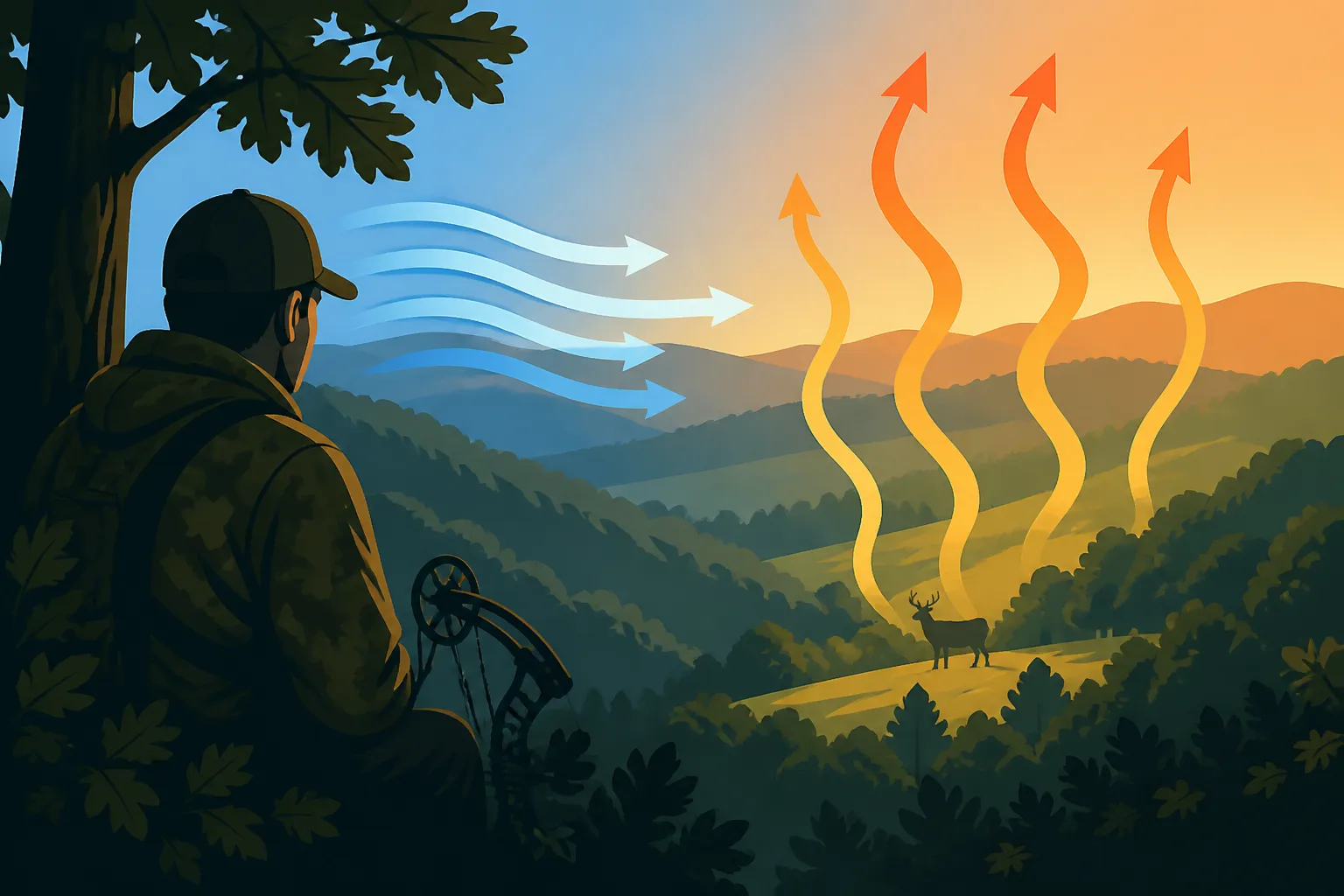
Thermals are essentially localized air currents caused by temperature differences. Think of it like a giant, natural convection oven. As the sun rises and warms the earth, the ground heats up unevenly. South-facing slopes, catching the sun earlier and more directly, warm faster than north-facing slopes or shaded hollows. This warm air becomes lighter and rises, creating what we call an "updraft" or an "uphill thermal." In the morning, as the sun begins to climb, you'll feel that air pulling upward, carrying your scent with it. This is a critical piece of information for anyone planning to hunt a ridge or a hollow during the early hours.
Conversely, as the sun dips below the horizon in the evening, the air cools rapidly, especially in shaded areas and low-lying hollows. Cooler air is denser and heavier, so it begins to sink and flow downhill, creating a "downdraft" or a "downhill thermal." This phenomenon is why an evening stand placement often differs significantly from a morning one. Imagine sitting in a creek bottom as the evening progresses; any scent you emit will be steadily pushed down the hollow, often right to where deer are moving to feed or water. Understanding these basic thermal principles is the foundation for effective hunting in varied terrain.
How Topography Shapes Wind
The physical layout of the Ouachita Mountains—its countless ridges, steep hollows, and saddles—acts like a giant, complex system of funnels and barriers for wind. What might feel like a steady breeze on a flat ridge top can become a swirling vortex just a few yards down into a steep hollow. This is where many hunters get burned. You're feeling a consistent wind at eye level, but at deer level, just feet above the ground, the air might be moving in a completely different direction, especially if there's a deep cut or a bend in the terrain.
Ridges often act as highways for wind, channeling it along their length. Saddles, those dips between two higher points, often create predictable pinch points where wind can accelerate or swirl, but they also offer opportunities. A saddle can draw air from both sides, creating a consistent, if sometimes swirly, crosswind depending on the primary direction. Hollows, on the other hand, tend to hold cooler air and channel thermals up or down, making them highly sensitive to solar radiation. Deer are incredibly adept at using these predictable air currents to their advantage, often bedding on leeward slopes where their scent is carried back into the hollow, or moving along contours where the wind is consistent. Using a mapping tool like GoHunt can be invaluable here, allowing you to study terrain features and visualize potential airflow before you even step foot in the woods.
Predicting Wind Patterns in Ouachita Hollows
Accurately predicting how wind and thermals will behave in the Ouachitas is less about magic and more about keen observation and understanding the daily cycle. It's about paying attention to more than just the flag on your truck; it's about sensing the subtle shifts in the air around you, hour by hour. This is where experience truly pays off, but even new hunters can develop this skill with practice.
Morning and Evening Thermal Shifts
The periods just after sunrise and just before sunset are the most dynamic when it comes to thermal shifts. In the early morning, before the sun has really warmed the ground, the air remains cool and heavy, clinging to the earth. If you're walking into a hollow at dawn, your scent will likely be pushed downhill. This makes your entry route critical. As the sun hits the eastern slopes, usually around 8-9 AM, that air begins to warm, lighten, and rise. This is the transition period where the downhill thermal reverses to an uphill thermal. Your scent, which was sinking, will now start to climb. This is why a stand placed too low in a hollow for a morning hunt can be a disaster once the thermals switch.
Come evening, the process reverses. As the sun begins to set, the warm air clinging to the slopes starts to cool. North-facing slopes and shaded creek bottoms cool first, and that dense, heavy air begins its descent. The uphill thermal gradually weakens and then switches to a strong downhill thermal, usually an hour or two before dark. This means any scent you're giving off will again be pushed down into the hollows and bottoms. A hunter on a ridge top needs to be mindful that their scent will eventually be sinking into the paths deer might be using to come up to feed. These shifts aren't instantaneous; they're gradual, and understanding that gradient is key.
Reading Wind Direction with Visual Cues
While your fancy weather app can give you a general idea of the prevailing wind, it often falls short in the Ouachita's undulating terrain. The real trick is to constantly check the wind at ground level, where the deer are. This means carrying a wind checker—a small squeeze bottle of unscented powder, like milkweed seeds or even finely crushed cedar dust. Every 10-15 minutes, or whenever you move to a new location, give it a puff and watch exactly how those tiny particles float. Do they rise, fall, swirl, or push consistently in one direction?
Don't just rely on what you feel on your face or see in the tree tops. Air currents can be drastically different at different elevations. I've been in stands where the wind felt steady at 20 feet, but a puff of powder showed it swirling wildly five feet off the ground. Pay attention to natural indicators too: the rustle of leaves on different sides of a tree, the way spiderwebs hang, or even the movement of small dust motes in a sunbeam. A very thin piece of thread tied to your bow string or rifle barrel can also be a surprisingly accurate indicator of subtle air movement right at your weapon. The more you "read" the air, the better you'll become at predicting its behavior and planning your next move.
Here's a quick reference for thermal behavior in the Ouachitas:
| Time of Day | Sun Exposure | Thermal Direction | Scent Implication | Optimal Stand Placement |
|---|---|---|---|---|
| Pre-Dawn | None | Downhill | Sinks into hollows | Low, for morning ascent |
| Morning | Rising/East | Uphill | Rises up slopes | High, for deer moving up |
| Mid-day | High | Uphill/Variable | Rises, can swirl | Higher, on saddles/ridges |
| Evening | Setting/West | Downhill | Sinks into hollows | Lower, for deer moving down |
| Night | None | Downhill | Sinks into hollows | N/A (no hunting at night) |
Tactical Application for Hunting Success
Knowing how thermals work is one thing; actually using that knowledge to your advantage in the field is another. This is where strategy and adaptation come into play, especially when hunting the challenging terrain of the Ouachita Mountains. Every decision, from your entry route to your stand placement, must be made with wind and thermals firmly in mind.
Approaching Stands and Stalking with the Wind
One of the biggest mistakes hunters make is blowing their morning hunt before they even get to their stand. In the early hours, as the air is still cool and heavy, the thermals are predominantly flowing downhill. This means your scent is also sinking and moving down into the bottoms and hollows. If you plan to hunt a ridge top or a bench, your approach needs to be carefully considered. It's often best to approach from below your chosen spot, allowing your scent to be carried downhill and away from where deer might be feeding or traveling in the bottomlands. As the sun rises and the thermals shift to uphill, your scent will then be carried up and over any deer below you.
When still-hunting or stalking, especially when trying to pinpoint where deer are bedded, you constantly need to adjust your route. Think about how deer use these same air currents. They'll often bed on a leeward slope where the wind blows over their back, carrying their scent downwind behind them, while they watch their backtrail. To effectively stalk these areas, you want to approach from the side, with a slight crosswind, or even from slightly upwind, allowing your scent to blow away from their potential bedding area. This requires slow movement, constant wind checking, and using terrain features to break up your silhouette. Mastering this approach can be critical to success when Still-Hunting Arkansas Pine Country.
Choosing Stand Locations Based on Thermals
Selecting the right stand location is perhaps the most crucial application of thermal knowledge. For a morning hunt, particularly if you anticipate deer moving up from lower elevations to feed or bed on benches, consider placing your stand higher up on a ridge or just below the crest of a primary ridge line. As the sun rises and the thermals begin their upward journey, your scent will be carried high over any deer moving below you. However, be mindful of the thermal switch; once the air starts rising strongly, any deer above you on the ridge could pick up your scent. A good mapping tool with topography lines, like GoHunt, can help you visualize these elevation changes and plan accordingly.
For evening hunts, the strategy shifts. As the thermals reverse and begin to flow downhill, you want your stand placed lower, often in a hollow, creek bottom, or on a bench just above a known deer trail that leads to feeding areas. Your scent will be carried down into the hollow, away from deer that are likely moving along those lower trails as they head to feed. This makes the classic "ridge-to-creek bottom" movement pattern of deer much more predictable. When studying aerial maps for potential spots, look for subtle benches or saddles that might offer more stable air currents during these transitional periods. Don't forget to consider how your access and exit routes might affect these choices; you don't want to blow out deer on your way in or out of your stand, which is a common problem for hunters trying to optimize their setup. Learning to read an Ozark bench for deer can be instrumental here.
Dealing with Swirling Winds
Let's be honest: even with all the knowledge in the world, the Ouachitas can throw you a curveball. Swirling winds are the bane of every mountain hunter's existence. You set up perfectly, the wind is ideal, and then suddenly, for a few agonizing minutes, it's doing a complete 180 or swirling like a blender. This often happens in deep, convoluted hollows, or at the intersection of multiple terrain features. When this happens, it's usually because localized pockets of air are being pushed and pulled by the broader thermal current and the topography.
While you can't entirely eliminate swirling winds, you can mitigate their impact. First, be incredibly diligent with scent control. Use high-quality scent-eliminating sprays, wash your hunting clothes in scent-free detergent, and store them in airtight bags. Second, consider stand placement in areas that tend to have more consistent airflow, such as broader saddles or more open ridge lines, rather than tucked deep into tight, winding hollows. Sometimes, moving just a few yards can make a world of difference. Third, acknowledge that some days, the wind simply won't cooperate. On those days, a more aggressive still-hunting approach, where you are constantly moving and checking the wind, might be more effective than sitting stationary. Always have a backup plan, and be willing to move if the wind isn't holding true. Remember, Scouting Arkansas Public Land Before Season isn't just about finding deer sign; it's also about understanding the terrain's relationship with the wind.
Disclaimer
Hunting is an inherently dangerous activity. Always prioritize safety, understand and follow all Arkansas Game and Fish Commission regulations, and obtain appropriate licenses and permits. The information provided here is for educational purposes and should not replace professional guidance or personal experience in the field. Conditions can change rapidly, and hunters should always exercise their own judgment and take necessary precautions.