Getting a Deer Out of an Ozark Hollow
You've done it! You put in the time, scouted hard, beat the elements, and finally dropped a beautiful deer deep in an Ozark hollow. That rush of adrenaline is incredible, but as soon as the initial excitement fades, a new, more daunting challenge often sets in: "How in the world am I going to get this animal out of here?" The steep, rocky, unforgiving terrain of the Arkansas Ozarks can turn a successful hunt into a grueling test of will and physicality. This guide is here to walk you through the practical steps, essential gear, and smart strategies to conquer the hollows and get your hard-earned venison home safely.
The Unique Challenges of Ozark Terrain
Getting a deer out of an Ozark hollow is a different beast entirely compared to dragging one across flat Delta fields or even a gently rolling pine plantation. The Ozarks have a way of humbling even the most prepared hunter, and understanding why it's so difficult is the first step to conquering the challenge.
Steep Grades and Rocky Footing
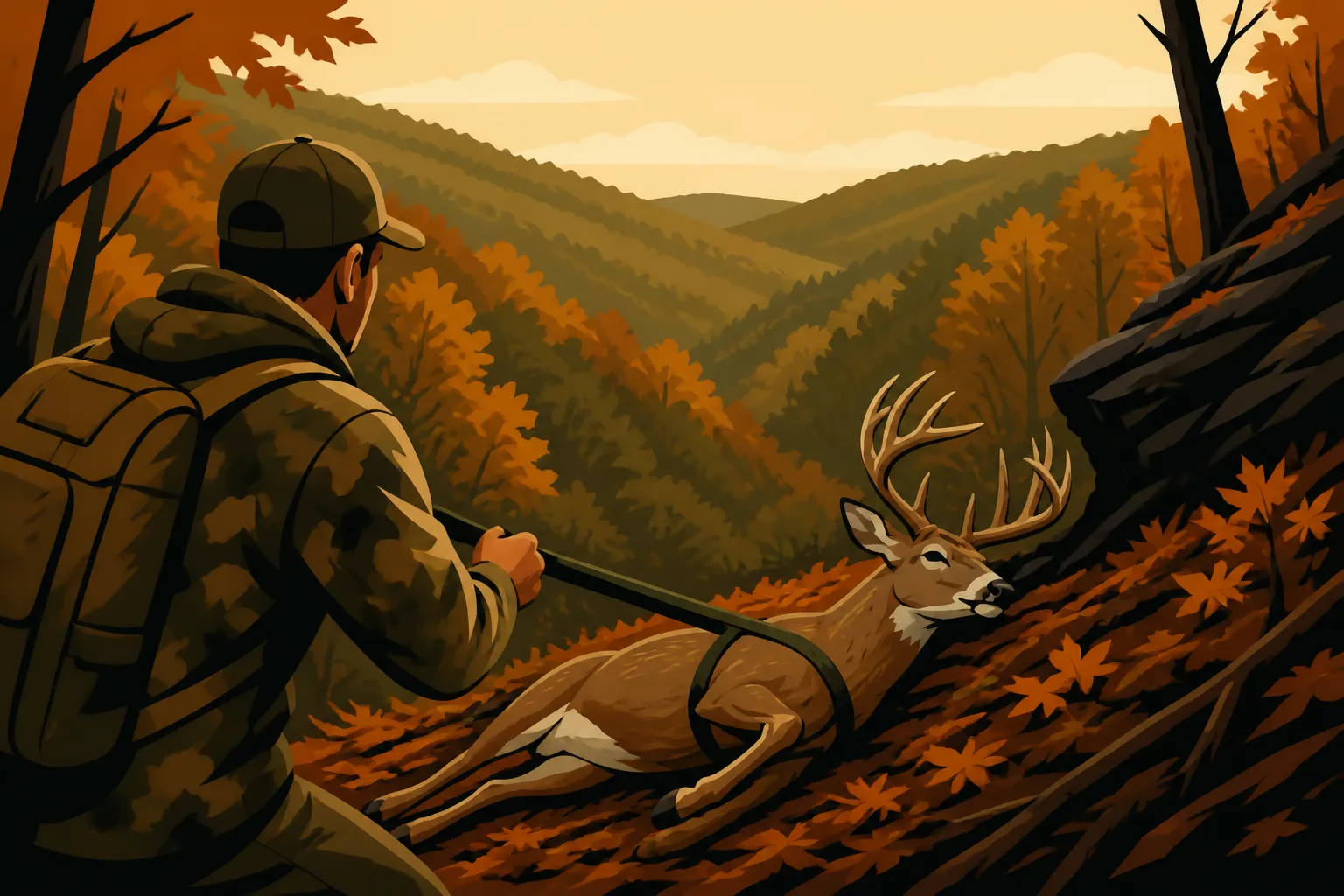
Anyone who has spent time hunting the Ozark National Forest Hunting knows that "flat" is a foreign concept. The hills are relentlessly steep, often with grades that feel like you're climbing a ladder. Now imagine trying to drag a 150-pound deer up or down that incline. It's not just the steepness; it's the footing. The ground is a constant mosaic of loose rocks, slick leaf litter, exposed roots, and moss-covered stones. A single misplaced step with a heavy load can lead to a nasty fall, injury, or worse, losing control of your valuable game. This is especially true when you're already fatigued from the hunt itself. The constant need to watch your step, test the ground, and maintain balance while maneuvering a bulky animal drains energy at an alarming rate.
Think about traversing a hollow where the incline feels like 45 degrees, covered in a fresh layer of fallen oak leaves over wet dirt. Every step is a gamble. Trying to pull a deer, even a smaller one, uphill in these conditions often feels like you're trying to pull an anchor. Downhill brings its own risks; gravity becomes a powerful, uncooperative ally, threatening to turn your controlled descent into an uncontrolled tumble if you're not careful. This kind of terrain demands deliberate movement, constant awareness, and a healthy respect for its ability to create problems.
Dense Undergrowth and Limited Visibility
Beyond the sheer elevation changes and rocky surfaces, Ozark hollows are often choked with dense undergrowth, briar patches, tangled vines, and thick saplings. What looks like a clear path on an aerial map can quickly become an impenetrable jungle on the ground. This thick cover, while excellent for deer habitat and for methods like Hunting Ozark Ridges and Hollows for Deer, becomes a nightmare when you're trying to move a large animal through it. Every few feet, you might have to lift the deer over a downed log, untangle its antlers from a low-hanging branch, or hack your way through a wall of greenbriar.
This dense vegetation also significantly limits visibility. You might be struggling to pull your deer up a steep bank, only to realize you've gone a mere 20 yards in 30 minutes, and the ridge top still feels miles away. This can be incredibly demoralizing and lead to exhaustion if you're not mentally prepared. Furthermore, the limited visibility makes it harder to scout the most efficient retrieval path before you start the process. You might find yourself backtracking or veering off course, adding precious time and energy to an already demanding task. It underscores the importance of a good plan and careful observation even before you make the first drag.
Water Crossings and Elevation Changes
Many Ozark hollows contain small creeks, seepages, or seasonal drainages that, while beautiful, add another layer of complexity to deer retrieval. What might be a small trickle during dry periods can become a significant obstacle after a good rain. You might find yourself needing to cross a rocky-bottomed creek that's too wide to jump and too deep to simply step across without getting wet. Getting a deer across flowing water, especially when the banks are steep and muddy, requires extra planning and effort. The deer will quickly become waterlogged, adding immense weight to an already heavy load.
Beyond the water, the terrain itself is a constant series of micro-elevation changes, even within a general uphill trend. You might navigate a relatively flat bench for a short distance only to immediately hit another steep climb, or encounter a sudden drop-off into a ravine that wasn't apparent from above. These unpredictable dips and rises can be disorienting, especially if you're attempting to move the deer in fading light. Understanding how Wind and Thermals in Ouachita Hollows interact with these terrain features can give you clues about potential game trails, but even those are no guarantee of an easy path when you're loaded down. Every contour, every rock outcropping, every minor drainage demands consideration and effort.
Essential Gear for Ozark Deer Retrieval
You wouldn't head into the Ozarks to hunt without your rifle or bow, and similarly, you shouldn't go without the right gear for getting your deer out. The proper tools can drastically reduce the physical toll and make the difference between a successful, efficient retrieval and a miserable, potentially dangerous ordeal.
The Right Pack and Hauling Equipment
When you're facing those notorious Ozark grades, traditional game carts often become more of a hindrance than a help. Their wheels get caught on rocks, they tip over on side hills, and they're almost impossible to maneuver through dense brush or up and down steep slopes. Instead, think about equipment that works with your body or allows you to break down the load.
An internal or external frame backpack designed for packing out game is often the unsung hero of Ozark deer retrieval. Brands like Mystery Ranch, Kifaru, and Exo Mountain Gear make rugged packs that can handle significant weight. If you plan to quarter your deer (which we'll discuss more), a good frame pack is indispensable. It allows you to distribute the weight across your back and hips, engaging your larger muscle groups more effectively than dragging. You can pack out the meat, hide, and antlers in multiple trips if necessary, making the load manageable.
For full-body retrieval on less extreme (but still tough) terrain, or as a drag aid, a heavy-duty game sled can be surprisingly effective. Look for one made of durable, slick plastic that can slide over rocks and stumps without snagging too much. The key is to have strong ropes attached at multiple points to prevent it from flipping. While still challenging on steep ascents, a sled can protect the hide and meat from abrasion and keep the carcass cleaner, especially when moving downhill or across relatively smoother stretches. Just remember, a sled requires a clear enough path to be truly efficient, which isn't always available in the deepest Ozark hollows.
| Retrieval Method | Ideal Terrain | Equipment Needed | Pros | Cons |
|---|---|---|---|---|
| Dragging (Whole) | Gentle slopes, open woods | Heavy-duty drag rope/harness, maybe a sled | Simple, no processing needed in field | Extremely tiring on steep/rocky terrain, damages hide/meat |
| Quartering/Packing | Steep, rugged, dense | Frame pack, sharp knife, game bags, saw (optional) | Most efficient for difficult terrain, preserves meat quality | Requires field dressing expertise, multiple trips, more time in field |
| Group Carry (Whole) | Moderate terrain, short distances | Strong poles, ropes, multiple people | Distributes weight, faster than solo dragging | Requires multiple hunters, still hard on steep terrain |
| Mechanical Winch | Extreme terrain, accessible trees | Hand winch, long straps/ropes | Can move heavy game uphill with less effort | Slow, requires sturdy anchor points, specialized gear |
Personal Safety and Navigation Tools
Your safety is paramount, especially when working alone or in remote areas. A well-stocked first-aid kit is non-negotiable, containing essentials for cuts, scrapes, sprains, and blisters. The Ozarks are rugged, and accidents can happen quickly when carrying heavy loads over uneven ground.
For navigation, don't rely solely on your phone. A fully charged GPS device (like a Garmin inReach, which also offers satellite communication) or a reliable smartphone app with downloaded offline maps is crucial. I've found that using mapping applications like GoHunt, Gaia GPS, or onX Hunt, which allow you to mark your stand, the deer's location, and plan potential retrieval routes, are invaluable. These tools, especially when used in conjunction with something like the AGFC Map Tool, can help you navigate around cliffs, dense thickets, or unexpected water features, particularly when you're Trackinga Deer in Ozark Rock and needing to find the path of least resistance for extraction. It's too easy to get turned around when you're focused on dragging a heavy deer, so having a way to confirm your direction and stay on course is critical.
Finally, don't forget headlamps or powerful flashlights with extra batteries. Daylight fades quickly in the deep hollows, and struggling to extract a deer in the dark without adequate light is dangerous and inefficient. A quality headlamp frees your hands, which you'll definitely need for grappling with your deer or holding onto roots and trees for balance.
Field Dressing and Preservation Supplies
Proper field dressing is critical, especially if you're hunting during periods when the Field Dressing in Arkansas Heat is a concern. You'll need a sharp, durable hunting knife (and a backup!), game cleaning gloves, and a small bone saw if you plan to quarter or cape your animal in the field. A knife sharpener is also a good idea.
Crucially, bring several game bags. These breathable cloth bags protect the meat from flies, dirt, and debris if you quarter the animal. They allow air to circulate, which is vital for Cooling Meat in an Arkansas November. Even if you're dragging the whole deer, having a few extra plastic trash bags can be useful for bagging the heart and liver, or for protecting any caped hide. Finally, a length of sturdy cordage or rope (at least 20-30 feet) has countless uses, from tying off a leg to get a better grip, to securing a pack, to creating improvised drag handles.
Strategic Approaches to Deer Extraction
With the right gear in hand and a clear understanding of the terrain, it's time to strategize your exit. The approach you take will largely depend on whether you're alone or with a group, and the specific challenges of your retrieval site.
Solo Hunter Techniques
When you're hunting alone, dropping a deer deep in an Ozark hollow presents the ultimate test of self-reliance. Dragging a whole deer, especially a large buck, is almost impossible up steep grades and can be incredibly dangerous. This is where the art of breaking down the animal in the field becomes your best friend.
The most common and efficient solo technique is to quarter the deer. This involves field dressing the animal and then carefully removing the four quarters (front shoulders and hindquarters), the backstraps, tenderloins, and sometimes the neck meat. If you want the cape for a mount, you'll need to learn how to properly cape it in the field, leaving enough hide for the taxidermist. By breaking the deer into smaller, manageable pieces, you can distribute the weight into your frame pack and make multiple trips. It’s certainly more work on the front end, but it saves immense physical exertion and time on the back end, and it significantly reduces the risk of injury.
Before you start quartering, take a moment to cool the carcass if possible. Position the deer on a slope or use logs to allow air circulation. Then, systematically remove the parts, placing them immediately into game bags to protect them from dirt and insects. You might make two or three trips, first with the heavier hindquarters and backstraps, then the front quarters and cape, and finally any remaining meat or skull if desired. Remember, the goal is to make each load manageable for your strength and the terrain. This method, while requiring a bit more skill and time in the field, is truly the only realistic way to get a large deer out of a truly formidable Ozark hollow by yourself.
Group Retrieval Methods
If you're fortunate enough to be hunting with a partner or group, you have more options for getting your deer out. Shared effort can make quick work of a retrieval that would be impossible solo.
The simplest group method is a two-person drag. Two hunters grab the deer by the antlers or a drag harness, and pull in unison. On relatively level ground or downhill, this can be quite effective. However, on steep uphills, it's still incredibly challenging. Often, a "leapfrogging" or "relay" method works best. One hunter pulls for a short distance, then the other takes over, allowing for brief rests. This conserves energy and prevents one person from getting completely gassed.
For truly steep or technical sections, a shoulder carry can be employed. This involves two or more hunters using a sturdy pole inserted through the deer's hocks (after cutting the tendons) or secured with ropes. The hunters then lift the pole onto their shoulders, carrying the deer out. This method elevates the deer off the ground, reducing friction and allowing easier navigation over obstacles. However, it requires careful coordination, especially on uneven ground, and can still be exhausting over long distances. For safety, ensure everyone is communicating clearly and moving together. This method is often best for shorter, extremely difficult sections before transitioning back to dragging on more forgiving terrain.
Mechanical Aids and Improvised Solutions
Sometimes, even with a group, the Ozark terrain throws a curveball that requires a little ingenuity or specialized equipment. While full-scale ATVs or side-by-sides are rarely an option deep in a hollow, smaller, portable mechanical aids can make a huge difference.
A hand-crank winch or come-along can be a lifesaver on incredibly steep uphill sections. If you have a sturdy tree or rock outcrop higher up the slope, you can secure the winch to it and then to the deer, slowly winching the animal uphill. This is slow, but it's far less physically demanding than trying to drag it yourself. Make sure you have plenty of strong, non-stretching rope and tree-saver straps to avoid damaging the anchor points. Always be mindful of safety, ensuring the winch is securely anchored and that no one is in the path of a snapping rope or rolling deer.
For river crossings or deep ravines, a block and tackle system can be rigged. This uses pulleys to multiply your pulling force, making it easier to lift or move a heavy deer. Again, this requires solid anchor points and a good understanding of knot-tying and pulley mechanics. Don't attempt these advanced techniques if you're not confident in your rigging skills, as they can be dangerous if done incorrectly.
In a pinch, you can also improvise a sled from a thick tarp or even a heavy-duty rain fly if you've already field dressed the deer. Wrap the deer (or quarters) in the material, and use ropes to create drag handles. It won't be as durable as a purpose-built sled, but it can get you out of a bind, protecting the meat from dirt and making it easier to slide over rough ground than a bare carcass. Remember to always consider the immediate environment; sometimes, dragging the deer downhill to a road you might have overlooked on your way in is easier than going back up the steep side you came down. This is where thorough Scouting Arkansas Public Land Before Season truly pays off.
Post-Retrieval Care and Ozark Considerations
Successfully getting your deer out of an Ozark hollow is a huge accomplishment, but the work isn't over. Proper care of your hard-won venison is essential to ensure it makes it to your freezer in prime condition.
Protecting Your Meat in Warm Weather
Arkansas weather, even during deer season, can be notoriously warm, especially in the early archery and modern gun dates. This means you need to be extremely vigilant about getting your deer cooled down quickly to prevent spoilage. Even after a successful retrieval, the meat can still be at risk.
Once you have the deer out of the hollow and ideally to a vehicle or processing station, prioritize cooling. If you've quartered the deer, get those game bags into a cooler with ice as soon as possible. Don't let the quarters sit in standing water; use racks or elevate them above the melted ice. For a whole deer, try to hang it if possible, allowing air to circulate around the carcass. If you can't hang it, lay it on its back, propping the cavity open with a stick to maximize airflow. Pack ice in bags inside the body cavity. This rapid cooling is critical, especially given the efforts you've already put into the retrieval itself. For more in-depth advice on this crucial step, check out resources on Cooling Meat in an Arkansas November. The clock starts ticking the moment the deer hits the ground, and every minute counts.
Respecting the Land and Leaving No Trace
As hunters, we have a responsibility to be good stewards of the land, especially when hunting on public access areas like the Ouachita National Forest. The immense effort of deer retrieval means you'll inevitably leave some sign of your passage, but the goal is to minimize your impact.
First, if you field dressed your deer in the hollow, be mindful of where you leave the gut pile. Try to place it away from game trails, water sources, and human travel paths. Nature will take care of it, but you don't want to create an eyesore or attract scavengers to a high-traffic area. Ensure you collect all your trash – gloves, plastic bags, rope scraps, and anything else you brought in. Leaving no trace means packing out everything you packed in.
Finally, think about the future. If you created an improvised path or cleared some brush, consider if it's necessary to leave it that way. While a small amount of disturbance is inevitable, aim to leave the area as natural as possible. Your efforts to get your deer out of that hollow are a testament to your dedication as a hunter, and by showing respect for the land, you ensure these wild places remain pristine for future generations to enjoy. This ethical approach is as much a part of the hunt as the shot itself, and it’s a commitment we all share when we venture into the beautiful, yet challenging, Arkansas wilderness.
Disclaimer
Please note that hunting regulations, seasons, and access rules can change frequently. Always consult the latest Arkansas Game and Fish Commission (AGFC) regulations before planning any hunt. This guide is for informational purposes only and does not replace official guidelines or common sense safety practices. Hunt safely and ethically.