Reading an Ozark Bench for Deer
Hunting deer in the rugged, unforgiving terrain of the Arkansas Ozarks can feel like an endless puzzle. You're constantly wondering where those elusive bucks disappear to, especially when the slopes are steep and the timber is thick. This guide is dedicated to unlocking one of the Ozarks' best-kept secrets for deer hunting: the humble, yet incredibly productive, bench. We'll dive deep into understanding these subtle terrain features and show you how to effectively identify and hunt them to put more venison in your freezer.
Understanding the Ozark Landscape and Deer Behavior
The Ozarks are a maze of steep hills, deep hollows, and dense hardwood forests. It's a challenging environment, but with a keen eye for terrain, you can pinpoint exactly where deer are spending their time. Benches are often the key to unlocking consistent success here.
What Exactly is an Ozark Bench?
Imagine you're walking up a steep hillside, and suddenly, the slope eases off into a relatively flat or gently sloping shelf before dropping off sharply again. That flat spot is an Ozark bench. These aren't always grand, obvious terraces like you might find out West; sometimes they're just subtle changes in elevation, maybe only a few feet wide, or they could be old, overgrown logging roads that have settled into the landscape over decades. They form through a combination of geological processes, like erosion and different rock layers weathering at varying rates, or simply from historical land use.
The frustration for many hunters is that these benches can be incredibly subtle, blending in seamlessly with the surrounding topography. You might walk right past a prime bench without ever realizing it, thinking it's just a slight dip in the hill. But to a deer, that slight dip or flattened area is a superhighway, a feeding zone, or a bedding sanctuary. They offer a break from the constant incline and decline, making travel less energetically taxing and providing strategic vantage points.
Why Deer Favor Benches
Deer, much like us, appreciate the path of least resistance, especially when it comes to navigating steep country. Benches provide an invaluable advantage for them. First and foremost, they offer easier travel. Instead of constantly slogging up and down a steep face, a deer can cruise horizontally along a bench, expending less energy. This is particularly true when moving between bedding areas higher up and feeding locations in the hollows below, or vice versa.
Beyond easy travel, benches are a security blanket for deer. The slight elevation change and often denser vegetation along a bench can provide excellent thermal cover, particularly during colder months, trapping warmth or deflecting cold winds. More importantly, it gives deer a strategic advantage in terms of visibility and scent detection. A deer on a bench can often see or hear what's coming from above or below, while their scent might swirl unpredictably, making them harder to pinpoint. This helps explain why you'll often find deer bedding right on a bench, especially if there's a good thicket or fallen timber providing extra cover. They can bed down, watch their back trail, and have the wind carry scent from below.
Food sources also play a huge role. Benches often accumulate fallen leaves and soil, which can lead to different vegetation growth compared to the steeper, leaner slopes. You might find patches of preferred browse or, critically, oak trees dropping acorns right on or just above a bench, creating a natural feeding corridor. Understanding these dynamics is crucial for successfully hunting Ozark ridges and hollows for deer.
Identifying and Interpreting Benches on Maps and in the Field
The beauty of modern hunting is that we have incredible tools at our fingertips to scout from home before ever setting foot in the woods. But there's no substitute for boots on the ground.
Using Topographic Maps and Satellite Imagery
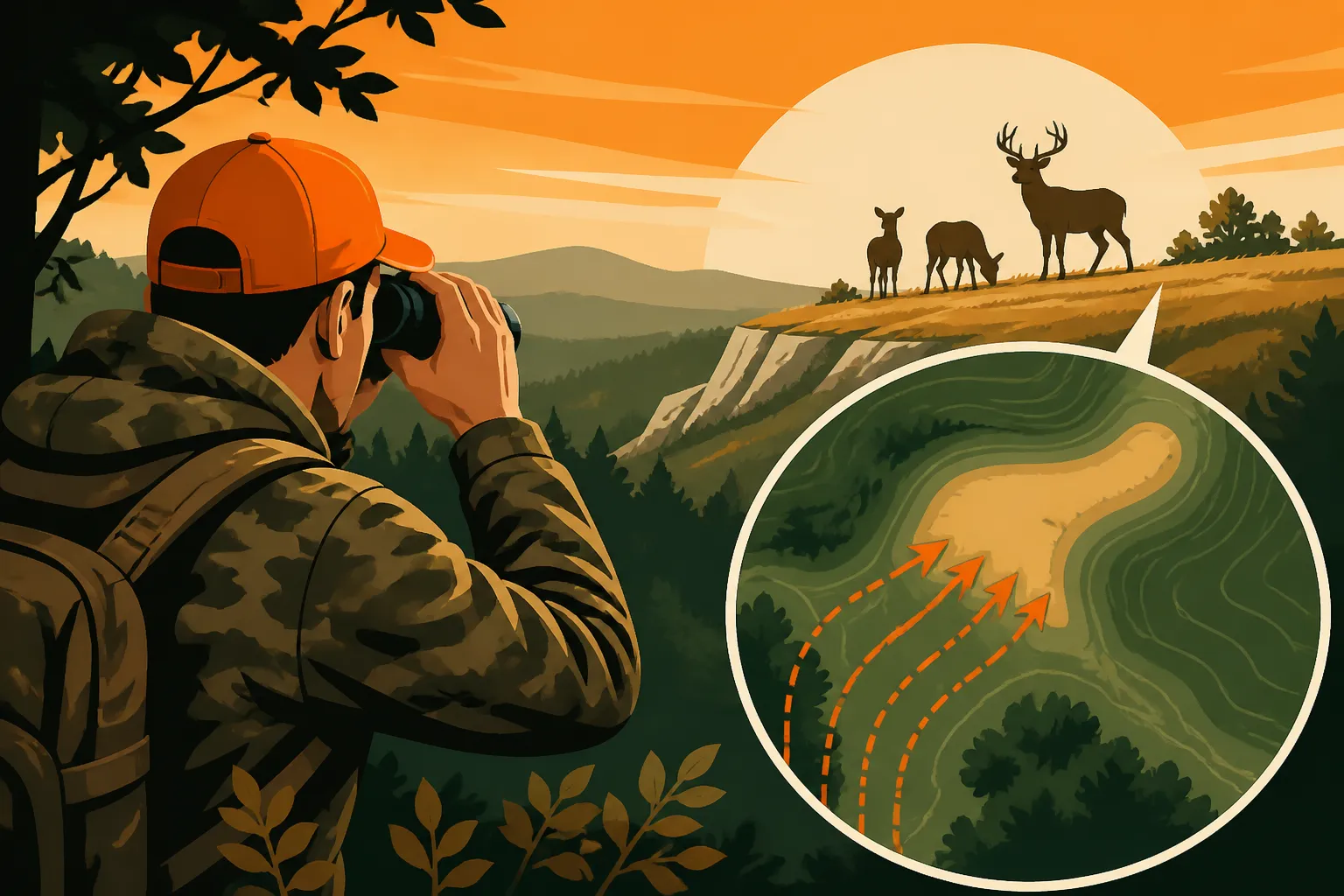
Before you even tie your boots, start your scouting with a good mapping application. Tools like GoHunt, onX Hunt, or the AGFC map tool are invaluable for this. On a topographic map, you're looking for contour lines that spread out, indicating a flattening of the terrain, in contrast to tightly packed lines that signify steep slopes. Imagine the contour lines as ripples in a pond; where they get wider apart on a hillside, there’s likely a bench.
Satellite imagery, especially high-resolution versions, can further confirm these findings. Look for changes in vegetation density or type that might indicate a bench. For example, a strip of slightly denser timber or a different species of tree might grow along a bench where soil conditions are better. Pay close attention to how these benches interact with other key terrain features. Do they lead into a saddle? Do they intersect a drainage or a draw? Do they wrap around a point? These intersections are often pinch points or travel hubs for deer. Being able to read these subtle changes on a map can save you countless hours of aimless wandering in the woods. When you’re scouting Arkansas public land before season, spending time with a map can reveal the exact paths deer are likely to take.
Ground Scouting for Key Indicators
Once you've identified potential benches on your map, it's time to hit the woods. On the ground, the evidence of deer activity on benches can be abundant if you know what to look for. Start by walking the benches you've identified. Look for well-worn game trails that run horizontally along the contour. These aren't always obvious superhighways; sometimes they're subtle depressions in the leaves or faint lines through the undergrowth. Pay attention to deer droppings, which indicate recent activity. The fresher the droppings, the more current the use.
Beyond fresh sign, look for rubs and scrapes, especially during the pre-rut and rut. Bucks will often cruise benches, scent-checking and marking territory. Rubs along a bench or scrapes just off it are clear indicators that deer are actively using that particular travel corridor. Old logging roads, even those completely overgrown, often function as natural benches, offering easy travel and sometimes holding different vegetation.
Finally, understanding wind and thermals is paramount, especially when you're dealing with the undulating terrain of the Ozarks. As the sun rises, thermals typically rise up the hillsides, and as it sets, they fall into the hollows. Deer often use benches to catch these thermal shifts, giving them a scent advantage. For instance, in the morning, a deer might move along a bench with rising thermals carrying their scent upwards, making it harder for predators (like you) to scent them from below. Mastering an understanding of wind and thermals in Ouachita Hollows, though distinct in some ways, provides invaluable insight into how these atmospheric currents influence deer movement across all Arkansas hill country.
| Deer Sign on Ozark Benches | What It Indicates | Best Time to Hunt |
|---|---|---|
| Well-Worn Trails | Consistent travel route, likely between bedding/feeding. | Anytime, especially peak movement hours. |
| Fresh Droppings | Recent activity, potentially feeding or bedding nearby. | Next hunt, observing wind direction. |
| Rubs and Scrapes | Buck activity, territorial marking, especially during rut. | Pre-rut and peak rut weeks. |
| Beds (matted leaves/grass) | Primary bedding area, often with good cover and wind advantage. | Approaching dawn/dusk, or still-hunting mid-day. |
| Acorn Cuttings | Current feeding activity, often with specific oak species. | When acorns are actively falling. |
| Browse Lines | General deer presence, feeding on young shoots/leaves. | Early season or late season. |
Effective Hunting Strategies for Ozark Benches
Once you've done your homework and found those promising benches, the next step is figuring out how to hunt them effectively. It's a delicate balance of stealth, patience, and smart positioning.
Stand Placement and Approach
When it comes to stand placement on an Ozark bench, your primary goal is to remain undetected while having a clear shot at the deer using the bench. The ideal spot is often slightly below the bench, overlooking it, or on the downwind side of a likely travel route along the bench. This allows you to catch deer as they move, without being silhouetted against the sky or having your scent blow directly into their path. Think about setting up where the bench narrows, or where it intersects a draw or saddle, creating a natural funnel.
Always consider your entry and exit routes. The Ozarks are notorious for their noisy leaf litter and steep terrain, making quiet approaches challenging. Plan your path to your stand to avoid disturbing potential deer on the bench. Sometimes, this means taking a longer, roundabout route to get in quietly. Just like with hanging a stand in bottomland hardwoods, you want to minimize your impact. You might even consider having multiple stand locations for different wind directions, as prevailing winds can shift significantly in hill country. A well-placed stand can offer you a prime vantage point for still-hunting Arkansas pine country, especially if the pines border a hardwood bench.
Still-Hunting and Drives on Benches
Benches are absolutely tailor-made for still-hunting. The slightly flatter terrain allows for quieter movement, and the natural contours provide excellent cover as you slowly creep along. The key to still-hunting a bench is to move incredibly slowly, taking one or two steps, then stopping for several minutes to scan, listen, and glass. Look for horizontal lines (a deer's back) in a world of vertical lines (trees). Use your binoculars constantly to pick apart the cover ahead. Move into the wind, or with a quartering wind, to keep your scent from blowing ahead of you. This methodical approach allows you to spot deer before they spot you, especially when they're using the bench for bedding or feeding.
For those who enjoy a more active approach, small-scale deer drives can be highly effective on benches, especially on smaller tracts of public land or private parcels. For two-person drives on small tracts, one hunter can slowly push along a bench, while the other waits at a known escape route or another section of the bench further along. The "pusher" should move deliberately, making just enough noise to encourage deer to move, but not so much that they spook and blow out of the area. The "watcher" needs to be absolutely still, concealed, and ready. This tactic can really shine when deer are seeking refuge in the dense cover of a bench, as they often prefer to sneak along the contour rather than busting straight up or down a steep hill. After the shot, be prepared for a challenge; tracking a deer in Ozark rock can be tricky, so mark the spot well.
Don't forget the power of calling. While rattling and grunting in Arkansas are often associated with open fields or thicker cover, they can be highly effective on benches, especially during the rut. A buck cruising a bench, looking for does, might respond to a well-placed grunt call or a subtle rattling sequence. Remember, the sound will carry differently in the broken terrain of the Ozarks, so adjust your volume accordingly. Often, a softer, more realistic grunt call in Arkansas river bottoms or hollows will be more convincing than an aggressive, loud one.
Seasonal Considerations and Advanced Tactics
Deer behavior changes throughout the hunting season, and understanding how they use benches in different periods can significantly increase your success.
Early Season to Peak Rut Bench Hunting
In the early archery season, when temperatures are still warm, deer are primarily focused on food and water. Benches that offer a consistent supply of acorns, wild grapes, or other preferred browse will be hotspots. Deer will often bed higher up and use benches as travel corridors to access feeding areas in the mornings and evenings. Pay close attention to white oak acorns in September and October; benches with these trees will be magnets for deer.
As the pre-rut and then the peak rut week in Arkansas approaches, benches transition from purely feeding and travel routes to cruising corridors for bucks. Bucks will actively travel these benches, scent-checking for does, making rubs, and leaving scrapes. This is an excellent time to set up on a bench that connects known doe bedding areas to feeding zones, or one that runs between two distinct ridge systems. A buck is likely to use the easiest travel route to cover ground, and benches provide just that. You might also find a doe in estrus leading a buck on a chase along a winding bench.
In the late season, after gun seasons have come and gone and food sources might be scarcer, deer will often seek out benches for their thermal cover and remaining mast. South-facing benches, which catch more sun, can be particularly good on cold, clear days, providing a warmer spot for deer to bed or browse.
Adapting to Pressure and Weather
Hunting pressure on Arkansas WMAs and public lands can quickly push deer into the thickest, most secluded cover. Benches, especially those that are subtle or hard to access, often become security zones for mature deer. When the woods are full of hunters, deer will gravitate to areas where they feel safe. This means overlooked benches, particularly those in deeper hollows or on steep slopes, can hold pressured bucks. Don't be afraid to hike a little further or climb a little higher than other hunters might be willing to go; the reward could be a less-pressured deer.
Weather also plays a critical role. A fresh rain can quiet the noisy Ozark woods, making still-hunting benches an absolute joy. It also refreshes scent, potentially drawing deer out to feed or move. Heavy snow, while less common in most parts of the Ozarks, can force deer to use benches even more heavily, as they offer easier travel than breaking trail through deep drifts on steep slopes. On extremely cold days, deer will often move less but will seek out those sun-drenched, south-facing benches for warmth. Always consider the weather forecast and recent conditions when formulating your bench hunting strategy.
Disclaimer
Hunting is an inherently dangerous activity. Always prioritize safety, follow all Arkansas Game and Fish Commission regulations, and obtain proper licenses and permits before heading into the field. Be aware of your surroundings, understand private property boundaries, and never hunt without proper hunter education and safety knowledge.