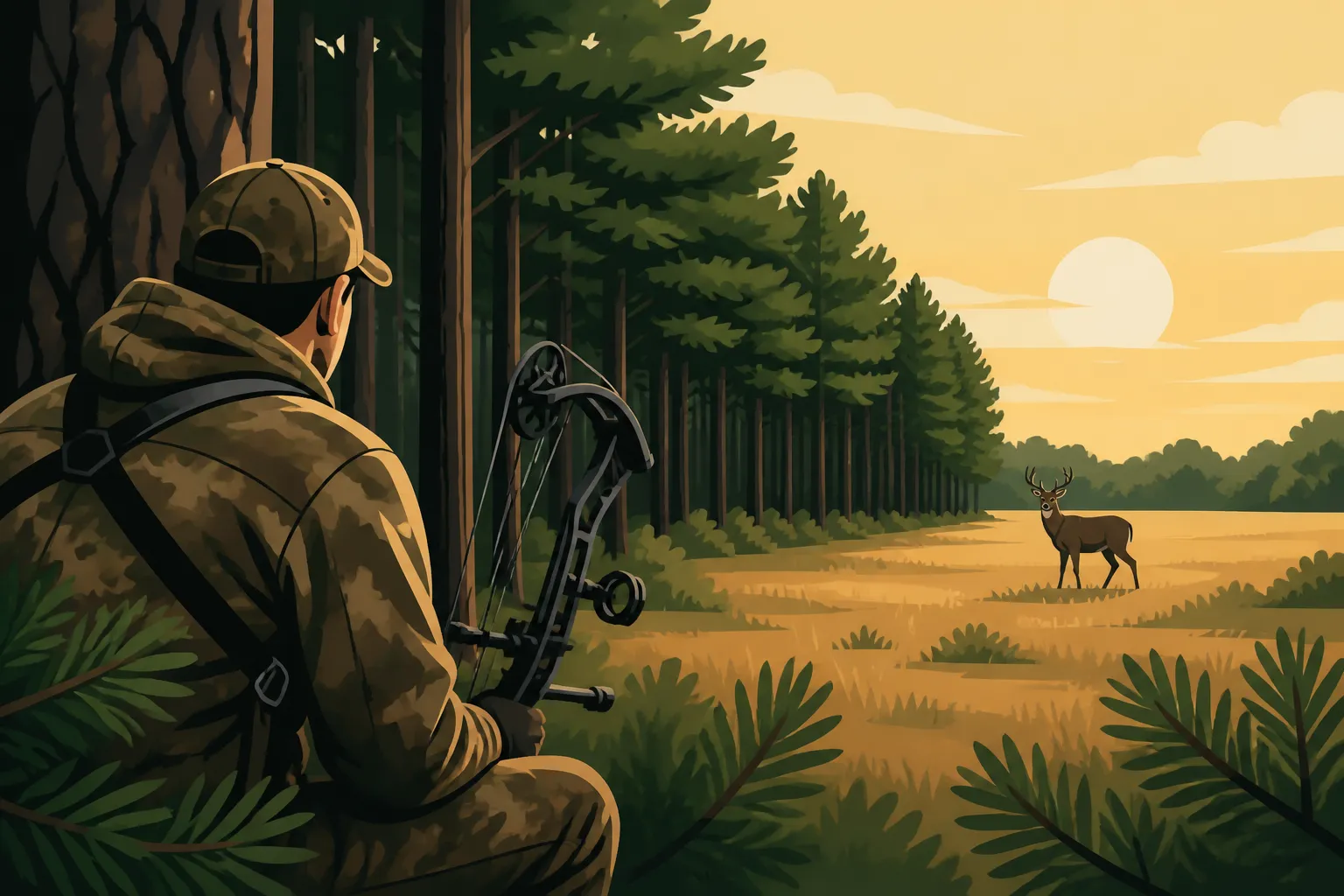
Setting Up on a Pine Plantation Edge
Hunting pine plantation edges in Arkansas can feel like both a blessing and a curse. On one hand, you know deer have to use these areas—they offer food, cover, and travel lanes. On the other, these vast, often uniform blocks of pines can make it incredibly difficult to pinpoint exactly where to set up for a shot opportunity. This guide is all about cutting through that confusion, helping you understand how deer utilize these unique habitats and giving you actionable strategies to set your stand or blind in the sweet spot, turning those endless rows of pines into your next successful hunt.
Understanding Pine Plantation Edges and Deer Movement
Pine plantations, especially those managed for timber production by companies like Weyerhaeuser, are a significant part of the Arkansas landscape. They offer a unique environment for deer, but you have to understand the nuances of how deer interact with these areas to hunt them effectively. It’s not just about finding any "edge"; it's about finding the right edge at the right time.
The Allure and The Challenge
Deer are creatures of comfort and efficiency, always seeking the path of least resistance or the most advantageous position for food, cover, and safety. Pine plantation edges provide an undeniable draw. Imagine a dense wall of young, regenerating pines meeting a mature hardwood bottom, an agricultural field, or even a different aged class of pine. That transition zone is a natural highway for deer. They use it for travel, bedding just inside the thick stuff, or staging before heading out to feed. The allure for a hunter is obvious: deer are there.
However, the challenge arises because these edges can stretch for miles, looking homogenous to the untrained eye. It's easy to plop down a stand along what looks like a good edge, only to find deer are consistently moving a hundred yards deeper into the pines or crossing at a completely different, unpressured point. The mistake many hunters make is assuming any edge is a good edge. Deer, much like us, avoid unnecessary exposure and seek out specific features within these edges that offer the most benefit.
Key Elements of a Productive Edge
Not all edges are created equal. A truly productive pine plantation edge for deer hunting typically boasts specific characteristics that make it more attractive to deer than a vast, uniform boundary. These are the details you need to key in on during your scouting.
First and foremost are habitat transition points. We're talking about where the pine plantation meets something different. This could be a mature hardwood forest, offering acorns and other hard mast. It might be a clearcut or a younger pine stand, providing dense browse and bedding cover. Perhaps it borders a creek bottom or a swampy area, which offers water, security cover, and different food types. These transitions create a natural funnel or a place where deer feel comfortable pausing. When you're Hunting Arkansas Pine Country, these transition areas are your bread and butter.
Secondly, look for food sources along the edge. While pine needles aren't exactly deer candy, the understory of a pine plantation edge can be surprisingly diverse. Think about any oak trees or persimmons that might have been left standing, or areas where natural browse like honeysuckle, greenbrier, or young woody stems are abundant. If the pine plantation borders an agricultural field—be it soybeans, corn, or winter wheat—that edge becomes a prime feeding corridor. Deer will often skirt the edges of fields before committing to open ground, or they'll browse on the transition vegetation before entering.
Finally, water access is a huge factor that's often overlooked. Deer need to drink daily, and if a creek, pond, or even a seep is located near a pine edge, it instantly elevates that spot's potential. They'll often follow the path of least resistance to water, and a well-used game trail leading from dense pine cover to a water source can be a goldmine, especially during hotter parts of the early season.
Scouting Your Pine Plantation Edge Effectively
Successful hunting on a pine plantation edge hinges almost entirely on meticulous scouting. You can't just show up and expect to find the hotspot. It requires a combination of digital reconnaissance and boots-on-the-ground verification, helping you find those subtle features that concentrate deer activity.
Pre-Season Digital Reconnaissance
Before you ever step foot in the woods, the best place to start is from your couch, with a good mapping app. Tools like GoHunt (or other similar platforms) allow you to view aerial imagery that can reveal hidden gems along seemingly uniform pine edges. What you're looking for are anomalies—changes in timber type, small clearings within the pines, drainage features, or even old logging roads that might not be visible on a standard topographic map. Zoom in close to identify those faint lines that could be deer trails, especially where the pine stand meets hardwoods or fields.
Pay close attention to identifying pinch points and funnels. These are areas where natural or man-made features constrict deer movement into a smaller area. For example, a narrow strip of timber between two clearcuts, a low spot where a creek crosses a ridge, or even a dense, impenetrable thicket that forces deer to walk around it. If a pine plantation edge runs up against one of these funnels, it becomes a high-percentage crossing area. Look for subtle bends in the edge, small fingers of pines that extend into an open area, or even slight elevation changes that might dictate travel routes. This virtual scouting is crucial for developing an initial game plan and figuring out where to concentrate your physical efforts. When you're looking at Reading Aerial Photos for Delta Deer or anywhere else, these details jump out.
Boots-on-the-Ground Verification
Once you've identified potential hotspots on your digital maps, it's time to put boots on the ground. This is where you confirm your theories and find the real, current sign. Don't just walk the edge; walk into the pines a bit and along the parallel habitat. You need to see how deer are truly using the area.
Your main goal here is reading sign: tracks, rubs, scrapes, and droppings. Tracks will tell you where deer are walking, their general direction of travel, and how fresh the activity is. Look for concentrations of tracks, especially where trails converge. Rubs (where bucks have rubbed their antlers on small trees) and scrapes (areas where bucks paw away leaves and urinate, often with an overhanging branch) are clear indicators of buck activity, particularly as you approach the rut. You can learn a lot about buck movement by observing Scrape Lines Along a Logging Road or along these edges. Droppings, while less exciting, can tell you if deer are feeding or bedding in an area, and the freshness can help gauge current use.
Beyond sign, focus on finding entry/exit trails. These are the distinct pathways deer use to enter or leave the dense cover of the pines to reach food sources, water, or other bedding areas. They'll often be subtle, barely visible, but repeated use will compact the ground. Note their direction and frequency of use. Finally, always be considering human pressure, especially if you're Hunting Pressure on Arkansas WMAs or other public lands. Deer are incredibly sensitive to disturbance. If an edge is easily accessible and heavily hunted, deer will quickly shift their patterns. Look for less obvious, harder-to-reach sections of the edge that might see fewer hunters. This often means walking further, crossing difficult terrain, or using entry routes that other hunters overlook. Sometimes, Finding Ground Others Walk Past is the key to success.
Optimal Stand and Blind Placement Tactics
After all that diligent scouting, the moment of truth arrives: deciding where to place your stand or blind. This decision is critical, as a poorly placed setup can ruin even the best-scouted location. Every detail, from the prevailing wind to your entry route, needs to be considered.
Wind Direction is King
I cannot stress this enough: wind direction is non-negotiable. Deer have an incredible sense of smell, and if your scent drifts into their travel corridor or bedding area, your hunt is over before it even begins. Always, always, always hunt with the wind in your favor, carrying your scent away from where you expect deer to approach. This might mean having multiple stand locations for different wind directions for a single productive edge feature. Don't try to outsmart a deer's nose; you'll lose every time.
Adding another layer of complexity, especially in the hillier parts of the state like the Ozarks and Ouachitas, are thermals. These are air currents created by temperature changes. In the mornings, as the sun warms the earth, thermals rise. In the evenings, as the air cools, thermals fall. This means your scent might be carried uphill in the morning and downhill in the evening, even with a seemingly steady prevailing wind. If you're Wind and Thermals in Ouachita Hollows, understanding these micro-currents is paramount. On flatter Delta ground, thermals are less of a factor, but the prevailing wind is still absolutely dominant. Always consider both the general wind forecast and how local topography might affect air movement.
Strategic Stand Types and Locations
Choosing the right type of stand and its exact location is the next piece of the puzzle. For pine plantation edges, both tree stands and ground blinds can be effective, depending on the specific situation.
Tree stands offer several advantages, primarily elevation, which helps with scent dispersal and provides a better vantage point over thick cover. When looking for a tree stand location along an edge, don't necessarily look for the perfect pine. Often, a lone hardwood tree (oak, hickory, sweetgum) that was left standing during the pine planting or a clump of mixed timber offers better concealment and stronger limbs for hanging a stand. Focus on areas where deer trails are heavily used, especially those parallel to the edge or cutting through it. Aim to set up slightly off the main trail, allowing for a good shot angle without being directly in their line of sight.
Ground blinds are fantastic for concealing movement and are often a good choice when suitable trees are scarce or in areas of extremely dense regeneration where a tree stand wouldn't offer clear shooting lanes. If you're Using a Ground Blind on an Arkansas WMA along a pine edge, brush it in thoroughly a few weeks before you plan to hunt it so deer get accustomed to its presence. Place it where it blends naturally into the surrounding cover, perhaps at the base of a large tree, in a small thicket, or even tucked into the corner where the pine edge makes a sharp turn. Focus your ground blind placement on hunting travel corridors or bedding-to-feeding transitions, allowing you to intercept deer moving between these areas. Remember, deer will often travel just inside the thick pines, where they feel most secure, so don't be afraid to set your blind 20-30 yards into the pines rather than right on the clear line.
A useful table comparing these options for pine plantation edges:
| Feature/Consideration | Tree Stand | Ground Blind |
|---|---|---|
| Visibility/Vantage | Excellent, covers wider area, aids in spotting | Limited to eye-level, narrow field of view |
| Scent Control | Elevated scent stream, but thermals can still drop it | Closer to ground, scent dispersal more critical |
| Concealment | Uses natural tree cover, needs good camo | Excellent, hides movement, requires brushing in |
| Setup Time | Can be quick (climber) or involved (hang-on) | Quick to set up, but brushing in takes time |
| Mobility | More mobile (climbers, saddle hunting) | Less mobile once brushed in, best for stationary hunts |
| Shot Angles | Downward angle, often better for vital shots | Eye-level, may require more precise shot placement |
| Comfort | Can be less comfortable, exposed to elements | Generally more comfortable, weather protection |
| Best For | Open edges, hardwoods near pines, spotting deer | Dense pine regeneration, thickets, high-traffic funnels |
Entry and Exit Routes
This is where many hunts go sideways. No matter how perfect your stand setup, if you spook deer on your way in or out, you've compromised the spot. Your goal is to minimize disturbance. This means planning your routes to avoid known bedding areas, active feeding zones, and main travel corridors. Use natural cover like ditches, creek beds, dense hedgerows, or even the rows of pines themselves to shield your movement and scent.
Consider using an indirect approach to your stand. Instead of walking straight in, try walking a longer, circuitous route that keeps you downwind and out of sight of potential deer activity. Dawn and dusk are prime times for deer movement, so getting to your stand well before daylight and staying until after dark is crucial. For exiting, wait until it's completely dark or until deer have moved off to feed elsewhere. If you have to walk past an active area, move slowly and deliberately. Thinking about Entry Routes Through Flooded Timber might seem different, but the principle of minimizing disturbance is universal across all habitats. Always have a plan B for entry and exit, especially if wind conditions change or if you notice new deer activity that makes your planned route risky.
Hunting the Edge Through the Season
Deer behavior changes dramatically throughout the hunting season, and your approach to hunting pine plantation edges needs to adapt accordingly. What works in September might not be effective in December.
Early Season Considerations
When Arkansas's archery season opens, it's often still pretty warm. Deer are still primarily focused on food, water, and minimizing heat stress. For pine plantation edges, this means focusing your efforts on food sources that are still green or producing soft mast. Early season soft mast like persimmons, muscadines, or early-dropping acorns along the edge of the pines can be irresistible. Look for browse lines where deer have been actively feeding on succulent leaves and shoots.
During this time, deer often bed just inside the cooler, shaded cover of the pines and move out to feed in the cooler hours of dawn and dusk. Setting up on a travel corridor between a bedding area and a food source is key. Remember that Bowhunting Arkansas in September Heat means deer are more nocturnal, and their movements might be dictated by cooler temperatures and available water. Be prepared for shorter windows of activity and potentially longer waits. Water sources along the edge become even more crucial when temperatures are high.
Mid-Season and the Rut
As October fades into November, things really start to heat up as the rut approaches across much of Arkansas. This is when buck movement patterns along edges during the rut become highly predictable. Bucks will use these edges as travel corridors to check for does, scent-checking parallel to the thick cover, looking for receptive females. This makes pine plantation edges incredibly productive during the peak rut. You might want to brush up on Hunting the Peak Rut Week in Arkansas.
Your setup should focus on intercepting these cruising bucks. Look for fresh rubs and scrapes that appear along the edge or just inside the pines, indicating a buck's regular travel path. Rattling and grunting can be very effective in calling a curious buck out of the dense pine cover and into shooting range. Consider Rattling Volume in Thick Cover—you don't want to overdo it. Look for funnels or pinch points where the edge narrows or where it intersects with another habitat feature, forcing deer to pass close by. Bucks will move throughout the day during the rut, so all-day sits can pay off immensely during this period.
Late Season and Food Focus
Once the rut winds down and colder weather sets in, deer behavior shifts back to prioritizing food and energy conservation. For pine plantation edges, this means concentrating on remaining food sources and bedding close to them for efficiency. Deer will seek out the most nutritious and available forage, which often means late-dropping acorns, winter food plots (if any are bordering the pines), or persistent browse that remains palatable.
During the colder parts of the late season, deer also seek out thermal cover. Dense pine plantations, especially those with thick understory, provide excellent protection from harsh winds and cold temperatures. Deer will often bed just inside these thick pines, soaking up any available sunlight. Set up on trails leading from these thick bedding areas to late-season food sources. Consider hunting midday, as deer might move more when temperatures are slightly warmer. Filling an antlerless tag late in the season on these food-focused edges is a great way to ensure some venison for the freezer.
Disclaimer
Hunting is an activity that carries inherent risks. Always prioritize safety, follow all local, state, and federal hunting regulations, and obtain appropriate licenses and permits. The advice provided here is for informational purposes only and should not replace proper hunter education, common sense, or professional guidance. Conditions in the field can change rapidly, and hunters should always be prepared for unexpected situations.