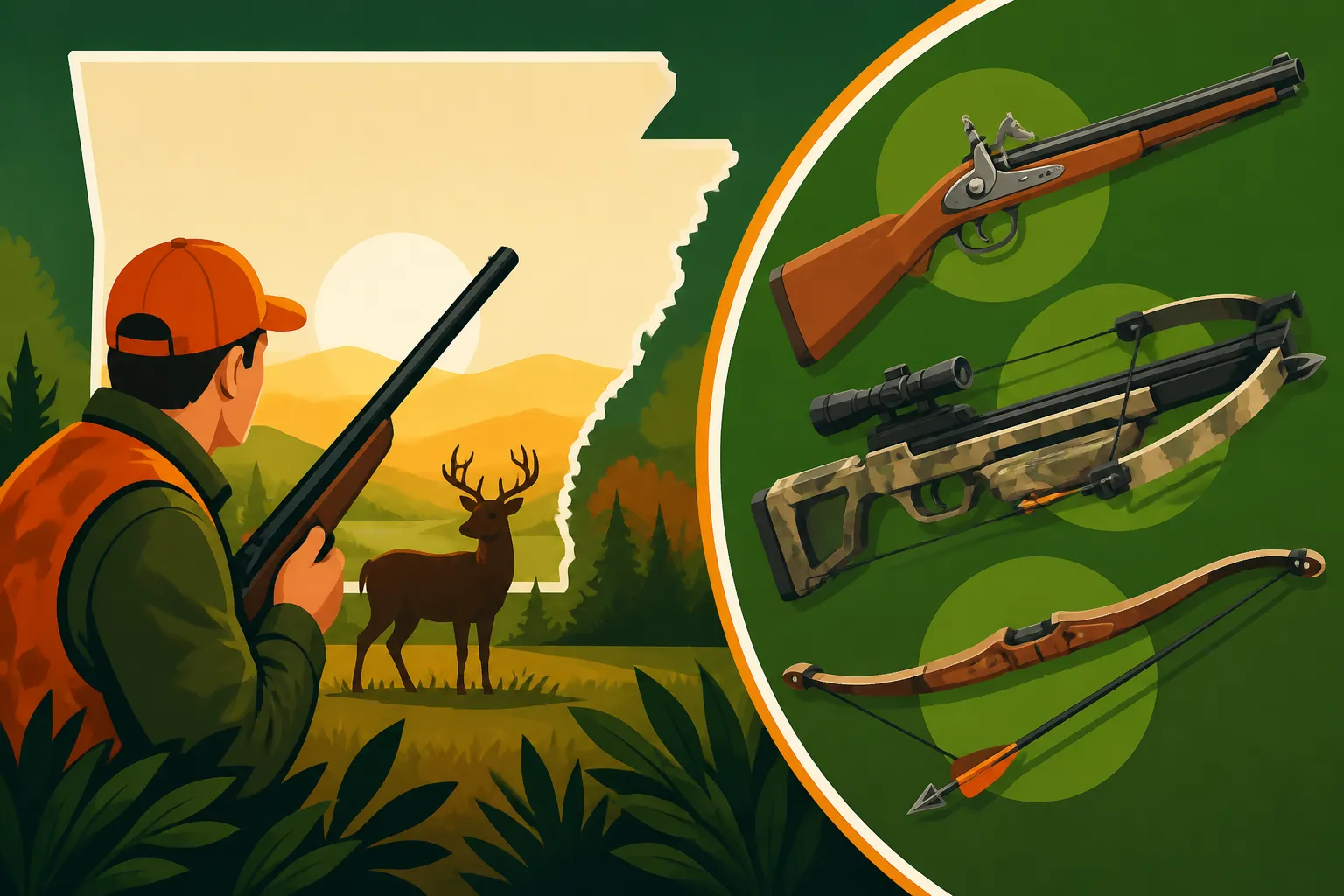
What Counts as an Alternative Firearm
It's easy to get tangled up in the specific rules and regulations that govern hunting in Arkansas, especially when you step outside the well-known archery and modern gun seasons. Many hunters wonder about those "other" seasons and the firearms permitted, leaving them scratching their heads about what exactly counts as an "alternative firearm." This guide aims to clear up that confusion, giving you a crystal-clear understanding of what these unique firearm categories entail, why they're part of our hunting heritage, and how you can participate safely and legally.
Unpacking the Definition of Alternative Firearms in Arkansas
When the Arkansas Game and Fish Commission (AGFC) talks about "alternative firearms," they're referring to a distinct set of weapon types that offer a different hunting experience compared to your standard centerfire rifle. These aren't just arbitrary distinctions; they're designed to either extend hunting opportunities, provide a specific challenge, or manage game populations more precisely. The goal is to ensure a fair chase while offering diverse options for hunters across the state. It's a way to keep things interesting and accessible for everyone, from the seasoned veteran looking for a new challenge to the newer hunter exploring different methods.
Muzzleloaders: The Original Alternative
For many, the mention of "alternative firearms" immediately conjures images of muzzleloaders. These classic firearms transport you back to a simpler time, demanding a different kind of discipline and approach in the woods. In Arkansas, muzzleloaders are considered alternative firearms and have their own dedicated seasons. This includes both traditional flintlock and cap-and-ball rifles, as well as the more modern in-line muzzleloaders.
When you're loading a muzzleloader, whether it's pouring black powder down the barrel and seating a patched round ball or using a pre-measured charge with a sabot bullet, you're engaging in a deliberate process that requires focus. The AGFC permits the use of muzzleloaders that are .40 caliber or larger for deer hunting. You'll typically use black powder or a black powder substitute, and the projectile must be loaded through the muzzle. These aren't your grandfather's single-shot rifle in terms of modern convenience, but they offer a profound connection to hunting history and a truly unique challenge. The range is generally more limited than a centerfire rifle, forcing you to focus on getting closer to your game, which is a thrill in itself.
Shotguns: Not Allowed This Season
While shotguns are commonly used for ducks, turkeys, small game, and deer during modern gun season, they are not part of Arkansas's alternative firearms seasons. AGFC's deer regulations state it plainly: shotguns with slugs are not allowed during alternative firearms season. If a slug gun is your main deer gun, save it for the modern gun season. Always check the current regulations to be absolutely sure.
If you hunt dense cover where long shots aren't feasible, a muzzleloader, a straight-wall cartridge firearm, or a big-bore air gun fills the same close-range role during this season. Many WMAs, for instance, limit deer hunting to shotguns, muzzleloaders, or archery equipment. Understanding these specific rules is part of being a responsible hunter, especially if you're navigating the nuances of areas like those mentioned in topics like Arkansas WMA Rules and Permits.
Air Guns for Big Game: A Growing Trend
One of the more recent additions to the "alternative firearms" category in Arkansas, and one that has sparked a lot of conversation, is the big-bore air gun. The AGFC has recognized the advancements in air gun technology and now allows certain powerful air rifles for deer and bear hunting during specific seasons. For deer, the air gun must be at least .40 caliber, while for bear, it must be .50 caliber or larger. These are not your backyard plinking guns; these are serious hunting tools capable of delivering significant energy on target.
Hunting with a big-bore air gun presents a unique set of challenges and ethical considerations. The effective range is often comparable to, or sometimes slightly less than, that of a shotgun slug, typically within 100 yards for deer. The projectiles are heavy lead pellets or slugs, propelled by compressed air. This requires careful shot placement and a deep understanding of your weapon's capabilities. Like muzzleloaders, air guns demand that hunters focus on stealth and closing the distance, adding a layer of primitive hunting skill to a modern platform. It's a rapidly evolving field, and many hunters are finding a new passion in the quiet power of these unique alternative firearms.
Other Handguns and Straight-Walled Cartridges
Beyond muzzleloaders and air guns, AGFC's list for alternative firearms season includes non-semiautomatic centerfire firearms that fire a straight-wall cartridge of .30 caliber or larger, including non-semiautomatic handguns with barrels 4 inches or longer. Cartridges such as .350 Legend, .450 Bushmaster, or .45-70 Government are straight-wall examples, as long as the firearm is not semiautomatic.
AGFC's list for alternative firearms season covers muzzleloading rifles and handguns, non-semiautomatic straight-wall centerfire firearms, and large-bore air rifles, and it notes that shotguns with slugs are not allowed. Always consult the most current AGFC hunting guide for caliber and barrel-length details. The key takeaway is that these options are generally selected for their reduced maximum range and energy compared to bottlenecked rifle cartridges, promoting safer hunting in specific environments or offering a distinct hunting challenge. For comprehensive understanding, you might want to delve into the detailed rules concerning Legal Firearms for Arkansas Deer.
Why Arkansas Embraces Alternative Firearms Seasons
The existence of alternative firearms seasons isn't just about giving hunters more toys to play with; it's a strategic move by the Arkansas Game and Fish Commission to serve several important ecological and recreational goals. These seasons play a crucial role in managing our diverse wildlife populations and ensuring that hunting remains a sustainable and cherished activity for generations to come. They also address practical concerns on both public and private lands, allowing for more flexible management.
Expanding Hunting Opportunities
One of the most immediate benefits of alternative firearms seasons is the sheer increase in hunting days available to the public. Our deer season, for instance, is already quite generous, running from September through February in various forms. But by creating specific windows for muzzleloaders and alternative firearms, the AGFC effectively extends opportunities beyond the traditional archery and modern gun periods. This is particularly valuable for hunters who might not have access to private land during modern gun season, or who prefer a less crowded experience often found outside the peak modern gun opening weekend. It allows for a more distributed harvest over a longer period, reducing pressure spikes and offering more flexibility for working individuals or those traveling to hunt. These seasons are often strategically placed between the intense early archery hunts and the modern gun rush, giving hunters a unique timeframe to be in the woods.
Balancing Hunter Experience and Game Management
Alternative firearms seasons strike a delicate balance between providing a unique challenge for hunters and achieving game management objectives. Using firearms with a more limited effective range, such as muzzleloaders or shotguns, often necessitates closer encounters with game. This can lead to a more intense and rewarding hunting experience for those seeking something beyond the long-range precision of a modern rifle. It harks back to more traditional hunting methods, requiring greater stealth, tracking skill, and patience.
From a game management perspective, these seasons allow for a controlled harvest without the potential for over-harvest that might occur if high-powered rifles were permitted continuously. They can also be used to target specific areas or populations that need additional harvest pressure, particularly antlerless deer, to maintain healthy herd dynamics. This careful segmentation of seasons, which you can see in depth by examining Arkansas Deer Seasons and Zone Limits, helps ensure the longevity of our deer herd.
Addressing Landowner and Public Land Considerations
Another significant reason for alternative firearms seasons ties into land management. On many public lands, particularly Wildlife Management Areas (WMAs) near populated areas or those with specific habitat types, the use of modern centerfire rifles may be restricted due to safety concerns or the need to manage pressure. Alternative firearms, with their inherently shorter effective ranges, can often be used safely in these environments. This allows hunters to utilize vast tracts of public land that might otherwise be off-limits for firearm hunting during certain times. Tools like the GoHunt app are invaluable for navigating public land boundaries and specific WMA regulations.
Similarly, private landowners sometimes prefer to limit the types of firearms used on their property, either for safety reasons, to control harvest, or to maintain a certain quality of hunting experience. The existence of alternative firearms seasons provides a framework for these preferences, allowing hunters to access private land with weapons that align with the landowner's comfort level. It's a pragmatic solution that fosters cooperation between hunters and landowners, while ensuring responsible and safe hunting practices throughout the state.
Practical Considerations for Alternative Firearms Hunting
Switching to an alternative firearm isn't just about knowing what's legal; it's about understanding how these different tools perform and what strategies you need to employ to be successful. Whether you're picking up a muzzleloader for the first time or planning to hunt deer with a shotgun, there are some key practical considerations that will enhance your experience and effectiveness in the field.
Ammunition, Ballistics, and Effective Range
One of the biggest differences with alternative firearms is their ballistic profile. Unlike high-velocity centerfire rifle cartridges, muzzleloader projectiles, straight-wall cartridge bullets, and air gun slugs travel at lower velocities and typically have more arch in their trajectory. This translates directly to a reduced effective range.
- Muzzleloaders: A well-tuned muzzleloader can be effective out to 150-200 yards, especially with modern in-lines and sabot bullets. However, many hunters limit their shots to within 100-125 yards for ethical reasons and higher certainty of shot placement. Understanding your specific powder charge and bullet combination is crucial. You need to meticulously test different loads to find what shoots best out of your rifle, and practice shooting at various distances.
- Straight-Wall Cartridges: Non-semiautomatic firearms in straight-wall cartridges of .30 caliber or larger fire heavy, relatively slow bullets that drop faster than bottlenecked rifle rounds, so know your range. Shotgun slugs are not allowed during alternative firearms season. Again, testing is paramount. What works in one firearm might not work in another.
- Big-Bore Air Guns: These powerful air rifles are typically most effective within 50-75 yards for deer, with some setups capable of ethical shots out to 100 yards under ideal conditions. The heavy, slow-moving slugs are affected significantly by wind and trajectory drop, making precise range estimation and understanding holdovers vital.
Regardless of the alternative firearm you choose, know your effective range. Don't push shots beyond what you and your firearm can consistently and accurately deliver. Ethical hunting demands that you make clean, quick kills, and that starts with understanding your equipment's limitations. For those thinking about getting into this, detailed information can be found in Arkansas Muzzleloader and Alternative Firearms Tactics.
Optics, Sighting, and Zeroing
Proper sighting is critical for any firearm, but it takes on added importance with the unique ballistics of alternative firearms. Many hunters choose to equip their alternative firearms with optics to improve accuracy.
- Muzzleloaders: While some traditionalists prefer open sights, a low-power scope (e.g., 1-4x, 2-7x, or a fixed 3x or 4x) is a popular choice for in-line muzzleloaders. It aids in target acquisition in low light and improves precision. Ensure your scope is rated for the recoil of a muzzleloader, which can be stout.
- Straight-Wall Firearms: A low-power variable or fixed power scope works well. Consider a scope with a large field of view for quick target acquisition. Red dot sights are also an excellent choice, offering fast aiming within their effective range.
- Big-Bore Air Guns: These typically benefit greatly from a scope, often one designed for air guns that can focus at closer ranges (parallax adjustment). Due to the pronounced trajectory curve, scopes with ballistic reticles or turrets designed for holdover adjustments are particularly useful.
Zeroing your alternative firearm requires the same diligence as a modern rifle, but with an emphasis on confirming accuracy at various close ranges. You might zero a straight-wall cartridge firearm at 75 yards, but then verify your point of impact at 25 and 100 yards. For air guns, you might have to consider a "battle zero" that allows for minimal holdover within your ethical range, knowing that the projectile will rise and fall significantly.
Here's a quick comparison of popular alternative firearm types:
| Firearm Type | Common Caliber/Gauge | Projectile Type | Effective Deer Range (Avg.) | Key Advantage | Key Challenge |
|---|---|---|---|---|---|
| Muzzleloader (In-Line) | .50 cal | Sabot/Conical | 125-200 yards | Historical feel, good accuracy | Reloading time, weather sensitivity |
| Muzzleloader (Traditional) | .50 cal | Patched Round Ball | 50-100 yards | Deep tradition, simple mechanics | Limited range, demanding skill |
| Straight-Wall Centerfire (non-semiauto) | .30 cal or larger | Expanding Bullet | 100-150 yards | Powerful, common firearm | Heavy recoil, limited range |
| Shotgun (any) | Any gauge | Slug | Not allowed | None this season | Not legal during alternative firearms season |
| Big-Bore Air Gun | .40 cal (deer), .50 cal (bear) | Heavy Lead Slug/Pellet | 50-100 yards | Low noise, unique challenge | Air tank management, steep trajectory |
Safety, Handling, and Hunter Orange Rules
Safety is paramount with any firearm, and alternative firearms have their own specific protocols. For example, muzzleloader safety involves careful powder handling, ensuring no double-loads, and always pointing the muzzle in a safe direction, even when unloaded. Air guns, despite their "air" moniker, are powerful weapons and must be treated with the same respect as any firearm.
In Arkansas, hunter orange requirements apply during modern gun and alternative firearms seasons, especially on public lands. This means wearing at least 400 square inches of hunter orange above the waist, visible from all sides. This is a non-negotiable rule designed to maximize safety in crowded hunting conditions. Even if you're on private land, it's a good practice, especially if others might be hunting nearby. Familiarize yourself with all the nuances of Arkansas Hunter Orange Rules before heading out.
Scouting and Strategy for Close Encounters
Hunting with an alternative firearm often means you need to get closer to your quarry. This requires a shift in scouting and hunting strategy.
- Enhanced Scouting: Your scouting needs to be even more meticulous. Identify bedding areas, natural funnels, and food sources that allow for closer approaches. Knowing the terrain inside and out, perhaps using a detailed mapping service like GoHunt, is critical. Look for pinch points where deer are funneled into smaller areas, increasing your chances of a close shot.
- Stealth and Wind: Because you're trying to get within 100 yards, your scent control, movement, and understanding of wind direction become incredibly important. Pay extra attention to wind thermals in hilly terrain.
- Stand Placement: Your stand or blind placement should optimize for closer shots, taking into account prevailing winds and expected deer travel paths. A quick, ethical shot is the goal, so make sure your setup provides clear lanes within your effective range.
- Tracking: Even with a clean shot, tracking can be challenging. Knowing how to efficiently track a deer, especially in varied Arkansas terrain, is a skill that becomes even more vital when using firearms with potentially less kinetic energy transfer than a high-powered rifle. For more tips on this, consider reading Scouting Arkansas Public Land Before Season.
By understanding what truly counts as an alternative firearm and adapting your approach accordingly, you can unlock new hunting experiences in Arkansas. These seasons are a testament to our state's rich hunting heritage and a commitment to providing diverse opportunities for all sportsmen and sportswomen.
Disclaimer
Please remember that hunting regulations can change. Always consult the most current Arkansas Game and Fish Commission (AGFC) hunting regulations guide before heading afield to ensure you are fully compliant with all laws and season dates. This information is intended for general guidance only and should not replace official regulations.