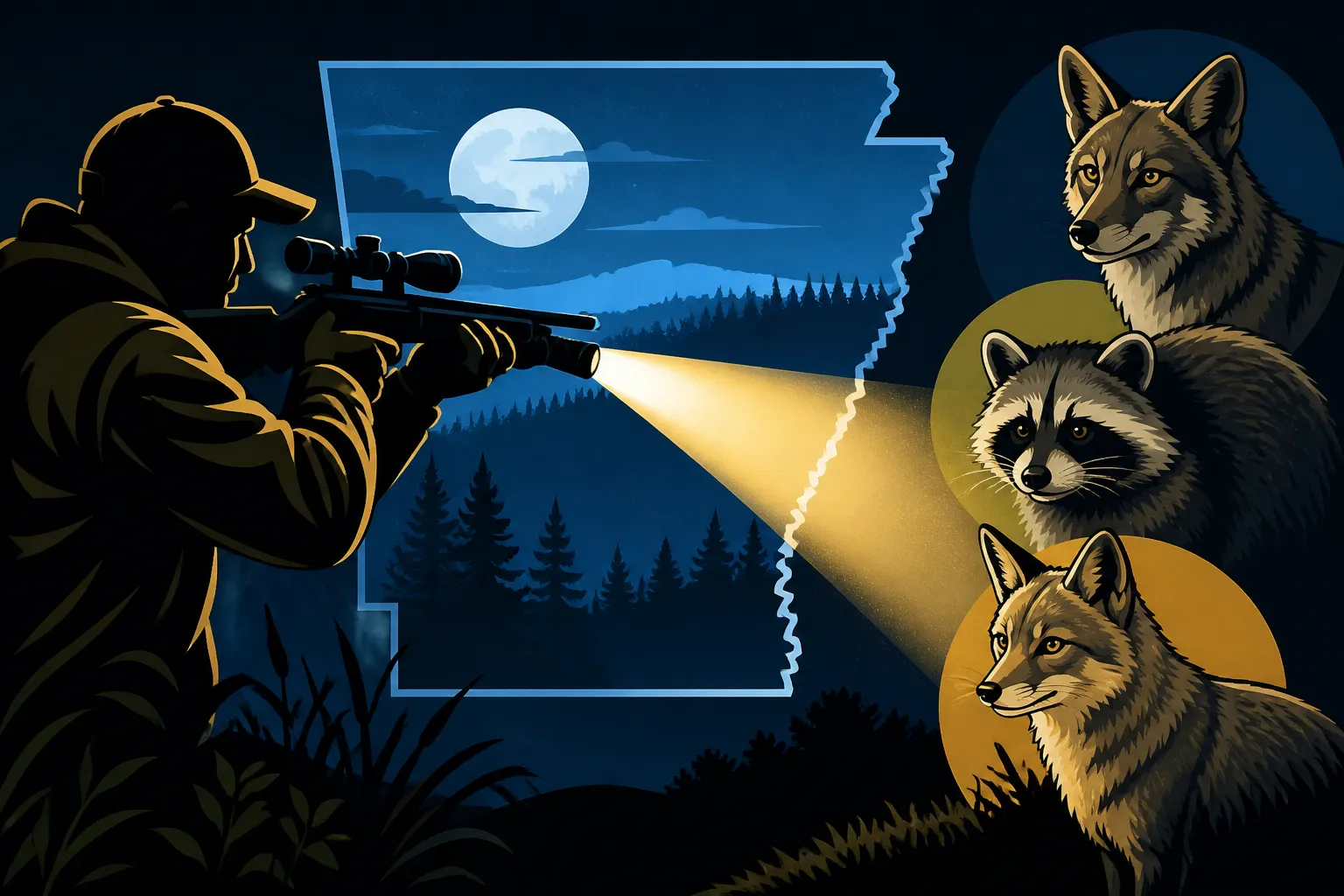
Night Hunting Rules for Arkansas Predators
The darkness of an Arkansas night holds a unique allure for hunters, a realm where different senses take over and common daytime game retreats. For many, the chance to pursue cunning predators under the cloak of stars is an exciting, yet often confusing, prospect. The rules for night hunting are distinct, and frankly, it can be a real headache to sort through the Arkansas Game and Fish Commission (AGFC) regulations to understand exactly what’s legal and what’s not, especially when it comes to using artificial lights, night vision, or thermal optics. This guide aims to clear up that confusion, offering a realistic look at how to navigate night hunting for predators in our great state, ensuring you stay legal, safe, and effective.
The Allure and Challenge of Night Hunting Arkansas Predators
There's something undeniably captivating about hunting when the sun dips below the horizon. The world transforms, sounds become sharper, and the animals that thrive in the shadows emerge. For many Arkansas hunters, this shift opens up entirely new opportunities, especially when it comes to managing and pursuing predator species.
Why Hunters Turn to the Cover of Darkness
The primary drivers for night hunting predators in Arkansas often boil down to necessity and opportunity. Coyotes, in particular, are incredibly intelligent and elusive animals that can be highly active after dark. Farmers and landowners grappling with livestock depredation or impacts on deer and turkey populations often find that daytime hunting simply isn't enough to curb coyote numbers. Night hunting allows them to capitalize on these animals' nocturnal habits. Beyond nuisance control, the challenge itself is a huge draw. Successfully calling in a bobcat under the glow of a red light or spotting a coyote with thermal imaging requires a different skillset and level of stealth, offering a profound sense of accomplishment.
It’s not just about the thrill, though. For furbearers like raccoons and opossums, night hunting is a long-standing tradition, often involving hounds and the distinct sound of a baying dog trailing game through river bottoms. This method of Raccoon Hunting at Night in Arkansas connects hunters to a rich cultural heritage while providing sport and, for some, valuable furs. The cooler temperatures of night, especially in the early and late seasons, can also make the experience more comfortable for both hunter and dog.
The Unique Thrill and Ethical Considerations
The thrill of night hunting is undeniable. Imagine sitting in complete darkness, every sense on high alert, listening to the subtle rustle of leaves or the distant howl of a coyote. Then, a pair of eyes reflects back from your spotlight, piercing the blackness. That moment, when the game reveals itself, is incredibly intense. However, with this heightened excitement comes a greater responsibility. Ethical considerations are paramount. Shooting a target that is only partially illuminated or seen through an optic requires absolute confidence in identification and a clear understanding of the backdrop.
One major concern is ensuring a humane kill. Reduced visibility can make shot placement more challenging, which is why understanding your equipment and practicing extensively in varying light conditions is crucial. Moreover, the public perception of night hunting can sometimes be negative, fueled by misconceptions or past abuses. As responsible hunters, it's vital to conduct ourselves with the utmost respect for wildlife and private property. This means strictly adhering to legal shooting hours, knowing exactly what's behind your target, and always being prepared to recover game efficiently. Tools like detailed digital maps, such as those offered by GoHunt, become even more critical at night, helping you verify property lines and plan safe shot angles before you even step into the field.
Deciphering Arkansas's Specific Night Hunting Regulations
Navigating the Arkansas hunting regulations can sometimes feel like trying to untangle a stubborn fishing line, especially when it comes to the nuances of night hunting. The rules vary depending on the species you're pursuing and the type of equipment you're using. Getting it wrong can lead to serious legal trouble, so understanding these specifics is non-negotiable.
Legal Hours and Permitted Species for Night Hunting
In Arkansas, the general rule is that legal hunting hours for most game animals run from 30 minutes before sunrise to 30 minutes after sunset. However, predators and certain nuisance species are notable exceptions to this rule, allowing for legitimate night hunting opportunities.
When it comes to coyotes and feral hogs, you have the green light to hunt them 24 hours a day, year-round. This is a huge advantage for hunters and landowners alike, as both species can cause significant damage to native wildlife populations and agricultural interests. There's no closed season or bag limit for either, reflecting the state's aggressive management approach to these animals. This means if you're out calling for deer or turkeys and a coyote comes in, you can ethically and legally take it, even if it’s outside standard deer or turkey hunting hours, provided you are otherwise in compliance with all regulations. For those interested in year-round pursuit, this flexibility is a game-changer.
For furbearers such as raccoons, opossums, bobcats, red foxes, gray foxes, striped skunks, beavers, nutria, and weasels, night hunting is also permitted, but it falls within specific furbearer seasons. These seasons are generally quite long, often starting in late fall and extending through winter. For example, the season for taking raccoons and opossums by hunting or trapping typically runs from September into March, allowing ample time for nocturnal pursuits. You'll need to confirm the exact dates each year as they can shift slightly. While these animals are nocturnal by nature, you can hunt them during daylight hours during their respective seasons as well. Always consult the current AGFC Furbearer Regulations to ensure you're within the legal window. If you're looking for more general information, checking out our guide on Predator and Furbearer Hunting in Arkansas can provide a broader overview.
Restrictions on Artificial Lights and Equipment
This is where many hunters get tripped up, as the regulations regarding artificial lights, night vision, and thermal imaging are quite specific and species-dependent.
For coyotes and feral hogs, the rules are very accommodating. You may use artificial lights, night vision devices, and thermal imaging equipment to hunt these species at night. This means you can mount a powerful spotlight on your rifle, wear night vision goggles, or scan the landscape with a thermal imager to locate and identify your target. This level of technology is crucial for effective and ethical hunting of these wary animals after dark.
However, for furbearers like raccoons, opossums, bobcats, and foxes, the rules are slightly different. You can use artificial lights, including handheld or weapon-mounted lights, to hunt these species by still-hunting or stalking during both daylight and nighttime hours of their open season. This allows for traditional coon hunting with a headlamp or a rifle-mounted light. What's important to note here is the omission of night vision and thermal imaging for furbearers in the same clause that permits them for coyotes and feral hogs. This implies that while artificial white lights (or colored lights like red or green) are fine for furbearers at night, advanced night vision and thermal optics are explicitly restricted to hunting coyotes and feral hogs after dark. This distinction is critical to avoid violations. Always double-check the latest AGFC code for the most current legal interpretations.
Understanding Public vs. Private Land Rules
The ground you hunt on can drastically change the rules for night hunting. Arkansas is blessed with vast expanses of public land, including Wildlife Management Areas (WMAs), National Forests (Ozark and Ouachita), and National Wildlife Refuges. However, these public lands often have more restrictive rules than private property.
Private Land: On private land, with the landowner's permission, you generally have the most flexibility, adhering only to the statewide AGFC regulations for species, seasons, and equipment. For many night hunters, securing good private land access is key, especially for targeting coyotes that impact livestock or deer populations. Always get explicit permission from the landowner, and clarify any specific rules they might have regarding night hunting on their property. This is also where an app like GoHunt becomes incredibly useful, allowing you to instantly verify property lines and ensure you're not encroaching on a neighbor's land in the dark.
Public Land: This is where you need to exercise extreme caution and diligence. Most WMAs and National Forests in Arkansas have blanket prohibitions against night hunting, or they may have very specific, limited exceptions. For instance, some WMAs might allow night hunting for feral hogs under a specific permit or during certain periods, but generally, hunting outside of typical daylight hours is forbidden. You cannot assume that just because you can hunt coyotes at night statewide, you can do so on any WMA. Every WMA has its own set of detailed regulations, often listed in a pamphlet or on the AGFC website specific to that area. It's not enough to know the statewide rules; you absolutely must know the WMA-specific rules. For example, while Scouting Arkansas Public Land Before Season is crucial for any type of hunting, it's even more vital for night hunting to understand access points, potential regulations, and safe zones. Disregarding these WMA-specific rules can result in citations, fines, and even loss of hunting privileges.
For clarity, here's a quick summary of the primary regulations for night hunting predators in Arkansas:
| Species | Legal Night Hunting | Artificial Lights Allowed? | Night Vision/Thermal Allowed? | General Season |
|---|---|---|---|---|
| Coyote | Yes | Yes | Yes | Year-Round |
| Feral Hog | Yes | Yes | Yes | Year-Round |
| Raccoon | Yes | Yes | No (only artificial lights) | Furbearer Season (Sept-Mar) |
| Opossum | Yes | Yes | No (only artificial lights) | Furbearer Season (Sept-Mar) |
| Bobcat | Yes | Yes | No (only artificial lights) | Furbearer Season (Nov-Feb) |
| Fox (Red/Gray) | Yes | Yes | No (only artificial lights) | Furbearer Season (Sept-Mar) |
| Skunk/Beaver/Nutria | Yes | Yes | No (only artificial lights) | Furbearer Season (Various) |
Disclaimer: This table is a general summary. Always consult the most current Arkansas Game and Fish Commission regulations before hunting.
Essential Gear and Responsible Practices for Night Hunters
Successfully and ethically hunting predators at night goes far beyond just knowing the regulations; it requires specialized gear, a commitment to safety, and a deep understanding of your capabilities and the environment.
Navigating Night Vision, Thermal, and Artificial Lights
The technology available to night hunters has advanced dramatically, offering incredible capabilities but also requiring careful consideration of legality and application.
Artificial Lights: For furbearers and, of course, coyotes and hogs, a good artificial light is indispensable. This can range from a simple headlamp for hands-free mobility to powerful weapon-mounted lights or spotlights that can illuminate targets hundreds of yards away. Many hunters prefer red or green lights, as these colors are less disruptive to human night vision and are often believed to be less alarming to nocturnal animals than bright white light. Companies like Lightforce or Coyote Light offer excellent options tailored for predator hunting. The key is to have enough power to identify your target positively, gauge distance, and make an ethical shot without over-illuminating and spooking the animal. Always ensure your light source is durable, has good battery life, and can withstand the elements, because Arkansas weather can be unpredictable.
Night Vision Devices: For hunting coyotes and feral hogs, night vision provides a distinct advantage by amplifying ambient light (starlight, moonlight) to create a green-tinted image. This allows for relatively natural vision in near-dark conditions. Entry-level digital night vision scopes are becoming increasingly affordable, while Gen 2 and Gen 3 analog tubes offer superior clarity and performance. Night vision requires some ambient light to function well, so heavily overcast nights or deep timber can limit its effectiveness. However, on clear nights, it can be incredibly useful for scanning, tracking, and target acquisition.
Thermal Imaging Devices: Perhaps the most game-changing technology for night hunting coyotes and feral hogs is thermal imaging. Unlike night vision, thermal does not rely on light but instead detects heat signatures. This means it can "see" animals through complete darkness, light fog, or even light brush, making it incredibly effective for locating well-camouflaged predators. A thermal scanner or monocular is excellent for surveying an area and spotting animals that would otherwise be invisible. A thermal rifle scope then allows for precision shooting. Thermal optics are generally more expensive but offer unparalleled detection capabilities, especially in situations where animals are trying to conceal themselves.
Regardless of the technology you choose, practice is paramount. Get comfortable with your equipment in low-light conditions, understand its limitations, and zero your optics precisely under conditions as close to actual night hunting as possible.
Safety Protocols and Ethical Shot Placement
Night hunting introduces unique safety challenges that demand strict adherence to protocols. The first and most critical rule is positive target identification. In the dark, sounds can be deceiving, and shapes can be misleading. Never, ever take a shot unless you are 100% certain of what you are shooting at and what lies beyond it. This means using your optics to confirm not just that it's a coyote, but that it's clear of fences, livestock, or other hazards.
- Backdrop Awareness: Always be aware of your backdrop. A hill, a thick tree line, or a safely open field are ideal. Never shoot towards roads, buildings, or other areas where a stray bullet could cause harm.
- Buddy System: When possible, hunt with a partner. One person can operate the light or scanner while the other is on the gun. This enhances safety and efficiency. Establish clear communication signals beforehand.
- Firearm Handling: Treat all firearms as if they are loaded. Keep the muzzle pointed in a safe direction at all times, even when scanning with lights. Only chamber a round when you are ready to shoot and have positively identified your target.
- Shot Placement: Aim for vital organs to ensure a quick, humane kill. Practice shooting in low light to understand how your specific optics and firearm perform. Remember, an ethical kill is the hallmark of a responsible hunter. Even though coyotes are often considered nuisance animals, they deserve the same respect as any other game.
These safety measures are not just recommendations; they are critical for preventing accidents and maintaining the integrity of hunting as a sport.
Managing Public Perception and Wildlife Stewardship
Night hunting can sometimes be misunderstood by the non-hunting public, so it's essential for us to be good ambassadors for the sport. This means conducting ourselves in a way that reflects positively on hunting. Avoid shining lights into people's homes or across public roads unnecessarily. Be discreet and respectful, especially when accessing private land near residential areas.
Furthermore, being a good wildlife steward involves more than just adhering to laws. It means understanding the role predators play in the ecosystem. While managing coyote populations can benefit deer and turkey numbers, it's about balance. For specific information on how you might contribute to understanding local wildlife, reviewing articles like How AGFC Counts Deer and Turkeys can provide insight into the biological data collection efforts that inform state management decisions.
Responsible night hunting also includes efficient game recovery. Even in the dark, you have an obligation to find and retrieve any animal you shoot. This might mean using tracking lights, a good dog (if permitted), or returning at first light. Leaving game unrecovered is unethical and can damage the reputation of all hunters. By prioritizing safety, ethics, and respect, we can ensure that night hunting remains a valuable and accepted part of Arkansas's hunting tradition.
Common Arkansas Predators and Night Hunting Strategies
Arkansas is home to a variety of predators and furbearers that offer exciting night hunting opportunities. Understanding their habits and the specific strategies that work best after dark is key to consistent success.
Coyotes: A Year-Round Challenge Under the Stars
Coyotes are perhaps the most popular target for night hunters in Arkansas, and for good reason. They are intelligent, adaptable, and incredibly numerous across the state, from the Delta farmlands to the Ozark mountains. Their impact on local deer, turkey, and small game populations, as well as livestock, makes them a year-round management priority for many.
Night hunting for coyotes often revolves around calling. Electronic callers, such as those from Foxpro or Primos, are highly effective, offering a wide range of vocalizations from distress calls (rabbit, fawn, bird) to coyote howls and barks. The key is to set up quietly, often against a dark backdrop or in a strategic ambush point near known travel corridors or feeding areas. Using a thermal scanner to sweep the area before and during calling can reveal approaching coyotes that might otherwise go undetected. Once a coyote is spotted, whether through thermal or by picking up eye shine with a red light, a quick, ethical shot is paramount. Many hunters prefer a .223 Remington, .22-250 Remington, or similar flat-shooting, accurate cartridge for night work. In some areas, shotgun hunting with heavy loads of buckshot can also be effective at closer ranges, especially in thick cover. Understanding Coyote Calling in Arkansas Farm Country can give you a leg up, even when applying those tactics under the cover of darkness. Remember, patience is crucial; some coyotes will respond quickly, while others may circle downwind or approach very cautiously.
Raccoons and Opossums: Fur Bearers of the Night
Raccoons and opossums are quintessential nocturnal animals, and hunting them at night, often with hounds, is a time-honored tradition in Arkansas. These species are abundant, particularly in the state's bottomland hardwood forests and along creek and river drainages.
Raccoon Hunting: This usually involves a pack of well-trained coonhounds. The dogs are released in likely raccoon habitat, where they pick up a scent and track the animal, typically to a tree. The sound of a "treed" dog is unmistakable, and hunters then locate the dogs, often using GPS collars, and shine a light up the tree to locate the raccoon. A .22 caliber rimfire rifle is a common and effective choice for dispatching treed raccoons. For those who enjoy the camaraderie and tradition of hound hunting, chasing raccoons and opossums under the moonlit canopy is a deeply rewarding experience. Ensuring your dogs are properly licensed and that you adhere to all Arkansas Furbearer Permit Rules is crucial before heading out.
Opossum Hunting: Opossums are often taken incidentally during raccoon hunts, as they share similar habitats and nocturnal habits. They are less wary than raccoons and tend to be easier to tree. While not as sought after for fur as raccoons, they offer additional opportunities for those out with their hounds. Both species can be hunted by still-hunting or stalking with artificial lights, though hound hunting is by far the most traditional and successful method.
Bobcat Opportunities and the Role of Calling
Bobcats are elusive and beautiful furbearers that present a significant challenge for night hunters. While not as numerous as coyotes or raccoons, they offer a thrilling hunt for those dedicated enough to pursue them. Their primary season typically runs from early November to late February, giving hunters a solid window to target them.
Like coyotes, bobcats respond well to calling, especially distress calls that mimic small prey animals like rabbits or birds. However, bobcats tend to be much more cautious and less likely to charge in aggressively. They often sneak in silently, using cover, so constant scanning with an artificial light is essential. Setting up near thick cover, such as brush piles, dense timber edges, or natural travel corridors, can increase your chances. A quiet approach and minimal movement are vital, as a bobcat's senses are incredibly keen. For detailed strategies, refer to our guide on Bobcat Hunting in Arkansas, many of which can be adapted for night hunting with the appropriate lighting. Because bobcats are generally less common and harder to call in, patience is key. Sometimes, an hour or more of calling in one spot might be necessary to entice a wary cat to show itself.
Whether you're targeting the cunning coyote, the traditional raccoon, or the elusive bobcat, night hunting in Arkansas offers a unique and challenging experience. By understanding the regulations, utilizing the right gear, and practicing responsible hunting ethics, you can safely and successfully pursue these nocturnal predators.
Disclaimer
Please remember that hunting regulations can change. It is your sole responsibility to consult the most current Arkansas Game and Fish Commission (AGFC) regulations and local ordinances before engaging in any hunting activity. This guide is for informational purposes only and should not be considered legal advice. Always prioritize safety and ethical hunting practices.