Arkansas WMAs With the Most Acres
It's incredibly frustrating, isn't it, when you pull into a public hunting access point in Arkansas, only to find a dozen other trucks already there, all aiming for the same little patch of woods? It feels like the truly expansive, get-away-from-it-all hunting experiences are harder and harder to find. But don't despair! Arkansas still boasts some incredibly vast Wildlife Management Areas (WMAs) and national forest lands that, when combined, offer thousands upon thousands of acres for you to explore and hunt. This guide is all about helping you pinpoint those colossal tracts and understand how to make the most of hunting these immense landscapes.
Why Acreage Matters on Public Land Hunts
For many of us, the appeal of hunting goes beyond just the harvest; it's about solitude, about truly immersing ourselves in nature, and about the challenge of finding game in wild places. Smaller public land parcels, while valuable, often can't deliver that feeling of wilderness. That's where the sheer size of a WMA truly shines.
Escaping the Crowds and Pressure
Imagine walking for a mile or two, sometimes even three or four, from your truck without seeing another boot print or hearing another human voice. That's the dream, right? On smaller tracts, or even on highly accessible parts of larger WMAs, that's often just not possible. You'll run into other hunters, hear distant shots, and feel the constant hum of human activity. This pressure can significantly alter game behavior, making deer more nocturnal, ducks more wary, and turkeys more tight-lipped.
On an expansive WMA, the sheer amount of ground allows hunters to spread out. While popular access points might still see some traffic, the further you're willing to walk, paddle, or even crawl, the more likely you are to find those untouched pockets of habitat where game animals feel more secure. This isn't just about avoiding other people; it's about finding game that behaves more naturally, offering a more rewarding and authentic hunting experience. It demands more effort, sure, but the payoff of knowing you're hunting an area few others reach is immense. For more on navigating public land crowds, check out Hunting Pressure on Arkansas WMAs.
Diverse Habitats and Strategic Opportunities
Another huge advantage of hunting the largest WMAs is the incredible diversity of habitat you'll encounter. A small 500-acre parcel might be mostly pine plantation or a single type of bottomland. But a WMA spanning tens of thousands of acres? That's where you'll find a mosaic of ecosystems. You could start your morning in an old-growth hardwood bottom, transition through a dense pine thicket by midday, and finish your hunt on a brushy ridgetop or along a creek bed.
This variety means a wider array of food sources, bedding areas, and travel corridors, which in turn supports a healthier, more robust game population. For the strategic hunter, it means more options. If deer aren't moving in the hardwoods, perhaps they're tucked away in a thick clearcut. If ducks aren't hitting one section of flooded timber, maybe a different stand of cypress farther back holds them. This also often means opportunities to pursue multiple species within the same general area, from deer and turkey to small game and sometimes even bear. Understanding the lay of the land, and how different habitat types connect, becomes a crucial part of your strategy, allowing you to adapt to changing conditions and game behavior.
Top Arkansas WMAs by Sheer Size
When we talk about the "largest" WMAs, it's important to remember that some of Arkansas's biggest public hunting grounds are a mix of dedicated WMAs and expansive national forests that function very similarly, or even contain designated WMAs within their boundaries. These are the places where you can truly get lost in the woods (sometimes literally, so bring a map!).
Ouachita National Forest (Various WMAs Within)
While not a single WMA, the Ouachita National Forest is a colossal hunting ground that hosts several large WMAs within its vast expanse. Stretching across western Arkansas and into Oklahoma, this area encompasses hundreds of thousands of acres of rugged, mountainous terrain dominated by pine and mixed hardwood forests. WMAs like Winona, Muddy Creek, and Caney Creek Wilderness Area are all part of this larger national forest system, offering incredible opportunities for deer, bear, and turkey hunting. The sheer scale means you can hike miles into remote valleys and ridges, finding spots that rarely see human disturbance.
Hunting here is often physically demanding, with steep climbs and descents, but it offers a true wilderness experience. Expect mature timber, clear-cut regeneration, and winding creeks. Deer densities might not be as high as in the Delta, but the chance at an older, wiser buck, or a black bear, is very real. For a deep dive into hunting this region, check out Ouachita National Forest Hunting.
Ozark National Forest (Various WMAs Within)
Much like the Ouachitas, the Ozark National Forest in northern Arkansas provides an enormous public hunting playground. It’s characterized by steep, rocky bluffs, deep hollows, and hardwood forests mixed with some pines. WMAs such as White Rock, Sylamore, and Gene Rush (which includes the elk herd range) are embedded within this vast forest. These areas together offer incredible opportunities for deer, turkey, and even a chance at an elk permit if you're lucky enough to draw one.
The terrain here is notoriously challenging, but it's exactly this ruggedness that keeps many hunters out, creating pockets of less-pressured game. You'll find yourself navigating rocky stream beds, climbing to scenic overlooks, and descending into hidden hollows. Learning to read the subtle features of the terrain, like benches and saddles, is key to success here. For more insights on the varied hunting areas, take a look at Ozark National Forest Hunting.
Dave Donaldson Black River WMA
Located in northeast Arkansas, Dave Donaldson Black River WMA is a prime example of a massive Delta WMA, spanning tens of thousands of acres. While widely renowned for its world-class duck hunting in flooded timber, it also offers exceptional deer hunting in the hardwoods that define the region. The WMA is a complex mosaic of bottomland hardwood forests, sloughs, and cypress swamps, all subject to natural flooding patterns of the Black River.
Hunting deer here often means dealing with water, mud, and thick cover, but the area's rich environment supports a healthy deer population. Access can be challenging, often requiring boats or extensive wading, especially during the wetter parts of the season. This difficulty, however, contributes to its wilderness feel and keeps some of the pressure at bay. Arkansas Delta WMAs and Green Timber is an excellent resource if you're planning a trip to this part of the state.
Bayou Meto WMA
Perhaps the most famous WMA in Arkansas, Bayou Meto is globally recognized for its incredible duck hunting. While often associated with waterfowl, its immense acreage, particularly in areas like the WMA's north and south units, also holds good populations of deer and small game. It's a vast expanse of green timber and sloughs, primarily managed for ducks, but offering rugged terrain for the determined deer hunter.
Navigating Bayou Meto can be an adventure in itself, with extensive wading and boat use common. The sheer size of the WMA means you can often find unpressured spots if you're willing to put in the effort to get away from the main thoroughfares. Just be prepared for the distinctive environment of the Delta.
Other Notable Large Tracts
While the national forests and their embedded WMAs represent the largest contiguous public hunting lands, several other significant WMAs stand out for their size:
- Trusten Holder WMA: Located in southeast Arkansas, this WMA offers substantial acreage of bottomland hardwoods, sloughs, and agricultural fields. It's a fantastic spot for deer and small game, with some excellent duck hunting opportunities.
- Rex Hancock Black Swamp WMA: Another significant Delta WMA in northeast Arkansas, this area is characterized by its bottomland hardwoods and cypress-tupelo sloughs. It offers great deer hunting and is a prime spot for waterfowl and small game.
- Dale Bumpers White River National Wildlife Refuge: Though a National Wildlife Refuge rather than a WMA, it operates under similar public access rules and offers a massive hunting footprint. Running for miles along the White River in the Delta, it's famous for its deer hunting in the bottomland hardwoods and legendary duck hunting.
| WMA Name (or Forest System) | Estimated Acreage (Public Hunting) | Primary Hunting Opportunities | Notable Features |
|---|---|---|---|
| Ouachita National Forest WMAs | 1.8 million (total forest) | Deer, Bear, Turkey, Small Game | Rugged mountains, pine/hardwood forests, challenging terrain |
| Ozark National Forest WMAs | 1.2 million (total forest) | Deer, Turkey, Bear, Elk (permit draw) | Steep bluffs, hollows, rocky terrain, wilderness areas |
| Dave Donaldson Black River WMA | ~25,000 | Duck, Deer, Small Game | Flooded timber, bottomland hardwoods, sloughs |
| Bayou Meto WMA | ~33,000 | Duck, Deer, Small Game | Green timber, intricate water systems, globally renowned for waterfowl |
| Trusten Holder WMA | ~13,000 | Deer, Small Game, Duck | Bottomland hardwoods, agricultural fields, river access |
| Rex Hancock Black Swamp WMA | ~12,000 | Deer, Small Game, Duck | Bottomland hardwoods, cypress-tupelo sloughs |
Note: Acreage figures are approximate and subject to change based on specific unit designations and management decisions. Always check current AGFC regulations for precise boundaries and rules.
Maximizing Your Hunt on Expansive WMAs
Hunting vast public lands isn't just about showing up; it's about smart planning, diligent scouting, and understanding how to use modern tools to your advantage.
Leveraging Mapping Technologies for Scouting
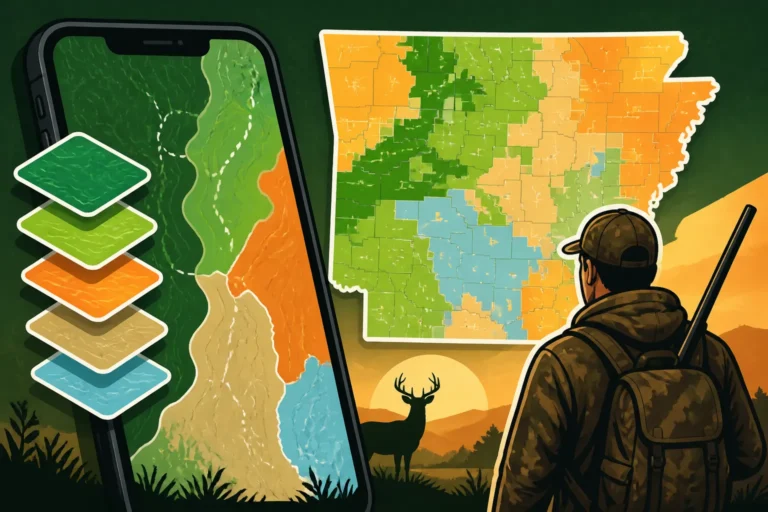
Gone are the days when a paper map and compass were your only navigation tools. While still excellent skills to have, digital mapping apps have revolutionized how we approach public land hunting, especially on large WMAs. Tools like onX Hunt and GoHunt are invaluable. These platforms allow you to:
- Identify Public/Private Boundaries: Crucial for staying legal on the edges of massive WMAs, ensuring you don't inadvertently trespass.
- Analyze Topography: Understand elevation changes, saddles, ridges, and hollows, which are key for predicting game movement, especially in the Ozarks and Ouachitas.
- Scrutinize Satellite Imagery: Look for subtle habitat changes, potential food sources (like oak flats), water sources, bedding thickets, and travel corridors. Reading Aerial Photos for Delta Deer can offer specific tips. You can spot old logging roads or faint trails that might not be visible on a topographic map.
- Track Your Movements: Use the app's GPS to mark your vehicle, stand locations, sign you find (scrapes, rubs, tracks), and your route in and out. This is a lifesaver when trying to navigate back to your vehicle in the dark after a long walk in the woods.
A real-life scenario might involve using onX Hunt to identify a remote block of timber on the edge of a WMA, bordered by a private farm field. The satellite imagery shows a faint creek running through it, creating a natural bottleneck. You can then mark this spot on your map, plan an entry route that uses the wind to your advantage, and scout it thoroughly before the season. For more general guidance on digital tools, refer to Using the AGFC Map Tool.
Pre-Season Scouting and Remote Access Strategies
There’s simply no substitute for boots on the ground, especially on these huge tracts. Pre-season scouting on large WMAs should be a serious endeavor, akin to training for a marathon.
- Walk the Miles: Don't just stick to main roads or trails. Get deep into the timber. Look for fresh rubs, old scrapes, well-worn game trails, and bedding areas. The farther you walk, the more likely you are to find undisturbed pockets of game. This requires physical conditioning and comfortable, durable gear.
- Identify Key Features: Look for natural funnels, pinch points, transition zones between different habitat types, and areas with abundant food sources (e.g., acorn crops under mature oaks). In big timber, finding a unique landmark or a specific type of tree can help you orient yourself.
- Plan Your Entry and Exit: On large WMAs, especially those with limited road access, planning how you'll get in and out silently and efficiently is critical. Consider if you'll need a boat, a bicycle, or just your own two feet. Think about wind direction and thermal currents, particularly in mountainous regions. Scouting Arkansas Public Land Before Season provides invaluable advice here.
Understanding Regulations and Zone Specifics
Even within the largest WMAs, hunting regulations can vary significantly. Never assume uniform rules across a massive area.
- WMA-Specific Rules: Always check the Arkansas Game and Fish Commission (AGFC) regulations for the specific WMA you plan to hunt. There might be unique rules regarding vehicle access, ATV use, camping, specific weapon restrictions, or even designated "still hunting only" areas. For example, some WMAs might prohibit dog hunting for deer, while others allow it.
- Deer Zones and Limits: Arkansas is divided into different deer zones, each with its own bag limits and season dates. A large WMA might span multiple zones or be entirely within one, but it’s crucial to know which zone you’re in and what the specific regulations are for that zone. Understanding Arkansas Deer Zones Explained is paramount for legal hunting.
- Permit Requirements: Some WMAs, particularly those managed intensively for waterfowl or offering specific draw hunts (like elk in Gene Rush WMA), may require additional permits beyond your standard hunting license and stamps. Always confirm this well in advance of your hunt.
Challenges and Considerations for Large WMAs
While the allure of vast, unpressured land is strong, hunting these behemoth WMAs comes with its own set of challenges. Being prepared for these can make or break your hunt.
Increased Physical Demands and Logistics
Let's be realistic: getting deep into a 20,000-acre WMA means you're going to put in some serious miles. This isn't a casual stroll. You need to be in decent physical condition, able to carry your gear, and prepared for a potentially long, strenuous hike back out, especially if you're carrying a deer or a limit of ducks.
- Gear Weight: Every ounce counts. Streamline your pack to carry only essentials like water, snacks, first-aid, navigation tools, and appropriate clothing layers.
- Deer Retrieval: This is perhaps the biggest logistical hurdle. If you drop a deer two miles from the nearest road, how will you get it out? Dragging, quartering and packing it out, or using a game cart (if terrain allows) are all options. Think through your plan before you pull the trigger. Consider carrying lightweight game bags and a sharp knife for field dressing and quartering on the spot.
- Emergency Preparedness: The further you are from civilization, the more critical it is to be self-sufficient. Carry a small first-aid kit, a headlamp with extra batteries, fire-starting materials, and a way to communicate (satellite messenger if cell service is spotty) in case of an emergency.
Managing Hunter Pressure (Even on Big Tracts)
While larger WMAs tend to spread hunters out more, they are not immune to pressure, especially during opening weekends or peak rut. Popular access points will still see crowds, and even a large WMA can feel small if everyone is hunting the first half-mile from the road.
The key to finding solitude, even on these big pieces of ground, is to identify areas that are difficult to access. This might mean:
- Hiking Deeper: The majority of hunters won't walk more than a mile or so. Push past that.
- Using Alternative Access: Can you access a remote section of the WMA by canoe, kayak, or by crossing a less-used logging road?
- Hunting Mid-Week: Weekends are almost always busier. If your schedule allows, a mid-week hunt can feel like you have the place to yourself.
- Hunting the Late Season: As seasons progress, hunter numbers typically dwindle, leaving more ground open.
The philosophy of Finding Ground Others Walk Past is particularly relevant here. It often means getting away from established trails and finding routes that require more effort.
Navigating Terrain and Water Features
Arkansas's largest WMAs present a full spectrum of topographical and hydrological challenges. In the Ozarks and Ouachitas, you'll contend with steep, rocky slopes, thick cedar glades, and deep creek bottoms. In the Delta, it's all about water – flooded timber, muddy sloughs, cypress swamps, and potentially high river levels.
- Terrain-Specific Footwear: Invest in appropriate footwear. Sturdy hiking boots with good ankle support are a must in the mountains. Waterproof knee-high boots or waders are essential in the Delta.
- Water Safety: If hunting areas with water, always be aware of depths, currents, and potential hidden obstacles. Wear a PFD when in a boat, even a small one. Understand the rules for Entry Routes Through Flooded Timber.
- Weather Awareness: Large areas mean you can be a long way from shelter if a storm rolls in. Monitor weather forecasts closely and be prepared for sudden changes, especially in mountainous regions where conditions can shift rapidly.
Hunting Arkansas's largest WMAs offers some of the most rewarding and challenging experiences available to a public land hunter. With proper preparation, the right tools, and a willingness to put in the effort, you can unlock some truly incredible hunting opportunities and find that coveted solitude we all seek in the great outdoors.
Disclaimer
This article is for general informational purposes only and does not constitute professional advice. Laws, prices and regulations vary by location and change over time. Consult a qualified professional for guidance on your specific situation.