Transport Rules for Cleaned Birds
There’s nothing quite like the feeling of a successful hunt in Arkansas, whether it’s a limit of greenheads from a flooded timber hole or a gobbler strutting through the Ozarks. But the excitement can quickly turn to anxiety when you start thinking about getting your hard-earned harvest home legally. Many hunters worry about accidentally breaking rules for transporting cleaned birds, especially when crossing state lines. This comprehensive guide will walk you through the essential regulations and best practices for transporting your migratory and resident game birds after a successful hunt in the Natural State, ensuring a smooth journey from the field to your freezer.
Understanding the Basics of Bird Transport in Arkansas
Bringing your game birds home isn't just about tossing them in a cooler. There are specific rules, both state and federal, designed to ensure proper wildlife management and prevent illegal activity. These regulations help game wardens verify that hunters are adhering to bag limits and identifying species correctly. Ignoring these rules, even unintentionally, can lead to fines and loss of hunting privileges, which is certainly not the memory you want to take home from a great hunt.
The Importance of Species Identification
One of the most critical aspects of transporting game birds, especially migratory species, is maintaining their identity. Imagine a game warden stopping you and needing to verify that you haven't exceeded your daily bag limit for a particular duck species, or that you haven't taken a hen turkey when only gobblers are legal. If all your birds are completely de-feathered and breasted out beyond recognition, it becomes impossible for them to do their job, and you might find yourself in a heap of trouble.
This is precisely why regulations exist that require certain parts of the bird to remain attached during transport. These rules aren't meant to make your life harder; they are a vital tool for conservation and law enforcement. For many birds, particularly waterfowl, keeping at least one wing or the head attached allows officials to quickly and accurately identify the species and, in some cases, the sex, ensuring that legal harvest limits are being respected.
Distinguishing Migratory from Resident Game Birds
The rules for transporting birds can differ significantly based on whether they are considered migratory or resident game. This distinction is crucial because migratory birds fall under both state and federal regulations, adding another layer of compliance. Resident game, while still subject to state laws, typically doesn't have the same stringent federal oversight regarding transport.
Migratory game birds in Arkansas include all species of ducks, geese (including specklebellies and snow geese), coots, doves, woodcock, and snipe. These are the birds that travel vast distances along the flyways, and their populations are managed collaboratively across states and even internationally. Because of this, federal agencies like the U.S. Fish and Wildlife Service (USFWS) have specific rules that apply regardless of which state you're hunting in. When you buy your Arkansas Waterfowl Stamp Requirements and complete your Arkansas HIP Registration for Migratory Birds, you're acknowledging these additional responsibilities.
Resident game birds in Arkansas primarily include wild turkey and quail. While there's a history of pheasant stocking in other parts of the country, it's not a prevalent wild hunt in Arkansas. For these birds, state regulations are generally the primary concern. For instance, successfully harvesting a wild turkey requires specific checking and tagging procedures, which are unique to Arkansas's state regulations. Understanding this difference is the first step in ensuring your game is transported legally, no matter the species.
Specific Rules for Migratory Waterfowl and Doves
Arkansas is a magnet for migratory waterfowl, drawing hunters from all over the country to its famous duck and goose fields. With such popularity comes a heightened focus on ensuring regulations are followed to protect these incredible resources. Transporting ducks, geese, and doves comes with a few extra considerations that every hunter needs to know before they leave the blind.
Wing or Head Attachment Rule for Migratory Birds
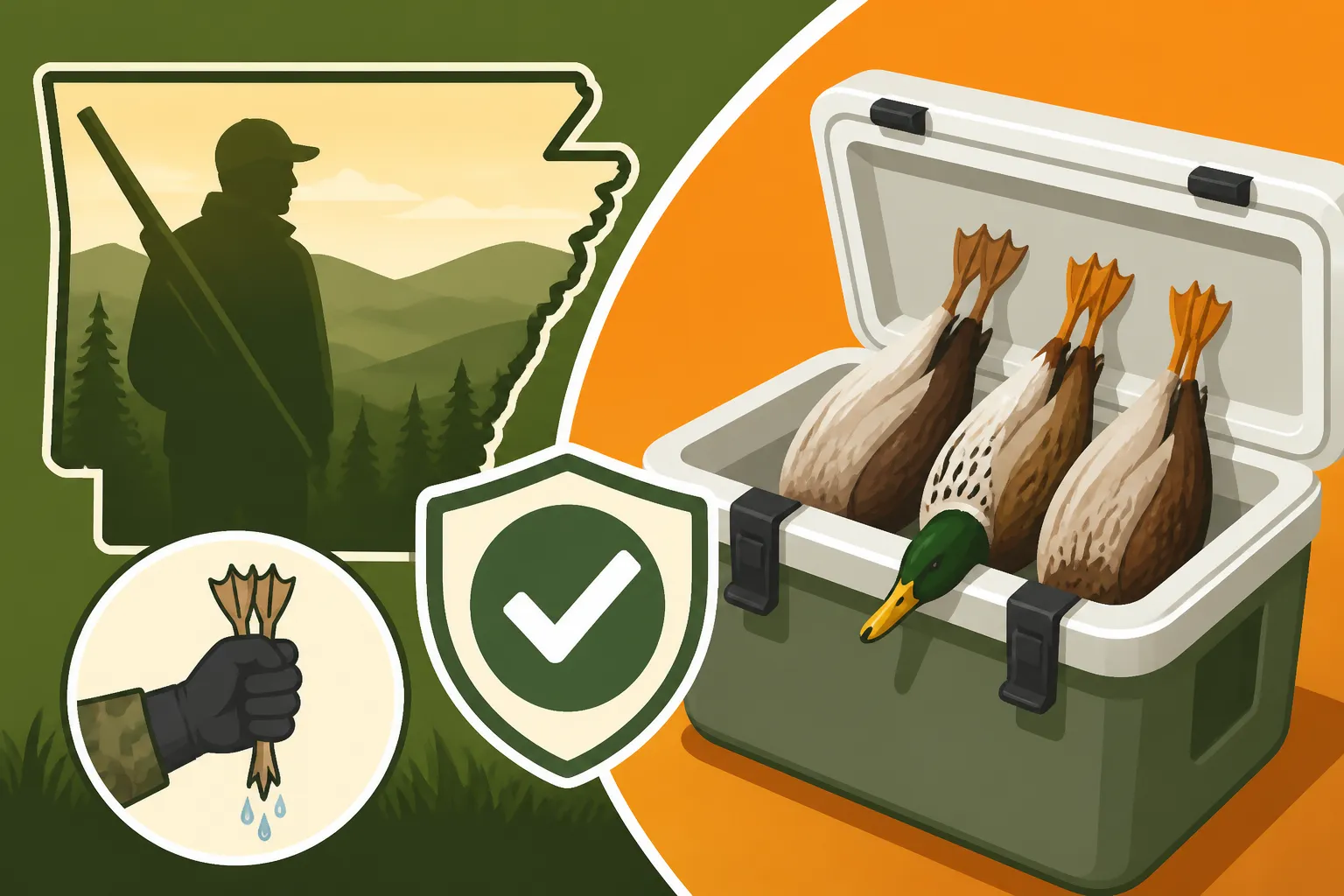
The single most important rule for transporting migratory game birds is often called the "wing attached" rule. Federal regulations, which Arkansas adheres to, state that at least one fully feathered wing or the head must remain naturally attached to all migratory game birds (including ducks, geese, doves, woodcock, snipe, and coots) while you are in the field or in transit. This attachment must be maintained until the birds reach your permanent residence or a commercial processing facility.
Why is this rule so strict? It allows any game warden who inspects your harvest to easily identify the species and, in many cases, the sex of the bird. For example, a mallard drake has very distinct plumage on its wing that differs from a pintail or a gadwall. Without this identifying feature, it would be nearly impossible for law enforcement to confirm that you haven't exceeded the Arkansas Duck Daily Bag Limit for a specific species, or taken a bird that isn't legal. Many hunters get eager to breast out their ducks right in the field to save cooler space, but doing so without leaving that identifying wing attached can result in a serious violation. So, resist the urge until you're truly home or at the processor!
Once you arrive at your permanent residence – which is typically your home – or a licensed commercial processor, you are then free to completely clean and process your birds as you wish. If you're staying at a hunting camp for an extended period and processing your birds there, that can often be considered a "temporary residence" where final cleaning is permissible, but always verify local interpretation with an AGFC official if you're unsure.
Packaging and Labeling for Transport
Beyond keeping a wing attached, how you package and label your birds for transport is also important, especially if you're not the only one in the hunting party or if the birds are being shipped. For instance, if you've harvested birds with a friend, and you're driving them home, ensure each hunter's birds are kept separate and clearly identifiable as belonging to that individual.
If you are transporting birds for someone else, or if the birds are being shipped, the law typically requires that each package containing migratory game birds be clearly labeled with the following information:
- The name and address of the person who killed the birds.
- The name and address of the person to whom the birds are being sent (if different).
- The total number of each species of bird contained in the package.
- The date the birds were killed.
Practically speaking, this means using sturdy, clear plastic bags for individual birds or groups of birds, and then labeling them with a waterproof marker. This might seem like a small detail, but clear labeling helps prevent misunderstandings and keeps everything legal. When packing birds in coolers, ensure they are kept cold, ideally on ice, but try to prevent them from becoming waterlogged if possible, which can degrade the meat quality and make labels illegible.
Federal and State Possession Limits
It's easy to focus on the daily bag limit – how many birds you can shoot in one day. But there's another crucial limit to consider: the possession limit. This refers to the maximum number of birds you can have in your possession at any given time, whether they're fresh from the field, in your cooler, or stored in your freezer at a location other than your permanent residence. For most migratory game birds, the possession limit is typically three times the daily bag limit. This becomes particularly relevant if you're on a multi-day hunt or traveling through different zones.
For example, if the daily bag limit for mallards is 4, your possession limit might be 12. If you hunt for three days and shoot 4 mallards each day, you've hit your possession limit of 12 mallards. Even if you haven't reached your daily limit on the fourth day, you cannot harvest more mallards until you dispose of some of the birds you possess or return to your permanent residence where possession limits don't apply to properly stored, processed game. Always double-check the current Arkansas Duck Daily Bag Limit and Arkansas Specklebelly Daily Bag Limit for specific species and zones.
Here's a quick look at how daily and possession limits generally work for some common migratory birds, though these numbers can change annually, so always verify current regulations.
| Species | Typical Daily Bag Limit | Typical Possession Limit (3x Daily) | Wing/Head Attached Rule Applies? |
|---|---|---|---|
| Mallard (drake) | 4 (often 2 hen limit) | 12 | Yes |
| Pintail | 1 | 3 | Yes |
| Canada Goose | 2-3 | 6-9 | Yes |
| Specklebelly | 2 | 6 | Yes |
| Mourning Dove | 15 | 45 | Yes |
| Woodcock | 3 | 9 | Yes |
Always check the latest AGFC regulations for the most accurate and up-to-date limits.
Rules for Resident Game Birds (Mainly Turkey)
While migratory birds have their own set of specific rules, resident game birds like wild turkeys also have important regulations governing their transport. These rules are generally focused on state-level harvest management, ensuring that hunters properly report their take and adhere to season limits. If you're lucky enough to tag a big gobbler in the spring, knowing these rules is key to a hassle-free journey home.
Checking and Tagging Requirements for Turkeys
Unlike migratory birds that are tracked primarily through federal harvest surveys and daily observations, wild turkeys in Arkansas require a more direct reporting process. After you successfully harvest a turkey, it is mandatory to check it in with the Arkansas Game and Fish Commission (AGFC). This check-in process generates a unique confirmation number, which serves as your proof of legal harvest. This is similar to how deer are checked in, ensuring accurate harvest data for wildlife management.
The AGFC provides several convenient ways to check your turkey: through their official mobile app, their website, or by phone. This must be done before you transport the turkey beyond the immediate vicinity of the kill site, or before you begin any processing that would prevent identification. Once you have that confirmation number, you’ll typically need to attach a physical tag to the bird, often provided with your license, with that number written on it. This tag should remain attached until the bird reaches its final destination for processing or consumption. Keeping your hunting license and permit information readily accessible during transport is also crucial, as game wardens may request to see it along with your checked turkey. For more detailed instructions, you should review Arkansas Turkey Checking Rules.
Processing and Transport for Turkeys
Once your wild turkey has been properly checked and tagged, the transport rules are generally less restrictive than those for migratory birds concerning the attachment of specific parts. While there isn't a federal "wing attached" rule for turkeys, it's still a smart practice to keep proof of sex (like the beard and/or spurs) intact on the bird until you are ready for final processing at your home or a commercial facility. This helps to easily confirm that you harvested a legal bird, especially if bearded hens are not allowed during the season, as is often the case in Arkansas. Why Arkansas Bans Bearded Hen Harvest explains more about these specific regulations.
Most hunters will field dress their turkey shortly after harvest to cool the meat and reduce weight for transport. This involves removing the internal organs but generally leaves the rest of the bird intact. Field dressing is crucial for preserving meat quality, especially in Arkansas's often warm spring weather. For tips on managing game in the heat, see Field Dressing in Arkansas Heat. After field dressing and checking, the entire bird can usually be transported to your home or a processor. Some hunters choose to breast out their turkeys in the field, which is often permissible after the bird has been properly checked and tagged, as long as the confirmation number and necessary identifying features (like the beard/spurs if applicable) are retained and clearly associated with the meat. However, when in doubt, transporting the bird with as much of its natural form as possible, along with your check-in confirmation, is always the safest bet.
Interstate Travel and General Best Practices
The process of transporting cleaned game birds becomes a bit more complex when you're crossing state lines. What's perfectly legal in Arkansas might be a violation in a neighboring state or the state you call home. Planning ahead and knowing the rules for all states involved in your journey is just as important as knowing the rules for your hunting grounds.
Transporting Game Across State Lines
This is perhaps the trickiest part of game bird transport. While Arkansas's regulations dictate what you can do within its borders, the laws of the state you are traveling through or to also apply. For migratory birds, the federal "wing or head attached" rule for identification generally applies across state lines until the birds reach your permanent residence. This is a federal standard designed for consistency.
However, each state can have additional or more stringent rules. Some states might require a permit to import game, or have different packaging and labeling rules for game coming from out of state. For instance, while Arkansas allows you to fully process your birds at your permanent residence, your home state might have a rule that requires a specific tag or manifest even for fully processed meat if it originated from out-of-state. It is your responsibility as the hunter to research and comply with the game transport laws of every state your birds will pass through and eventually enter. A quick call to the wildlife agency of your home state and any states you'll drive through can save you a lot of grief.
Additionally, while generally not applicable to birds, it's worth noting the stringent rules around carcass transport for species like deer in the context of Chronic Wasting Disease (CWD). While not directly related to bird transport, understanding Arkansas CWD Rules and Carcass Transport illustrates how critically important it is to be aware of disease-related transport restrictions for any game animal, and how those can vary drastically between species and locations.
Recommended Practices for Smooth Transport
Beyond the specific legal requirements, there are some practical tips that can make your game bird transport smoother and less stressful:
- Know Before You Go: Before leaving on your hunting trip, especially if it's out-of-state, download or print copies of the hunting and transport regulations for Arkansas and your home state, as well as any states you'll be driving through. Having them readily available on your phone or in your glove compartment can be a lifesaver if you're stopped.
- Coolers and Ice are Your Friends: Proper cooling is paramount. Pack your birds efficiently in coolers with plenty of ice. This not only keeps the meat from spoiling but also helps preserve the birds in an identifiable state until you reach your destination. Consider draining meltwater regularly and refreshing ice, especially on long drives.
- Don't Overpack: While it's tempting to cram as many birds as possible into a cooler, try to arrange them in a way that allows a game warden easy access for inspection if needed. Being cooperative and making their job easier can often lead to a quicker and more pleasant interaction.
- Be Prepared for Inspection: Game wardens have the authority to inspect your vehicle, coolers, and game. Be polite, answer their questions truthfully, and present your license and harvest as requested. They are dedicated professionals working to protect wildlife and ensure fair chase, and a respectful attitude goes a long way.
What to Do with Processed Meat
Once you've reached your permanent residence and fully processed your game birds, the rules for transport become much simpler. At this point, the meat is generally considered personal property. You can usually transport processed, packaged, and frozen meat freely, whether it's to a friend's house for a cookout or to your own freezer.
However, it's still a good habit to label all packages of processed meat clearly with the species, date of harvest, and your name. This helps in your own organization and also provides clear documentation if there's ever a question about the origin of the meat. If you intend to ship frozen game meat, be aware that commercial carriers (like FedEx or UPS) have their own strict rules and packaging requirements for shipping perishable items. You'll need to use insulated containers, dry ice, and follow their specific guidelines for labeling and drop-off times. Always check with your chosen carrier well in advance to avoid any last-minute surprises. Getting your cleaned birds home safely and legally is the final step in a successful hunting adventure, and with a little preparation, it can be a smooth one.
Disclaimer
This article is for general informational purposes only and does not constitute professional advice. Laws, prices and regulations vary by location and change over time. Consult a qualified professional for guidance on your specific situation.