Arkansas Turkey Population Trends
It can be incredibly disheartening to hit your favorite turkey hunting spot year after year, only to notice fewer gobblers sounding off, or worse, see scarce sign where birds once roamed. Many of us in Arkansas have witnessed the wild turkey population fluctuate, leaving us scratching our heads and wondering what’s truly happening with these magnificent birds. This guide aims to shed light on the recent trends in Arkansas’s wild turkey numbers, breaking down the factors at play, how we track them, and what it all means for hunters and conservationists alike.
The Rollercoaster of Arkansas Turkey Populations: What's Really Going On?
For a long time, Arkansas was renowned for its robust wild turkey populations, drawing hunters from all corners to experience the thrill of a gobbler sounding off on a crisp spring morning. We saw decades of successful restoration efforts, with trap-and-transfer programs literally bringing turkeys back to areas where they had been extirpated. However, over the last decade or so, many hunters have felt a distinct shift, a noticeable decline in the number of birds they encounter, and it's not just anecdotal — the data supports these observations.
Historical Highs and Current Realities
To truly understand where we are, we have to look back at where we've been. Following the early 20th-century devastation of turkey populations due to unregulated hunting and habitat destruction, Arkansas, like many other states, embarked on aggressive conservation campaigns. By the late 1980s and into the early 2000s, wild turkeys were thriving, with numbers reaching impressive peaks. These were the "good old days" many of us remember fondly, when it felt like every holler had a gobbler and the woods were alive with their calls. Hunting success rates were high, and the future seemed bright.
However, the reality today is a stark contrast to those boom times. While we still have huntable populations, especially in certain areas, the overall trend has been a downward slide. Hunters are reporting longer stretches of silence, fewer tracks, and generally harder hunting. The Arkansas Game and Fish Commission (AGFC) data confirms this, showing a significant drop from those historical highs. Understanding this shift is the first step in addressing it, and it's crucial for anyone who cares about the future of Wild Turkeys in Arkansas.
The Decline: When Did We Start Noticing?
The subtle changes began to accumulate around the mid-2000s, but it really became evident to the average hunter in the 2010s. Suddenly, those once-reliable creek bottoms and ridge tops weren't holding the same number of birds. The spring woods felt quieter, and finding a gobbler became more of a needle-in-a-haystack endeavor rather than a confident expectation. This decline wasn't a sudden crash but a gradual erosion, making it harder to pinpoint an exact moment.
The AGFC, through its extensive monitoring programs, was certainly tracking these trends. Their biologists began raising concerns as early as the late 2000s, noting changes in recruitment rates, which is essentially the number of young turkeys surviving to adulthood. This slow but steady reduction in young birds entering the population is a major reason for the overall decrease, and it's a trend that's been observed across much of the Southeast. It left many of us asking, "Why Arkansas Turkey Numbers Fell?" and looking for answers beyond just a bad hatch year.
Key Factors Driving Turkey Population Changes
It's never just one thing, is it? When it comes to wild turkey populations, there's a complex web of environmental, ecological, and even human-related factors that can influence their numbers. Understanding these drivers is critical because it helps us appreciate the challenges our turkey populations face and why management strategies are so intricate.
Habitat Loss and Fragmentation
Arkansas, like many growing states, experiences ongoing changes to its landscape. Prime turkey habitat, especially the mature hardwood forests, diverse undergrowth, and open areas turkeys rely on for nesting and foraging, is constantly under pressure. This isn't always about clear-cutting every single acre; sometimes it's more subtle. Think about development pushing into rural areas, agricultural expansion, or even changes in timber management practices that favor monoculture pine plantations over mixed hardwood stands.
When habitats become fragmented, meaning they're broken up into smaller, isolated patches, it impacts turkeys significantly. They need large, interconnected areas to roam, find mates, raise their young, and avoid predators. Small, isolated pockets of habitat often can't sustain a healthy turkey population, making birds more vulnerable and limiting their ability to expand and recover. This is particularly noticeable in certain regions of the state where development or intensive agriculture has reshaped the land.
Predation Pressures: A Constant Battle
Wild turkeys have always faced predators, it's a natural part of their existence. However, the balance of nature can shift, and in recent decades, many areas have seen an increase in certain predator populations, particularly raccoons, opossums, coyotes, and even feral hogs. These predators can decimate turkey nests and target poults (young turkeys), which are incredibly vulnerable in their first few weeks of life. When these predation levels get too high, especially coupled with other challenges, it can severely impact a turkey's ability to successfully reproduce and recruit new birds into the population.
This isn't to say predators are "bad"; they are a vital part of the ecosystem. But when their numbers are unchecked, or when other factors weaken turkey populations, their impact can be disproportionately negative. For example, a nest in fragmented habitat, closer to human activity or disturbed areas, might be more easily found by a predator than one deep in an undisturbed forest. This interplay of factors makes understanding Nest Predation and Turkey Hatches so important for turkey management.
Weather's Impact on Reproduction
Ask any seasoned turkey hunter, and they'll tell you that the weather during nesting and brooding season is absolutely critical. Wild turkeys typically nest in the spring, and the poults hatch in late spring or early summer. What happens during those crucial weeks can make or break a year's recruitment. Prolonged periods of cold, wet weather can be devastating to newly hatched poults, which are highly susceptible to hypothermia and disease. They rely on their mothers to brood them and keep them warm and dry, but extreme conditions can overwhelm even the best hen.
Conversely, very dry conditions can also impact habitat, reducing insect populations that poults rely on for protein. A mild, dry spring with abundant insects and cover is ideal for a strong hatch and high poult survival. Arkansas, with its diverse weather patterns, sees its fair share of extremes. A series of bad weather years during critical nesting periods can have a cumulative negative effect on the overall population, leading to a noticeable decline in the Poult-to-Hen Ratios and What They Mean for several years down the line. We often look at Weather in the Weeks After the Hatch as a crystal ball for the next year's hunting prospects.
Understanding Brood Surveys and Harvest Data
So, how do biologists and wildlife managers actually track these populations and identify trends? It's not just guesswork or anecdotal reports from hunters (though those are valuable!). They rely on scientific methods, primarily brood surveys and analysis of annual harvest data, to get a clearer picture of the state of our wild turkeys. These tools help them understand reproduction success and overall population health, guiding future management decisions.
The Poult-to-Hen Ratio: Our Report Card
One of the most crucial pieces of data for turkey biologists is the poult-to-hen ratio. This metric is gathered through summer brood surveys, where wildlife personnel, and often volunteer hunters, observe hens with their broods and count the number of poults per hen. This ratio gives us a direct indication of nesting success and early poult survival. For instance, if you see a hen with eight poults, that's a much better sign than a hen with only one or two, or worse, a "lone hen" without any poults at all.
A healthy, stable turkey population typically needs a poult-to-hen ratio of around 2.0 to 2.5 or higher to maintain or grow its numbers. When this ratio consistently dips below that threshold, it signals trouble for future recruitment. The AGFC publishes these Arkansas Turkey Brood Surveys annually, providing invaluable insight into how the population is trending. Hunters can even contribute to these surveys through reporting apps or online portals, turning their casual observations into critical data points. GoHunt often features articles that help hunters understand how to interpret these state-level reports, providing a deeper dive into what the numbers mean for specific regions.
Interpreting Annual Harvest Numbers
Another vital dataset is the annual turkey harvest numbers. Every time a hunter checks in a turkey, that information contributes to a larger database that helps the AGFC understand population distribution, hunter success rates, and overall population trends. While harvest numbers don't directly tell us how many turkeys are in the woods, they provide a snapshot of what hunters are able to take, which is an indirect indicator of population health and density.
A declining harvest over several years, especially if hunter effort remains consistent or even increases, often correlates with a declining population. For example, if the Arkansas Turkey Harvest Numbers show a steady drop, it suggests there are simply fewer birds available to harvest. This data also helps identify regional differences, as some zones might be doing better or worse than the state average. It's important to remember that regulations like the Arkansas Spring Turkey Season Dates and bag limits are often adjusted based on these long-term trends to ensure sustainable hunting opportunities for the future.
AGFC's Role in Turkey Management and Restoration
When we see these population shifts, it's natural to wonder what's being done about it. The Arkansas Game and Fish Commission plays a pivotal role in monitoring, managing, and working to restore our wild turkey populations. Their work involves a multi-faceted approach, from hands-on habitat projects to in-depth research, all aimed at ensuring future generations can still enjoy the thrill of spring gobbler hunting.
Habitat Improvement and Conservation Efforts
A cornerstone of turkey management is habitat work. Recognizing that habitat loss and degradation are major contributors to declining numbers, the AGFC actively engages in projects across public lands, and often partners with private landowners, to improve conditions for turkeys. This can include prescribed burning to create fresh new growth and control undesirable vegetation, thinning timber to promote diverse understories for nesting and foraging, and planting beneficial food plots or native grasses.
These efforts are not just about making the woods look pretty; they're about creating the specific conditions turkeys need to thrive. For instance, opening up dense canopy cover allows sunlight to reach the forest floor, spurring the growth of bug-attracting plants that poults feast on. Creating a mosaic of habitat types – dense cover for roosting, open woods for strutting, and fields for bugging – provides all the elements a turkey needs within its home range. Organizations like GoHunt also often highlight how private landowners can implement similar beneficial practices on their own properties, contributing to the broader conservation effort.
Research and Monitoring Initiatives
Beyond collecting annual harvest and brood survey data, the AGFC continually conducts more intensive research to better understand turkey ecology in Arkansas. This can involve tracking turkeys with radio telemetry to study their movements, nesting success, and survival rates. They also investigate specific issues like the impact of disease, genetic diversity, and the effects of various hunting pressure levels on different populations.
This scientific inquiry is crucial for adaptive management. As new challenges arise or existing ones intensify, solid research provides the foundation for making informed decisions about season lengths, bag limits, and specific management actions. For example, understanding The Best Brood Years Since 2013 and the conditions that led to them helps biologists replicate those favorable conditions where possible, or at least understand what factors are working against the birds in less successful years.
Hunter Contributions and Future Outlook
While biologists and land managers are on the front lines, hunters are absolutely vital partners in turkey conservation. Every license and stamp purchased directly funds these management efforts. Beyond financial contributions, hunters' observations in the field, when reported, provide critical data points for brood surveys and general population trends. Adhering to regulations, practicing ethical hunting, and actively participating in conservation groups all play a role in the future of Arkansas Turkey Population Estimate.
The future of wild turkeys in Arkansas depends on a collective effort. It's not a lost cause, but it demands continued vigilance and adaptation. The AGFC remains committed to managing the species, and with the support and participation of the hunting community, there's hope that we can see our turkey populations rebound and thrive once again. Even small changes in your personal hunting practices, like ensuring you understand the Arkansas Turkey Checking Rules, contribute to the bigger picture of data collection and management.
Adapting Your Hunting Strategy to Current Trends
Facing lower turkey numbers can be frustrating, especially if you're used to finding birds easily. However, it doesn't mean you should hang up your calls. Instead, it calls for a more strategic, patient, and often more physically demanding approach to spring turkey hunting. Understanding current population trends helps you refine your tactics and increase your chances of success.
Scouting Smarter in Lower Density Areas
When turkeys are scarce, you can't just wander into the woods and expect to bump into birds. Smart scouting becomes even more critical. This means hitting the woods well before the Arkansas Spring Turkey Season Dates to look for fresh sign: tracks in soft dirt, droppings, feather sheds, and dusting bowls. Listen for distant gobblers at dawn and dusk, trying to pinpoint consistent roosting areas. Don't be afraid to cover a lot of ground, using mapping apps like those often recommended by GoHunt to identify potential travel corridors, pinch points, and food sources.
Focus on areas with diverse habitat – where open fields meet dense woods, near water sources, or along ridge lines that offer good visibility and easy access to roost trees. In the Ozarks, this might mean spending more time listening for gobblers in specific hollows and on prominent ridges, rather than just randomly walking. The key is to find the birds before the season opens, so you're not wasting precious hunting time searching aimlessly.
Patience and Persistence: A New Approach
With fewer birds, your patience will be tested like never before. The days of multiple gobblers answering every call might be behind us in some areas, replaced by a need for stealth, subtle calling, and a willingness to sit longer. You might only get one response, or no response at all, but that doesn't mean there are no birds. It just means they're not as vocal or as numerous.
Instead of running and gunning if you don't hear anything right away, consider setting up in a likely travel route or feeding area and calling sparingly. Use softer calls, like clucks and purrs, to pique a tom's curiosity without overdoing it. Be prepared to sit for an hour or two in a spot you've scouted well, letting the woods wake up around you. If a bird does respond, be incredibly patient. He might be coming, but slowly and cautiously. Mastering techniques like Calling Arkansas Gobblers in the Ozarks with a lighter touch can make all the difference in these lower-density environments. This new reality demands a blend of careful planning and unwavering commitment, knowing that success, though harder earned, is all the more rewarding.
Arkansas Wild Turkey Brood Survey & Harvest Trend Summary
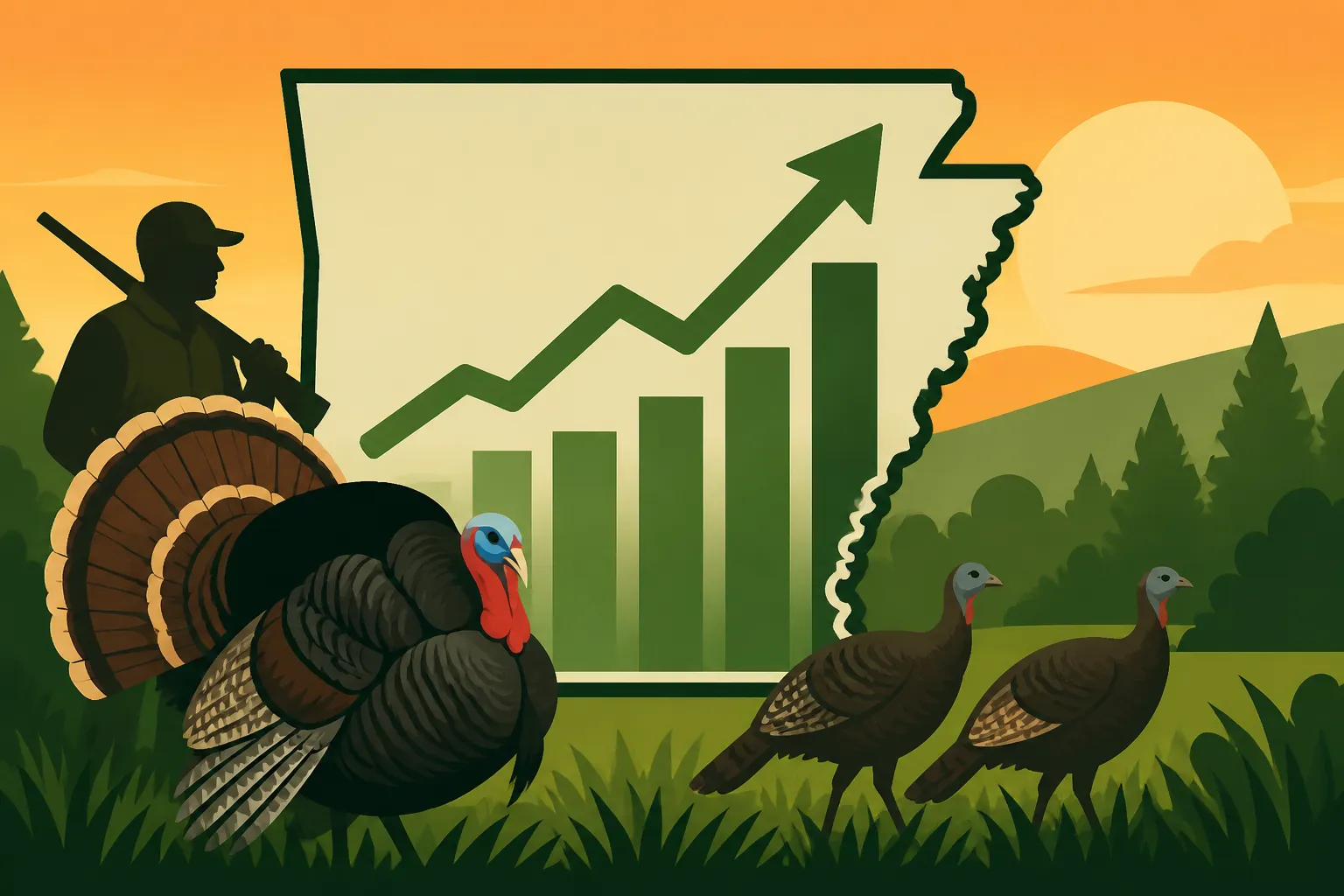
To help visualize some of the trends we've discussed, here's a simplified look at how key metrics might appear over several years, illustrating the shifts in poult-to-hen ratios and associated harvest numbers. This kind of data is what helps the AGFC and hunters understand the health of our turkey populations.
| Year | Poult-to-Hen Ratio (Statewide Avg.) | Total Spring Gobbler Harvest (Approx.) | Trend Insight |
|---|---|---|---|
| 2018 | 2.8 | 10,500 | Strong recruitment, healthy population |
| 2019 | 2.5 | 9,800 | Good recruitment, slight dip |
| 2020 | 1.8 | 8,000 | Below average recruitment, noticeable decline |
| 2021 | 1.5 | 7,200 | Poor recruitment, continued decline |
| 2022 | 1.7 | 7,500 | Slight improvement, still low recruitment |
| 2023 | 2.1 | 8,300 | Moderate improvement, cautiously optimistic |
Note: The numbers in this table are illustrative and represent hypothetical trends to demonstrate the relationship between brood success and harvest numbers. Actual AGFC data may vary.
Disclaimer
The information provided in this guide is for general informational purposes only and is not intended as legal advice regarding hunting regulations. Hunting regulations, seasons, and bag limits can change, and it is the hunter's responsibility to review and comply with the most current regulations set forth by the Arkansas Game and Fish Commission (AGFC) before engaging in any hunting activities. Always refer to the official AGFC hunting guide and specific WMA regulations.