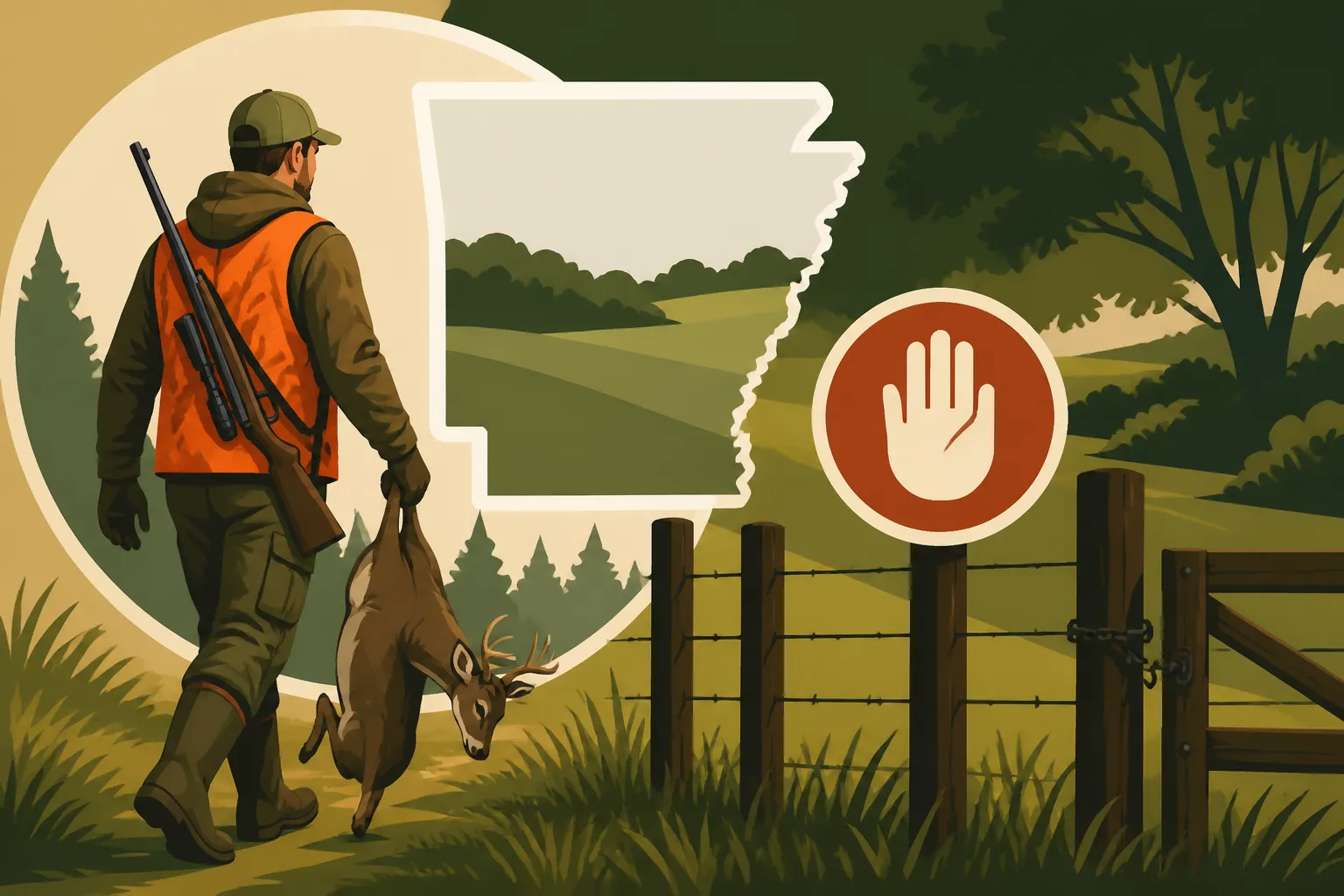
Retrieving Game From Private Land
There's nothing quite like the rush of a successful shot, that moment when you know you've done everything right. But then, the heart sinks as you watch your deer, or maybe even that big gobbler, bound across a property line you don't have permission to hunt. That feeling of dread, knowing your game is just out of reach but legally inaccessible, is a scenario far too many Arkansas hunters face. This guide will help you understand the rules, navigate the tricky ethical waters, and provide clear steps for how to legally and respectfully retrieve game that crosses onto private land in the Natural State.
The Frustration of a Followed Blood Trail: Understanding Arkansas Law
We've all been there, or at least imagined it. You make a good shot, the animal runs, and you pick up a promising blood trail. You're following it, every step filled with anticipation, and then – boom – a fence line, a clearly marked "No Trespassing" sign, or even just a field you know belongs to someone else. It's an immediate gut punch, a terrible dilemma: abandon your downed game, or risk breaking the law to recover it? In Arkansas, the law is pretty clear on this, and it’s important to understand it before you make a move you might regret.
What Arkansas Law Says About Trespass
In Arkansas, entering private land without the express permission of the landowner or leaseholder is considered trespass. It really is that simple. There's no special carve-out in the law that says, "Oh, but if you're retrieving a wounded animal, it's fine." Your intent, no matter how pure – and what hunter doesn't feel an ethical obligation to recover game? – doesn't change the legal definition of trespass. It means you can't just hop the fence, even if you see your trophy lying just on the other side.
This can feel incredibly unfair, especially when you've put in the effort, made a clean shot, and just want to finish the job. But the law is designed to protect private property rights, and those rights are held strongly here in Arkansas. Ignoring them can lead to serious consequences, from fines and potential arrest for criminal trespass to the loss of your hunting license. It's a tough pill to swallow, but understanding Arkansas Trespass and Permission Law is the first crucial step to resolving this common hunting dilemma responsibly.
The "Good Samaritan" vs. Property Rights
You might hear whispers around deer camp or read forums online suggesting a "good Samaritan" rule, or that you have a right to recover your game. Let's be unequivocally clear: in Arkansas, no specific "good Samaritan" law for game retrieval exists that overrides a landowner's right to prevent trespass. While some states might have specific provisions, Arkansas does not. This means that if a landowner says "no," or if you can't reach them, entering their property, even to retrieve a deer, is illegal.
This is where the ethical hunter faces a real internal conflict. We're taught to never waste game, to always follow up on a shot. But we're also bound by laws and the fundamental respect for private property. The frustration of watching an animal you've legally harvested expire just a few yards into someone else's property, knowing you can't simply go get it, is immense. It challenges our core hunting ethics. However, violating property rights, even with the best intentions, can escalate quickly and damage the reputation of hunters as a whole. It's a critical balance, and one that absolutely requires communication over assumption.
The Critical Step: Seeking Permission
Given the clear stance of Arkansas law on trespass, the only legal and respectful path forward when game crosses onto private land is to seek permission from the landowner or leaseholder. This isn't just a courtesy; it's a legal requirement that can save you a lot of grief and potential trouble down the road.
The Absolute Necessity of Asking
Let me say it again: you must ask. This is the cornerstone of responsible hunting when a situation like this arises. The process involves identifying the landowner, making contact, and politely requesting access. It's not always easy, especially if you're in the heat of the moment and adrenaline is pumping, but it's absolutely necessary. Imagine being on the other side: a stranger just walks onto your land, rifle in hand, without a word. Most landowners would react negatively, and rightfully so.
When you approach a landowner, clarity and respect are paramount. Explain the situation calmly: you shot an animal, it ran onto their property, and you would be incredibly grateful for the opportunity to quickly retrieve it. Offer to show them the blood trail, the downed animal, and assure them you will leave no trace. Your demeanor can make all the difference. Sometimes, a landowner who might initially be wary will soften when they see you're being honest, respectful, and aren't trying to pull a fast one. Remember, you're asking for a favor, not demanding a right.
Tools for Identifying Landowners in Arkansas
Okay, so how do you even figure out who owns that patch of woods or field your deer just disappeared into? This is where modern technology has become an absolute game-changer for Arkansas hunters. Mapping applications are your best friend here.
Apps like onX Hunt or even GoHunt provide incredibly detailed property line maps overlaid with satellite imagery. You can literally stand on your property line, look at your phone, and see exactly whose land is next door, often with the landowner's name right there. Some of these apps even provide contact information, or at least enough data (like a parcel ID) to help you find it quickly. This is invaluable in a retrieval situation. You can pinpoint the exact property, get the landowner's name, and then search for contact details or even drive to their listed address if it's nearby.
Think of it like this: before you even step foot on hunting land, you should be using tools like Using the AGFC Map Tool or onX Hunt to understand the lay of the land, especially what private parcels butt up against your hunting area. This proactive scouting can help you identify potential problem areas and even get ahead of the game by asking for permission before the season, just in case.
Beyond the apps, if you don't have access or prefer traditional methods, your local county assessor's office or courthouse maintains public records of property ownership. It might take a bit longer, but the information is there. When you're dealing with a downed animal, time can be of the essence, so being familiar with these digital tools, like how to use onX Hunt for Finding Arkansas Property Lines, can truly make a difference in a stressful situation.
Navigating the Conversation: What to Do (and Not Do)
Once you've identified the landowner, the next step is the direct approach. This can feel intimidating, especially if you don't know the person. However, a polite, prepared, and respectful conversation is your best chance at success.
Approaching an Unfamiliar Landowner
Let's walk through the ideal scenario for approaching an unfamiliar landowner. First and foremost, leave your weapon behind. Or, if you absolutely must carry it (e.g., if you're still actively hunting close by, though I'd recommend against it for the approach), unload it and secure it in your vehicle. Approaching someone's home or property with a visible firearm can immediately put them on edge.
Your attire matters too. While you might be covered in camo, consider removing your face mask or heavy gear if you're going to a house. Present yourself as a responsible, respectful individual.
Here’s a breakdown of how to handle the conversation:
- Introduce Yourself: Start with your name and where you're hunting (e.g., "Hi, my name is John Smith, and I'm hunting the property just across your south fence line.").
- State Your Purpose Calmly: "I made a shot on a deer earlier, and it appears to have run onto your property. I've followed the blood trail right up to your fence line, and I believe it's likely just over there."
- Ask for Permission, Don't Demand: "I would be incredibly grateful if you would grant me permission to quickly retrieve it. I promise to be as respectful as possible, get in and out, and leave no trace."
- Offer to Show Them: "I can show you exactly where the blood trail leads, and I'd be happy to point out the animal once I find it." This demonstrates transparency and builds trust.
- Be Prepared for a "No": This is tough, but it's a real possibility. A landowner has every right to deny you access. If they say no, accept it gracefully. Thank them for their time and leave. Pressing the issue or arguing will only make things worse and could lead to legal trouble.
Empathy goes a long way. Think about their perspective. They might have livestock, kids playing outside, or just value their privacy. Your calm, respectful approach is key.
When Permission is Denied (or Unreachable)
Sometimes, despite your best efforts, you just can't get permission. Maybe you can't reach the landowner by phone, or perhaps they're home but simply refuse. This is, without a doubt, one of the hardest parts of ethical hunting. A "no" means no. You absolutely cannot enter their property, even if you can see your buck lying there.
It's a moment of profound ethical conflict for a hunter. We want to honor the animal, to not let the meat go to waste, and to complete the harvest we started. But the law, and respect for private property, must take precedence. In Arkansas, a denial of access for retrieval means you legally cannot proceed.
In extremely rare cases, if you suspect foul play or if the animal is posing a danger (e.g., a wounded bear in a populated area), you might consider contacting the Arkansas Game and Fish Commission (AGFC). However, be aware that the AGFC's primary role is wildlife management and law enforcement. While they may investigate specific violations, they are generally not going to compel a private landowner to grant you access for game retrieval. They will uphold trespass laws. Do not expect them to act as your retrieval service. So, the vast majority of the time, if permission is denied or unreachable, you have to accept the loss. It's a painful but sometimes necessary consequence of hunting near private property lines.
Preventing the Dilemma: Ethical Hunting and Planning
While dealing with a lost animal on private land is a tough situation, the best defense is a good offense. Proactive measures, ethical hunting practices, and strategic planning can significantly reduce the chances of ever finding yourself in this predicament.
Shot Placement and Tracking Skills
The single most impactful thing you can do to prevent your game from running onto unpermitted land is to make a clean, ethical shot that anchors the animal quickly. This means knowing your firearm or bow, practicing regularly, and understanding the anatomy of the animal you're hunting. Never take a shot you're not confident in, especially near property lines. Passing up a marginal shot is far better than losing an animal and potentially breaking the law.
Even with the best shot, animals sometimes run. That's where solid tracking skills come in. After the shot, give the animal time, especially if it's a deer. This allows it to bed down and expire, often closer to where it was shot. Don't rush in. Learn to read a blood trail, looking for subtle signs like disturbed leaves, broken twigs, or even the direction of the animal's hooves. Good tracking can help you recover an animal much closer to your initial shot, preventing it from crossing boundaries. Developing your skills in areas like Tracking a Deer in Ozark Rock or knowing how to proceed with Blood Trailing After Dark in Arkansas can be invaluable.
Pre-Season Scouting and Landowner Relationships
This is where the real work happens before opening day. Proactive scouting isn't just about finding game; it's about understanding the land you hunt and its surroundings. Use your mapping apps like onX Hunt or the AGFC's online tools to identify every property line adjacent to your hunting area. Learn who owns those parcels.
Building relationships with neighboring landowners before the season begins is perhaps the most effective preventative measure. A friendly chat, an offer to help with a small chore, or simply introducing yourself as a responsible hunter can open doors. If you've already established a rapport, asking for permission to retrieve a downed animal, should the need arise, becomes much easier and more likely to be granted. It's about being a good neighbor, not just a good hunter. Many successful Arkansas hunters will tell you that Knocking on Doors in Arkansas Farm Country has opened up more opportunities than any hunting club membership.
Practical Tools and Strategies
Beyond good shot placement and building relationships, having the right tools and strategies in your hunting kit can make a big difference.
| Action/Tool | Description | Benefit |
|---|---|---|
| Mapping Apps (onX Hunt, GoHunt) | Digital maps showing property lines, landowner names, and satellite imagery. | Quickly identify adjacent landowners and their contact info when a situation arises. Great for Scouting Arkansas Public Land Before Season. |
| High-Quality Flashlight/Headlamp | Essential for blood trailing, especially in low light or at night. | Enhances visibility of blood, helping you stay on the trail and recover game faster. |
| Flagging Tape (with permission) | Non-biodegradable tape to mark the blood trail, but only if you have permission to be on the property. | Helps maintain the trail, especially if you need to leave and return. Never use on land where you don't have permission. |
| Binoculars/Spotting Scope | For observing wounded game from a distance without pushing it further. | Allows you to locate game from afar, minimizing movement and potential for the animal to cross more boundaries. |
| Communication Device | Fully charged phone or satellite communicator. | Essential for contacting landowners, AGFC (if necessary), or fellow hunters for help. |
| Knowing Your Limits | Understanding your effective shooting range and passing on shots that are too far or too risky, especially near property lines. | Prevents wounded game from crossing boundaries in the first place, upholding Arkansas Hunter Education and Safety Rules. |
The bottom line is that prevention truly is the best medicine here. By being an ethical, prepared, and respectful hunter, you can minimize the chances of a beloved harvest ending up in that agonizing legal limbo on someone else's land.
Disclaimer
This article is for general informational purposes only and does not constitute professional advice. Laws, prices and regulations vary by location and change over time. Consult a qualified professional for guidance on your specific situation.