Diver Ducks on Arkansas Reservoirs
It's easy to get caught up in the allure of Arkansas's legendary green timber duck hunts or the excitement of field shooting over rice. But for those who crave a different kind of challenge, a hunt where the vastness of the water meets the raw power of migratory birds, Arkansas's expansive reservoirs offer an incredible, often overlooked opportunity for diver ducks. If you've ever felt frustrated by crowded timber holes or struggled to find unpressured birds, this guide is here to introduce you to the unique world of diver duck hunting on Arkansas's big lakes, detailing the species you'll encounter, where to find them, and the specialized tactics needed for success.
The World of Diver Ducks on Arkansas Reservoirs
Diver ducks are a distinct group of waterfowl, different in their feeding habits and preferred habitats from the more commonly targeted puddle ducks like mallards. While puddle ducks "tip up" to feed in shallow water, divers plunge beneath the surface to forage for aquatic vegetation, mollusks, and small fish in deeper environments. This fundamental difference means they gravitate towards different kinds of water bodies – specifically, the vast, clear, and deep reservoirs that dot the Arkansas landscape.
Identifying Key Diver Species in Arkansas
When you're out on an Arkansas reservoir, you'll primarily be looking for a handful of common diver species, each with its own characteristics. Knowing these birds helps immensely in scouting and setting up your spread. You'll often see flocks of Ring-necked Ducks, easily identified by their black backs, gray flanks, and the distinctive white ring at the base of their bill (though the 'ring' on the neck is often hard to see). They're agile flyers and tend to raft in large numbers.
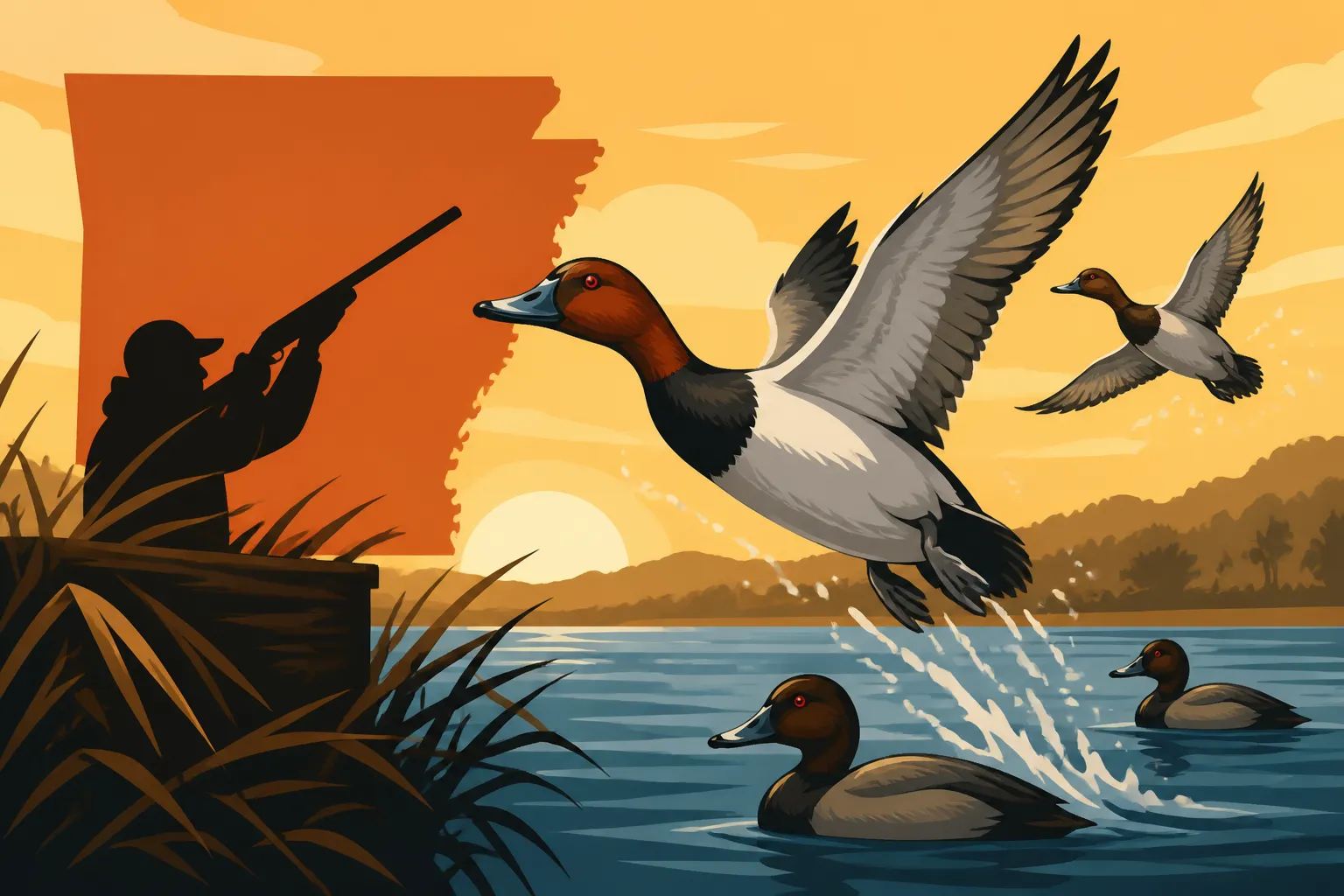
Then there are the Lesser Scaup and Greater Scaup, often collectively called "Bluebills" or "Broadbills." These are robust, fast-flying ducks that look very similar, with black heads and chests, gray backs, and white sides. Distinguishing between Lesser and Greater Scaup in the field can be tricky, but both are common migrants. Finally, the kings of the divers, Canvasbacks and Redheads, are highly prized. Canvasbacks are large, powerful ducks with sloping foreheads and reddish heads, while Redheads have a rounder head and more distinctly red plumage. Both are striking birds and offer a thrilling challenge. Understanding Arkansas Duck Daily Bag Limit for each species is crucial before you head out.
Why Reservoirs Attract Divers
Arkansas's reservoirs, often man-made impoundments like Beaver Lake or Lake Ouachita, provide the deep, expansive, and relatively clear water that diver ducks absolutely thrive in. Unlike the flooded timber or shallow fields of the Delta, these large lakes offer abundant submerged vegetation, mussel beds, and aquatic insects that divers feed on. They feel secure on these wide-open bodies of water, which mimic their coastal wintering grounds or large inland lakes.
Furthermore, these vast waters often experience less direct hunting pressure for ducks than the well-known hotspots. While many hunters are focused on Hunting Arkansas Flooded Green Timber or Hunting Rice Fields and Levees, the divers are quietly using the deeper lakes, sometimes in massive rafts. This can lead to a more secluded and focused hunting experience, though it requires specific tactics and equipment not always suited for other duck hunting scenarios. The sheer volume of water also means birds can spread out, making finding them an exercise in patience and good scouting.
Seasonal Movements and Timing for Divers
Diver duck migration into Arkansas typically begins later than some of the early puddle duck movements. While some species like Blue-winged Teal arrive with the Arkansas's September Teal Season, the bulk of the divers show up when colder temperatures really start to push birds south from the northern breeding grounds. You'll usually see the highest concentrations of divers from late November through January.
Early season might see a trickle of Ringnecks, but as the winter deepens, you can expect larger flocks of Scaup, Redheads, and Canvasbacks. These birds are looking for stable, open water that isn't frozen over, and Arkansas's larger reservoirs provide just that. The timing of cold fronts and persistent north winds often correlates directly with fresh pushes of divers, making weather watching a critical part of your scouting routine. Pay close attention to migration reports and local conditions, as diver movements can be quite dynamic.
Prime Hunting Grounds: Arkansas's Big Water
Arkansas is home to numerous large reservoirs, many of which offer fantastic opportunities for diver duck hunting. These aren't your typical shallow-water affairs; they require different scouting and hunting methods. Knowing which lakes to target and what specific features to look for within them is key to success.
Key Reservoirs and Their Characteristics
When you think about diver hunting in Arkansas, you're looking at the bigger, deeper bodies of water. Lakes like Beaver Lake in Northwest Arkansas, Bull Shoals Lake and Norfork Lake in the north-central part of the state, and Greers Ferry Lake in Central Arkansas are prime examples. Further south, Lake Ouachita and DeGray Lake also offer strong potential. These lakes are characterized by deep, clear water, rocky points, and often extensive submerged timber or brush lines along their edges.
Divers aren't usually found in the very shallow, muddy backwaters. Instead, they prefer the main lake basins, large coves, and areas around prominent points, submerged islands, or old creek channels that are still deep. These features provide them with security and easy access to their preferred food sources. Many of these reservoirs are managed by the U.S. Army Corps of Engineers, and understanding Arkansas Corps of Engineers Lakes rules is essential. Keep an eye on water levels as well; while divers prefer deep water, extreme fluctuations can affect food availability and how birds use specific areas.
Scouting for Success on Open Water
Scouting for diver ducks on a large reservoir is a very different game than looking for mallards in a flooded field. You're covering vast distances, often using binoculars or spotting scopes from vantage points to locate rafts of birds. Divers often gather in huge groups, sometimes hundreds strong, far out in the main lake or large coves. Look for areas where these rafts consistently form.
Topographical maps, especially those with bathymetric (underwater contour) data, are invaluable. Tools like GoHunt can help you identify submerged points, humps, and old river channels where divers might concentrate their feeding. These digital mapping tools allow you to study the bottom structure from your couch, giving you a serious edge. Once you identify potential areas, physically scout from your boat, looking for birds, fresh droppings on rocks, or signs of feeding activity. Wind is another critical factor; divers often raft on the leeward side of points or islands during strong winds, seeking shelter. Being aware of Scouting Arkansas Public Land Before Season general principles, adapted for open water, will make your efforts much more effective.
| Arkansas Reservoir | Primary Diver Species | Key Features to Hunt | Typical Hunting Methods |
|---|---|---|---|
| Beaver Lake | Scaup, Ring-neck, Redhead | Main lake points, deep coves, submerged islands | Layout boats, shoreline blinds |
| Bull Shoals Lake | Scaup, Ring-neck | Large coves, bluffs, deep water near channels | Layout boats, limited shoreline |
| Norfork Lake | Scaup, Ring-neck | Wide bays, prominent points, old river channels | Layout boats, pontoon blinds |
| Greers Ferry Lake | Scaup, Ring-neck, Canvasback | Open water, submerged timber, rocky islands | Layout boats, large spreads |
| Lake Ouachita | Ring-neck, Scaup | Deep coves, major points, clearer sections | Boat blinds, natural cover |
Strategies and Gear for Reservoir Diver Hunting
Hunting diver ducks on Arkansas's reservoirs demands a specialized approach, from the type of decoys you use to your boat setup and safety protocols. It's an exhilarating hunt, but one that requires careful planning and the right equipment.
Decoy Spreads for Divers
Diver ducks are flocking birds, and they respond best to large, confidence-inspiring decoy spreads. Forget the small puddle duck spreads; for divers, bigger is almost always better. Spreads of 50-100+ decoys are common. You'll want sturdy, keeled decoys that ride well in choppy water. Many hunters use long lines, setting out multiple decoys on a single main line with clips or droppers, which makes deploying and retrieving large numbers of decoys more efficient.
Common patterns include "V" or "J" shapes, mimicking a flock landing or swimming, with an open pocket for birds to land in front of your blind. Spacing is important; divers like their space, so don't crowd your decoys too tightly. A few large goose decoys or even swan decoys mixed in can add realism and confidence to your spread, as divers often associate with other large waterfowl. The effectiveness of these spreads is a stark contrast to the tighter, more intimate spreads used for Setting Decoys in Timber Holes. Incorporating some motion decoys, like jerk cords or spinning-wing decoys, can also draw attention on a vast expanse of water, though static decoys are often more important for sheer numbers.
Blinds, Boat Placement, and Concealment
Concealment is paramount on open water where cover is scarce. Many serious diver hunters use specialized layout boats, which are low-profile vessels designed to be almost flush with the water, allowing hunters to lie down and remain hidden. These are typically set some distance from the main spread. Alternatively, well-brushed boat blinds (often a pontoon or large flat-bottom boat completely covered in natural vegetation) can be effective when anchored near a point or a subtle shoreline feature.
When placing your boat or blind, consider the prevailing wind. Divers almost always land into the wind, so position yourself downwind of your decoy spread to ensure birds finish in your shooting zone. Keep an eye on sun position to avoid being silhouetted. Remember, on wide-open water, anything that looks out of place will be noticed by wary birds, so meticulous brushing and camouflage are critical. Unlike stalking deer in the Ouachitas, where you might use Wind and Thermals in Ouachita Hollows to your advantage, on open water, wind dictates bird movement and your setup entirely.
Calling, Shooting, and Nontoxic Shot
Diver duck calling is generally much less intense than puddle duck calling. While you might use some soft cooing or purring sounds, or even a confidence call, the sheer size and visibility of your decoy spread are often the primary attractants. Unlike the frantic chatter of a Grunt Calls in Arkansas River Bottoms for deer, diver calling is subtle. A good Scaup or Ring-neck call, used sparingly, can sometimes help seal the deal, but don't expect to "work" divers in the same way you would a mallard.
Shooting at diver ducks often involves longer ranges and faster birds than timber hunting. They come in hot and are incredibly tough birds, so a heavier load of nontoxic shot is recommended. Steel shot in sizes BB, 1, or 2 are common choices, often in magnum loads for extra punch. Remember, Nontoxic Shot Rules in Arkansas are strict for all waterfowl hunting, and for good reason – protecting our environment. Practice your lead and swing before the season; these birds are rockets.
Weather and Safety on Big Water
Hunting on large reservoirs means confronting Mother Nature head-on. Weather is arguably the biggest factor. Strong winds can quickly turn a calm lake into a dangerous expanse of rolling waves, making boat travel hazardous and decoy deployment nearly impossible. Always check marine forecasts before you head out, and if conditions look dicey, it's always better to stay home. A small craft advisory should be a definitive no-go.
Cold weather is also a major concern. Hypothermia is a serious risk on the water, even on relatively mild days if you get wet. Dress in layers, wear waterproof outer gear, and always, always wear a U.S. Coast Guard-approved Personal Flotation Device (PFD). Ensure your boat is well-maintained, has all required safety equipment (lights, fire extinguisher, horn, paddles, anchor), and that you have plenty of fuel. Sharing your float plan with someone on shore using a reliable app like GoHunt can literally be a lifesaver. Hunting Arkansas Reservoir Ducks is incredibly rewarding, but your safety and preparedness should always come first.
Disclaimer
This article is for general informational purposes only and does not constitute professional advice. Laws, prices and regulations vary by location and change over time. Consult a qualified professional for guidance on your specific situation.