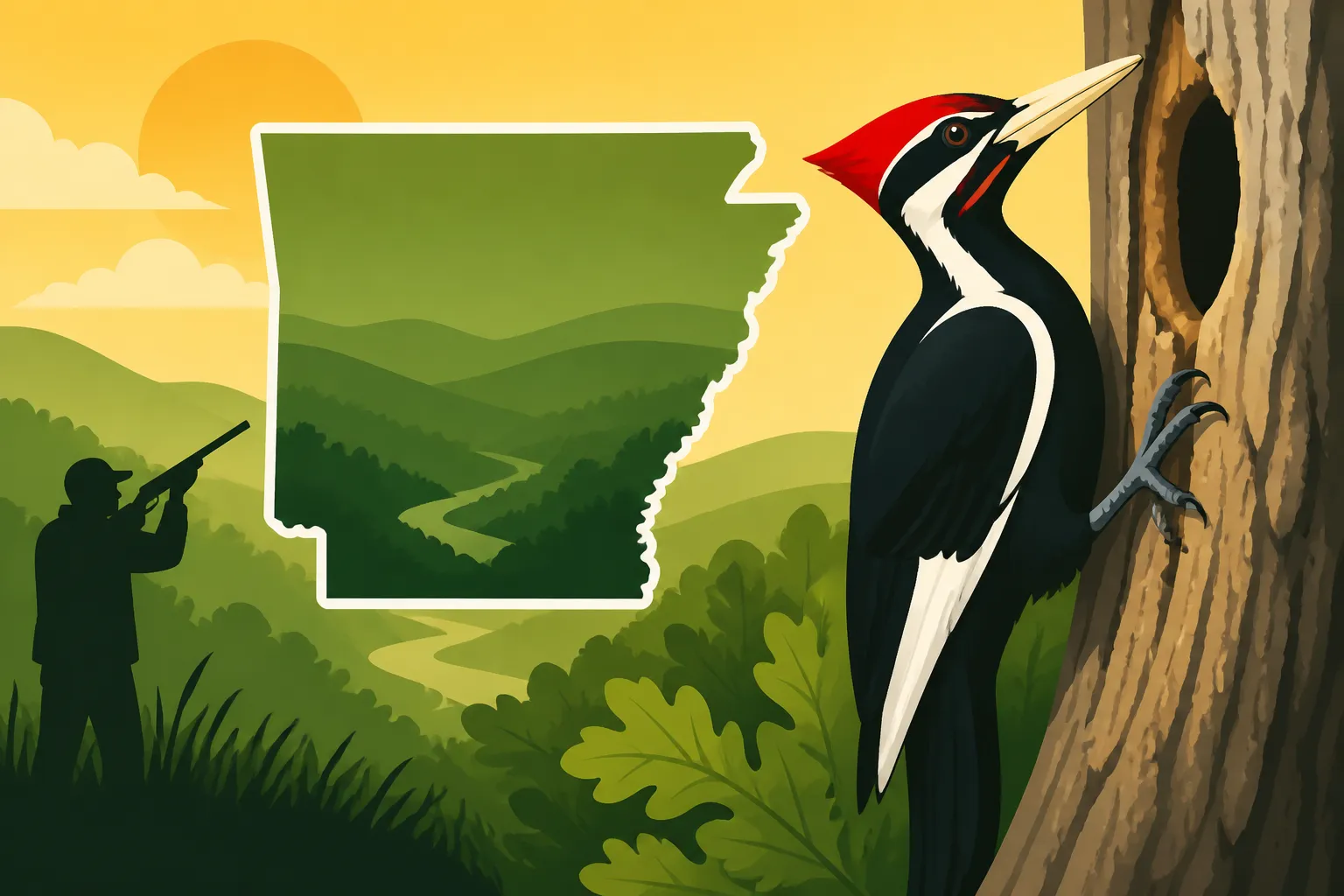
Ivory-Billed Woodpecker Reports in Arkansas
The enduring mystery of the Ivory-billed Woodpecker in Arkansas is a topic that stirs a deep sense of wonder and, let's be honest, a fair bit of friendly debate among us outdoors enthusiasts. For decades, hunters, birdwatchers, and scientists alike have chased whispers and fleeting glimpses of this magnificent bird, often dubbed the "Lord God Bird" or "Ghost Bird," in the hope that it still graces our state's ancient bottomland hardwoods. This guide will delve into the history, the famous reports, and what these elusive sightings mean for the conservation efforts that benefit all of us who cherish Arkansas's wild spaces.
The Haunting Echoes of the Past: Ivory-bill History in Arkansas
For many of us who've spent countless hours in the timber, chasing ducks or still-hunting for deer, there’s an almost mythical quality to the Ivory-billed Woodpecker. It’s the ultimate ghost story of the Arkansas woods. Once widespread across the old-growth forests of the southeastern U.S., including much of Arkansas, the bird was a spectacular sight. Imagine a woodpecker nearly two feet long, with a wingspan stretching almost three feet, flashing brilliant white patches on its wings as it flew, and the males sporting that vivid red crest. Its call, often described as a tooting kent or kentonk, was unmistakable.
The problem, of course, was its specialized diet and habitat. These birds thrived in vast tracts of old-growth bottomland hardwood forests, particularly those with plenty of large, recently dead or dying trees that harbored the grubs and beetle larvae they preferred. As logging boomed in the late 19th and early 20th centuries, these ancient forests, especially in the Delta, were systematically clear-cut to make way for agriculture and timber production. With its habitat literally disappearing, the ivory-bill population plummeted.
Arkansas, particularly its vast Delta region, held some of the last remaining strongholds for the species. Places like the Cache River basin and the White River bottoms were once synonymous with the ivory-bill. By the mid-20th century, confirmed sightings became incredibly rare. The last widely accepted photograph of a living Ivory-billed Woodpecker was taken in Louisiana in 1932. After that, it was a slow, agonizing slide into what many believed was extinction. The last widely accepted sighting in Arkansas was in the early 1940s. Yet, every now and then, a tale would surface, a blurry photo, a distant flash of white, keeping the hope alive. It’s a testament to the power of nature and the human spirit that we collectively refused to completely let go of this magnificent creature.
The Great Rediscovery and Subsequent Searches
Then came the seismic news in 2005. A team of researchers, primarily from the Cornell Lab of Ornithology and The Nature Conservancy, announced what many considered definitive evidence of the Ivory-billed Woodpecker's continued existence in Arkansas. The "rediscovery" stemmed from a 2004 sighting by kayaker Gene Sparling in the Cache River National Wildlife Refuge. This led to an intensive, year-long search, resulting in what the researchers presented as several visual observations and, critically, a four-second video clip showing a large, black-and-white woodpecker flying away from the camera. There were also alleged audio recordings of the distinct "kent" call and double-knocking sounds attributed to the ivory-bill.
This announcement ignited a firestorm of excitement and, predictably, skepticism within the scientific community. Millions of dollars were poured into further search efforts, primarily focused on the Big Woods region of the Arkansas Delta WMAs and Green Timber, including the Cache River NWR and the Dale Bumpers White River Refuge. Hunters, anglers, and hikers were suddenly looking at every large woodpecker with new scrutiny, hoping to be the next to confirm a sighting. I remember talking to folks who had spent a lifetime in those woods, and they all had their theories, their own fleeting glimpses, or their unwavering belief that the bird was still out there.
Unfortunately, despite years of dedicated searching, advanced remote sensing equipment, acoustic recorders, and countless human hours, no further irrefutable evidence has emerged. The initial video was hotly debated, with many ornithologists arguing it was more likely a Pileated Woodpecker, a much more common, though still impressive, species. The audio recordings were similarly contentious. The lack of clear, unambiguous photographs or videos since that initial announcement has led many scientists to conclude that the bird is likely extinct. Yet, the hope persists, especially among those who know the vast, wild, and incredibly dense bottomland hardwoods of eastern Arkansas. For us, the sheer scale and remoteness of these areas mean that a bird this rare could still be hiding. Many of us use tools like GoHunt for other species, but you can bet that when scouting, any strange flash of black and white catches our attention, fueled by the legend.
Differentiating the Ivory-bill from the Pileated Woodpecker
This is where the rubber meets the road for anyone hoping to spot an ivory-bill. Most "sightings" turn out to be the magnificent Pileated Woodpecker (Dryocopus pileatus), a large, charismatic bird that does thrive in Arkansas's forests. They're often seen and heard, and they can certainly get your heart racing. So, how do you tell them apart? It’s crucial, and it’s why so many supposed ivory-bill sightings remain unconfirmed.
Let's break down the key differences:
| Feature | Ivory-billed Woodpecker (Hypothetical) | Pileated Woodpecker (Common) |
|---|---|---|
| Size | Up to 20 inches long, 30-inch wingspan | Up to 19 inches long, 29-inch wingspan (slightly smaller on avg.) |
| Primary Color | Glossy black | Mostly black |
| Bill Color | Ivory-white, chisel-tipped, large | Dark (blackish/gray), long, pointed |
| Head Crest | Male: Red from crown to nape; Female: Black | Male: Red cap with red "mustache" stripe; Female: Red cap only |
| Face Stripes | Two prominent white stripes on face | One prominent white stripe from bill to neck |
| White on Wings | Extensive white patches on trailing edge of folded wing, forming a "saddle" on back; conspicuous white on flying wings | White underwings only, not visible when folded; only subtle white flashes on flying wings |
| Flight | Strong, direct, powerful | Undulating, typical woodpecker flight |
| Sound | Clear, trumpet-like kent or kentonk; distinct double tap (like a hammer blow) | High-pitched wuk-wuk-wuk; rapid drumming (long roll) |
| Habitat | Vast, undisturbed old-growth bottomland hardwoods | Mature forests (hardwood/pine), often near water |
The absolute biggest differentiator is the bill color and the white on the wings. A Pileated has a dark bill, and its white is primarily under the wings, visible in flight but not forming the prominent "saddle" on its back when perched or the massive white on the trailing edge of the upper wing. The ivory-bill's bill, true to its name, would be a stark, creamy white. It’s also said to be a much more powerful bird, often scaling massive dead trees and creating huge rectangular excavations for grubs.
So, if you’re out in the woods, maybe Hunting Arkansas Flooded Green Timber or scouting for White-Tailed Deer Across Arkansas, and you see a large black-and-white woodpecker, it's almost certainly a Pileated. But if you see that striking white bill and those unmistakable white wing patches, get a photo or video if you can, and note every detail. Your careful observation could contribute to an important conversation. Just remember, the bar for confirmation is incredibly high now.
The Conservation Ripple Effect of the Ivory-bill Search
Even if the Ivory-billed Woodpecker is, tragically, gone forever, the intense search for it has had an undeniably positive impact on conservation in Arkansas. Think about it: when the possible rediscovery was announced, it brought a flood of attention and funding to the very ecosystems that the bird symbolized – the vast, irreplaceable bottomland hardwood forests of the Cache and White River basins. These areas are not just potential ivory-bill habitat; they are critical for so many other species, including countless migratory waterfowl that depend on the Arkansas Waterfowl on the Mississippi Flyway and the Green Timber Duck Hunting in Arkansas opportunities these forests provide.
The effort to find the ivory-bill led to:
- Increased Habitat Protection: More land was purchased and added to national wildlife refuges and state wildlife management areas, expanding protected zones. This directly benefits deer, turkeys, bears, and, of course, ducks.
- Enhanced Research and Monitoring: Scientists gained a deeper understanding of these complex forest ecosystems. What makes a healthy bottomland forest? How do water levels impact tree health and wildlife? This research, while aimed at the ivory-bill, provided invaluable data for managing these lands for all wildlife.
- Public Awareness: The "Lord God Bird" captivated the public imagination. It made people who might not typically think about conservation suddenly aware of the unique and fragile nature of Arkansas's ancient forests. This awareness is crucial for garnering support for future conservation initiatives.
- Focus on Old-Growth Characteristics: The ivory-bill's specific needs highlighted the importance of preserving and restoring old-growth forest characteristics – large, mature trees, snags, and an undisturbed understory. This is beneficial for cavity-nesting birds, invertebrates, and diverse plant life.
I've personally seen the benefits of this focus when Scouting Arkansas Public Land Before Season in these areas. The emphasis on healthy, mature timber and sustainable management, though spurred by the ivory-bill, creates richer hunting experiences for us all. Whether the bird truly lives on or not, its legacy has helped secure a future for a vital part of Arkansas’s natural heritage. This is a topic that transcends just birdwatching; it's about valuing the wild places we all share. Even if you're using resources like GoHunt to plan your next hunting adventure, understanding the deeper conservation stories behind these landscapes adds another layer of appreciation.
Reporting a Potential Sighting Responsibly
So, what should you do if, against all odds, you truly believe you've seen an Ivory-billed Woodpecker in Arkansas? First, take a deep breath. Second, remember the extreme unlikelihood and the strict criteria for acceptance.
Here’s a responsible approach:
- Do Not Disturb: Under no circumstances should you try to approach or flush the bird. Its welfare and the integrity of a potential sighting are paramount. Your goal is documentation, not interaction.
- Document Everything:
- Visual Evidence: This is key. A clear photograph or video is gold. Even a blurry one is better than none, as long as it captures distinguishing features (bill color, wing patches, crest). Note the direction of flight, the height, and any identifying markings on the bird itself.
- Audio Evidence: Did you hear a distinct "kent" call or the unique double-tap drumming? Record it if possible. Even describing the sound in detail can be helpful.
- Detailed Observation Notes: Immediately after the sighting, write down everything you remember.
- Date, time, and precise location (GPS coordinates are ideal).
- Weather conditions (sunny, overcast, windy).
- Description of the habitat (e.g., "flooded bottomland hardwood, large dead oaks, dense understory").
- Estimated size of the bird compared to known objects (e.g., a crow, a duck).
- Color patterns, especially on the bill, head, and wings (folded and in flight).
- Type of flight (straight, undulating).
- Any distinct behaviors (foraging, preening, calling).
- How long you observed the bird.
- Contact Authorities: Do not post your sighting widely on social media or in hunting forums first. This can lead to unwanted attention, potential disturbance of the site, and a frenzy that complicates legitimate scientific investigation. Instead, contact the Arkansas Game and Fish Commission (AGFC) directly. They have protocols in place for reporting rare species and can connect you with the appropriate experts.
- Be Prepared for Scrutiny: Any potential ivory-bill sighting will undergo intense examination. Scientists will want to rule out every other possibility, especially the Pileated Woodpecker. Be ready to share all your details and potentially guide researchers to the location.
The desire to see the ivory-bill again is a powerful one, and it speaks to our shared love for the wild beauty of Arkansas. Whether it's the roar of a gobbler in the Ozarks or the sight of a flock of mallards dropping into a timber hole, these experiences connect us to something ancient and profound. The Ivory-billed Woodpecker represents the pinnacle of that connection for many, a symbol of hope that some wonders, once thought lost, might yet endure in the deepest, wildest corners of our state. The story of the ivory-bill isn't just about a bird; it's about the resilience of nature and the enduring spirit of discovery that drives us all.
Disclaimer
This article is for general informational purposes only and does not constitute professional advice. Laws, prices and regulations vary by location and change over time. Consult a qualified professional for guidance on your specific situation.