Arkansas Hunter Orange Rules
It’s a crisp autumn morning, the woods are alive, and you’re finally out there, pursuing your passion for hunting in Arkansas. But then a sudden thought hits you: "Am I wearing enough hunter orange? What are the rules really for this season?" That moment of uncertainty can be unsettling, distracting you from the hunt and even raising concerns about safety or compliance. This guide is here to untangle all the ins and outs of Arkansas's hunter orange regulations, ensuring you step into the woods with confidence, fully aware of when, where, and how you need to display this critical safety gear.
Why Hunter Orange Matters So Much in Arkansas
Let's be honest, sometimes regulations can feel like a nuisance, another hoop to jump through. But when it comes to hunter orange in Arkansas, it's truly a matter of life and death, a simple yet incredibly effective tool designed to keep every one of us safe in the field. The frustration of trying to remember all the specific dates and scenarios is real, but understanding the core purpose behind the rule makes it easier to appreciate its value.
The Core Purpose: Visibility and Accident Prevention
Imagine yourself deep in the dense hardwood forests of the Ozarks or threading through the thick Delta bottoms. Visibility can be incredibly limited, especially at dawn, dusk, or on an overcast day. In these conditions, a fellow hunter, focused on identifying game, can easily mistake movement or a glimpse of brown for a deer, bear, or elk. It's a terrifying thought, both for the person who might be mistaken and for the hunter who makes such a grave error. Hunter orange exists precisely to eliminate this horrific possibility.
It's not just a fashion statement; it's a universally recognized signal. When another hunter sees that unmistakable bright orange, their brain immediately registers: "Human! Not game!" This instantaneous recognition is crucial in preventing accidents caused by misidentification. It provides that vital split-second of clarity that can mean the difference between a safe hunt and an unthinkable tragedy. Even if you're absolutely certain you're alone in the woods, adhering to the hunter orange rule is an act of responsibility, not just for your own safety, but for the safety of anyone else who might unexpectedly enter your hunting area.
Statistical Safety Benefits and Real-World Impact
The effectiveness of hunter orange isn't just anecdotal; it's backed by decades of data. States that implemented mandatory hunter orange laws saw a dramatic decline in "mistaken for game" accidents. Before these regulations became widespread, a significant portion of hunting accidents involved a hunter being shot because they were perceived as an animal. Today, thanks in large part to hunter orange, those types of incidents are thankfully much rarer.
Think about a common hunting scenario: a deer drive. One group of hunters slowly pushes game through a section of woods, while another group waits on stand. Without hunter orange, the potential for a catastrophic error is incredibly high. But when every participant is brightly clad, each movement is clearly identifiable as human, not deer. The same goes for still-hunting or stalking through dense cover. You might be focused on subtle movements of game, but the vibrant splash of orange tells other hunters you're there, even if you're not making a sound. It acts as a constant, silent protector, a visual billboard proclaiming your human presence. This simple, brightly colored garment has saved countless lives and prevented untold heartache, making it an indispensable part of safe hunting practices across Arkansas and beyond.
Specific Scenarios Requiring Hunter Orange in Arkansas
The rules around hunter orange in Arkansas aren't always one-size-fits-all, and this can be where a lot of the confusion sets in. It often depends on what you're hunting, with what weapon, and during which specific season. Getting this wrong can lead to fines, but more importantly, it puts lives at risk. Let's break down the primary scenarios where this vital safety gear is absolutely required.
Modern Gun Deer Season Requirements
This is the big one, the time of year when hunter orange becomes truly non-negotiable for most hunters across the state. During any modern gun deer season in Arkansas, if you are actively hunting deer, bear, or elk, you must wear hunter orange. This isn't a suggestion; it's a hard and fast rule set by the Arkansas Game and Fish Commission (AGFC). This regulation is in effect regardless of whether you're hunting on private land that you own or on sprawling public grounds. It also applies to any person accompanying a hunter, even if they aren't carrying a weapon themselves.
The sheer volume of hunters in the woods during periods like the Modern Gun Opening Weekend on Arkansas Public Land makes this rule incredibly important. With so many people concentrated in popular areas, all focused on the same goal, visibility is paramount. It’s not just about you seeing others; it’s about making sure everyone can see you. If you're out there during these seasons, expect to be checked by a game warden for compliance. They're not trying to ruin your hunt; they're ensuring everyone's safety. For a deeper dive into these periods, check out our guide on Arkansas Modern Gun Deer Hunting.
Other Hunting Seasons Where It Applies
While modern gun deer season is the most prominent, hunter orange requirements extend to other firearm seasons for big game. This includes all forms of deer hunting outside of designated archery-only periods where a firearm, including a muzzleloader, is permitted. So, if you're participating in Alternative Firearms Deer Hunting in Arkansas, which typically includes muzzleloaders, you are still required to display hunter orange. The principle here is consistent: if you're using a firearm to hunt big game like deer, bear, or elk, you need to be highly visible to other hunters.
The rule typically doesn't extend to small game hunting with firearms unless it overlaps with an open big game firearm season. This means that if you're rabbit hunting with a shotgun, but it's also modern gun deer season in that zone, you'd still need to wear your orange. It's always about the highest risk activity taking precedence. This nuance can trip up even experienced hunters, so it’s always wise to double-check the current AGFC regulations for overlapping seasons in your specific hunting zone. It’s an easy mistake to make, but one with potentially serious consequences.
Public Versus Private Land Nuances
Many hunters feel a false sense of security when hunting on private land, assuming that because they have permission or own the property, the rules are different. This simply isn't true for hunter orange requirements in Arkansas. Whether you're hunting on your own back forty, a leased timber tract, or one of Arkansas's many public hunting areas like a Wildlife Management Area (WMA), the hunter orange regulations for big game firearm seasons remain the same.
The AGFC regulations are designed for the safety of all hunters statewide. While you might feel you know every inch of your private land, neighbors might be hunting adjacent properties, or other individuals (hikers, birdwatchers, shed hunters) might unexpectedly be present. On public lands, of course, the likelihood of encountering other hunters is much higher, making the rule even more critical. You might be deep in the Ouachita National Forest Hunting or quietly working a private woodlot, but the expectation for safety through visibility doesn't change. Always assume there could be another person out there, and dress accordingly.
Exemptions to the Arkansas Hunter Orange Rule
Just as important as knowing when to wear hunter orange is understanding when it's not required. These exemptions aren't arbitrary; they're based on the specific nature of the hunt, the species being pursued, and the typical methods used. Trying to maintain visibility with hunter orange in these situations could actually hinder your success or even be counterproductive to the hunting strategy.
Archery and Muzzleloader Specifics
This is where a lot of hunters get confused, and understandably so. During designated archery-only deer seasons, hunter orange is generally not required in Arkansas. This means if you're participating in Bowhunting Arkansas's Five-Month Archery Season, you won't need to don the blaze orange vest. The rationale here is that archery hunting often involves much closer ranges, extensive concealment, and often a more static, ambush-style approach where extreme camouflage is critical for success. The risk profile is different compared to the longer ranges and more dynamic movements typical of firearm hunting.
Similarly, there's often confusion with muzzleloader seasons. While a standalone, primitive weapons-only season might imply less of a need for orange, in Arkansas, muzzleloader hunting is typically grouped under "alternative firearms" seasons for big game. As we discussed, if you are hunting deer, bear, or elk with an alternative firearm (including muzzleloaders) during an open big game firearm season, hunter orange is required. The key is whether the season is strictly archery-only. Always consult the current AGFC regulations, as season structures can be complex, and you definitely don't want to get this wrong.
Waterfowl, Turkey, and Predator Hunting
When you're chasing migratory birds or trying to coax a tom into range, your camouflage becomes your most important tool. For these hunts, hunter orange is typically not required and would, in fact, be detrimental.
- Waterfowl Hunting: Whether you're tucked into a blind in a flooded timber hole during Green Timber Duck Hunting in Arkansas or hunkered down on a levee while Hunting Rice Fields and Levees, ducks and geese have excellent eyesight and can detect colors. Wearing hunter orange would essentially act as a giant "stay away" sign for incoming birds. So, for duck and goose seasons, ditch the orange and embrace full camouflage.
- Turkey Hunting: Turkeys are famously keen-sighted, with an incredible ability to spot even the slightest anomaly. Trying to call in a gobbler during Spring Turkey Hunting in the Arkansas Ozarks while wearing hunter orange would be an exercise in futility. Here, head-to-toe camouflage, including a face mask and gloves, is essential for breaking up your outline and blending into the environment. The risk of mistaken identity for a turkey is also very different; it's about identifying the legal bird by its beard and spurs, rather than simply identifying it as an animal.
- Predator and Furbearer Hunting: For activities like Coyote and Bobcat Calling in Arkansas, especially during low-light hours or at night, hunter orange is not required. Predators also have good eyesight, and often the effectiveness of your calling setup depends on being completely hidden. When you're calling coyotes or bobcats, particularly when trying to be discrete, hunter orange would defeat the purpose.
These exemptions are carefully considered to balance hunter safety with the practicalities of hunting specific species. The critical takeaway is to know your quarry, understand the season regulations, and dress appropriately for that specific hunt.
Proper Display and Amount of Hunter Orange
It's not enough to simply have hunter orange with you; you need to wear it correctly and ensure it meets the minimum requirements set by the Arkansas Game and Fish Commission. Skimping on the amount or improperly displaying it can render it ineffective, putting both you and others at risk, and potentially leading to a citation from a game warden.
Minimum Square Inches and Visibility
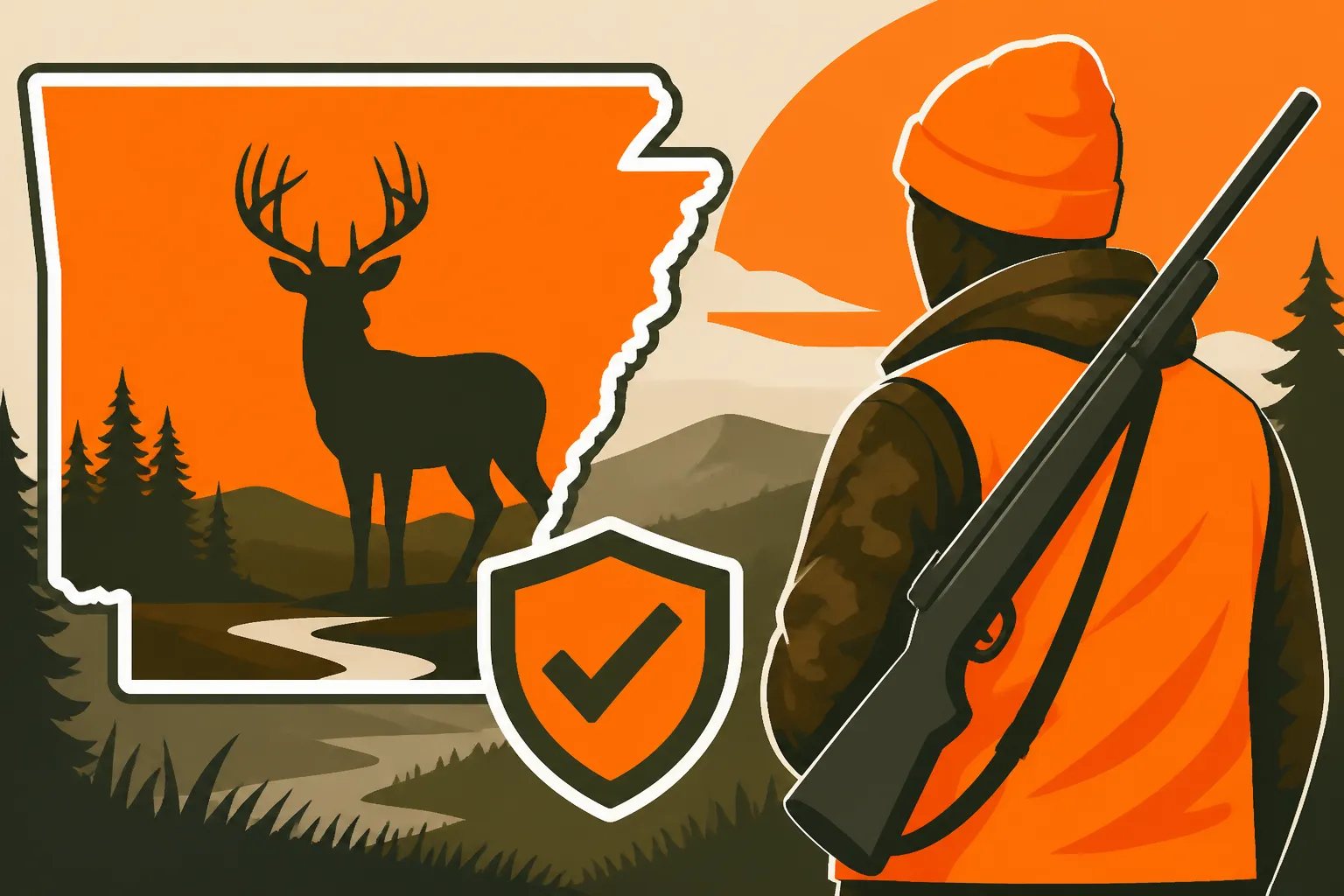
In Arkansas, during required seasons, you must display at least 400 square inches of hunter orange above the waist, and you also need to wear a hunter orange head covering. Let's break down what that actually means in practical terms. A typical hunter orange vest often provides the bulk of the required square inches, covering your torso. The additional head covering, usually a hat or cap, completes the requirement.
The "above the waist" rule is crucial. It ensures that the most visible parts of your body, particularly your torso and head, are clearly marked. This placement is strategic, as these are the areas most likely to be seen by another hunter in thick brush, over undulating terrain, or when peering through binoculars. It's not about having a patch of orange on your backpack that might be obscured; it’s about a continuous, highly visible presence.
Furthermore, the orange must be "visible." This means it cannot be tucked into your backpack, covered by an outer garment (unless that outer garment is also orange and meets the square inch requirement), or obscured by any gear. If you're wearing a large pack, consider vests designed to fit over it or supplement with additional orange on the pack itself to maintain the 360-degree visibility. The goal is that from any angle, another human should instantly recognize you as a person.
Wearing It Correctly: Head to Waist
Let's talk about actually putting it on. The head covering is non-negotiable. Your head is often the first part of your body to appear over a ridge, around a tree, or above brush. A bright orange hat, beanie, or cap ensures that this critical point of visibility is always marked. It’s a simple item, but its importance cannot be overstated.
For your torso, a vest or jacket that completely encircles your body is the standard. It should be worn as an outermost layer. Some hunters make the mistake of wearing a small, decorative patch, but that won't cut it. The 400 square inches need to be actual visible orange material. Imagine yourself still-hunting through a thick pine plantation. As you move, different parts of your body will be exposed. A well-fitting hunter orange vest ensures that whether someone sees you from the front, back, or side, your identity as a human is unmistakable. Layering is key, especially when the weather cools down. Ensure your orange vest is large enough to fit over your heaviest coat.
Color Standards and Materials
Not all bright orange is "hunter orange." The AGFC regulations specify "hunter orange," "fluorescent orange," or "blaze orange." This isn't just a marketing term; it refers to a specific, highly luminous shade of orange designed to stand out against natural backgrounds. It's not the same as a construction worker's safety vest (which might be yellow-green or a different shade of orange) or a simple bright red jacket. The specific wavelength of light reflected by hunter orange makes it exceptionally visible to humans while appearing dull to deer, who are largely red-green colorblind.
The materials themselves can vary. You'll find lightweight mesh vests perfect for Bowhunting Arkansas in September Heat when temperatures are still high, to more durable, insulated fabrics for the colder days of late modern gun season. Comfort is a huge factor here. If your hunter orange is scratchy, too tight, or uncomfortable, you might be tempted to shed it, even for a moment, which could compromise your safety. Many reputable outdoor brands, including those you might find on GoHunt, offer a wide range of compliant and comfortable hunter orange apparel. Remember that over time, repeated washing and exposure to sunlight can fade hunter orange. Check your gear before each season to ensure it's still vibrant and hasn't lost its crucial luminosity.
| Component | Requirement | Notes |
|---|---|---|
| Torso | Minimum 400 sq. inches visible above the waist | Typically a vest or jacket. Must be visible from all angles. |
| Headgear | Hunter orange head covering | Hat, cap, or beanie. Must be worn as outermost layer on head. |
| Color | Hunter Orange, Fluorescent Orange, or Blaze Orange | Specific high-visibility shade, not general bright orange or red. |
| Visibility | Must be unobscured by gear, clothing, or foliage | No tucking, covering, or wearing under non-orange layers. |
| Application | Required during big game firearm seasons (deer, bear, elk) | Applies to hunters and non-hunting companions. |
Consequences of Non-Compliance
While it might seem like a minor detail, ignoring Arkansas's hunter orange rules can lead to serious repercussions, both legal and, more critically, personal. It’s easy to get complacent or think "it won't happen to me," but the AGFC has these rules in place for a reason, and they enforce them diligently.
Penalties for Violations
Getting caught without the proper hunter orange during a required season can result in a citation from an AGFC game warden. These violations typically carry fines and court costs, which can quickly add up and put a significant dent in your hunting budget. It’s not just a slap on the wrist; these are official legal penalties that go on your record. In more severe or repeated cases, a hunter could even face temporary or permanent loss of hunting privileges, which for any avid hunter, is a truly devastating outcome. Imagine having your passion stripped away because of a preventable safety oversight.
Game wardens aren't just looking for major infractions; they're also checking for compliance with basic safety regulations like hunter orange. They understand that most hunters are good, law-abiding citizens, but they also know that simple mistakes or negligence can have dire consequences. Their presence and enforcement serve as a crucial deterrent, ensuring that hunters take these safety measures seriously. The inconvenience of a fine and a court appearance is a stark reminder that hunting safety rules are not suggestions; they are mandates designed to protect everyone in the field.
The Real Cost: Hunting Accidents
Beyond the legal and financial penalties, the true cost of failing to wear hunter orange correctly lies in the potential for a hunting accident. While hunter education and hunter orange have drastically reduced incidents of "mistaken for game," they still happen. And when they do, the impact is profound and irreversible.
Consider the human toll. For the victim, even a non-fatal shooting can result in life-altering injuries, permanent disability, immense pain, and psychological trauma. For the hunter who pulls the trigger, the guilt and horror of accidentally shooting another person can be a burden that lasts a lifetime, often leading to severe mental health struggles and an end to their hunting career. Families on both sides are shattered, and an activity meant to be a cherished pastime becomes forever associated with tragedy.
These accidents are overwhelmingly preventable. They often stem from a lapse in judgment, a moment of haste, or the failure to adhere to basic safety protocols, including wearing visible hunter orange. The brightly colored fabric serves as a constant visual reminder to all hunters that there are other people here. It forces a moment of recognition, a pause that allows for proper target identification and confirmation, before a shot is ever fired. No deer, bear, or elk is worth risking a human life. The real cost of non-compliance isn't a fine; it's the potential for devastating, irreparable harm.
Staying Safe Beyond Just Hunter Orange
While hunter orange is an incredibly effective tool for preventing certain types of accidents, it's just one piece of a larger safety puzzle. Relying solely on your blaze orange is like driving with only a seatbelt but no other safety precautions. True hunting safety in Arkansas requires a holistic approach, combining gear, knowledge, communication, and constant vigilance.
Situational Awareness and Hunter Education
Hunter orange is a passive safety measure; it helps others see you. But active situational awareness is about you seeing and recognizing potential hazards and other people. Always assume there are other hunters in the woods, especially on Public Hunting Land in Arkansas or popular WMAs. Even if you haven't seen anyone, listen for distant shots, look for parked vehicles, and pay attention to trails and signs of recent human activity. Never take a shot until you are absolutely 100% certain of your target and what lies beyond it. This is a fundamental principle of Arkansas Hunter Education and Safety Rules, which every hunter should internalize.
Hunter education goes far beyond just hunter orange. It teaches crucial skills like safe firearm handling, identifying legal game, understanding zones of fire, and how to safely navigate different terrains. It instills a mindset of responsibility and caution that is essential for a safe hunting experience. Even experienced hunters can benefit from a refresher course every few years, as regulations evolve and new safety insights emerge. Never let pride get in the way of learning or reinforcing good habits.
Communication and Hunt Plans
Effective communication is your best friend when hunting with a group, especially during active hunts like deer drives. Before you even leave the truck, establish a clear hunt plan:
- Who is going where? Designate specific stand locations or travel routes.
- What are the boundaries? Clearly mark no-shoot zones or areas where other hunters might be.
- How will you communicate? Use radios, cell phones (if service is reliable), or pre-arranged signals.
- What's the emergency plan? How will you contact help if someone gets lost or injured, particularly if you're Getting a Deer Out of an Ozark Hollow in a remote area?
Even if you're hunting solo, inform someone reliable about your hunting location and estimated return time. Leave a note on your vehicle dashboard with your plan. On public land, where you might encounter other lone hunters, politeness and a quick conversation can go a long way. A simple "Hey, I'm heading this way, thought I'd let you know" can prevent unexpected encounters and ensure everyone is aware of each other's presence. When planning your hunt, consider the impact of others and prioritize open communication.
Using Technology for Enhanced Safety
We live in an age where technology can significantly augment our safety measures. While a good compass and map are always essential backups, modern tools like GPS devices and hunting apps can provide invaluable real-time information.
Mapping applications, such as those offered by GoHunt, are game-changers. They allow you to:
- Pinpoint your exact location: Always know precisely where you are relative to property lines, roads, and other landmarks.
- Mark stand locations: If you're hunting with a group, you can share stand locations digitally, ensuring everyone knows where others are positioned.
- Track your movement: Review your route and avoid inadvertently trespassing or entering hazardous areas.
- Understand land ownership: See public and private land boundaries, helping you avoid accidental encroachment and respecting landowner rights.
Beyond mapping, consider personal locator beacons (PLBs) or satellite messengers, especially if you're venturing into areas with no cell service, like some of the more remote parts of the Ozark or Ouachita National Forests. These devices can send an emergency signal with your precise location to rescue services, a crucial lifeline in a serious situation. Combine these with basic survival gear like a whistle, first-aid kit, and enough water, and you'll be well-prepared for a safe and successful hunting adventure in Arkansas.
Disclaimer
Please remember that hunting regulations, including those pertaining to hunter orange, can change. While this guide aims to provide comprehensive and up-to-date information, it is your responsibility as a hunter to consult the most current Arkansas Game and Fish Commission (AGFC) regulations annually. Always refer to the official AGFC hunting guides and proclamations before heading into the field to ensure full compliance.